Basil can be confusing on a windy balcony because the plant may look healthy one week and weak the next. It may droop, dry at the edges, lose colour, or collapse even when the pot has been watered and the balcony receives enough light.
Basil dies on windy balconies because constant airflow pulls moisture from its soft leaves, cools the plant, and moves the stems more than the plant can comfortably handle. This creates stress faster than the roots can replace lost water, especially when basil is growing in a small balcony pot.
A basil plant can look healthy in the morning and become limp by afternoon after several hours of balcony wind. Many gardeners assume the plant simply needs more water, but the real issue is often moisture being pulled from the leaves faster than the roots can replace it.
This is why the problem often feels unfair. The soil may not be completely dry, and the plant may not be neglected. The balcony environment itself can be harsher than it looks, especially near railings, open corners, high floors, or coastal apartments.
This article explains why wind affects basil so strongly, what most basil advice misses about balconies, which balcony positions are most risky, and how to understand the difference between normal breeze and ongoing wind stress.
Why Windy Balconies Are Hard on Basil
Balconies behave differently from ground-level gardens. Wind does not simply pass gently over the space. It can move between buildings, bounce off walls, speed up near railings, and swirl around corners.
This matters because basil is a soft herb. It has tender leaves, flexible stems, and a shallow root system compared with tougher herbs like rosemary or thyme. In a sheltered garden bed, basil may grow strongly because the soil is deeper and the air is calmer.
On a balcony, basil often grows in a smaller pot with less soil around the roots. The pot heats and cools faster. The soil dries faster. The leaves are more exposed to moving air. When these things happen together, basil can decline even when the basic care seems correct.
Wind also changes how watering behaves. A pot may feel damp below the surface while the leaves are still losing moisture quickly. This is one reason basil can look thirsty even when the soil is not completely dry.
What Most Basil Advice Misses
Most basil advice is written for garden beds, patios, kitchens, or warm sheltered areas. That advice often focuses on sunlight, watering, pruning, and harvesting. Those things matter, but they do not fully explain why basil struggles on exposed balconies.
The missing part is airflow. A balcony can create constant drying pressure around the plant. Basil may not only be using water through normal growth. It may also be losing extra moisture through its leaves because wind is moving across them for hours.
This is why simply watering more does not always fix the problem. If the roots sit in wet soil while the leaves keep drying in the wind, the plant can still look stressed. The issue is not only how much water is in the pot. It is also how fast the balcony air pulls moisture away from the plant.
If the whole balcony feels exposed, it may help to compare basil with plants that naturally tolerate wind better. This guide on the best plants for a windy balcony gives useful context for choosing stronger plants in harsher spaces.
How Wind Damages Basil Over Time
Wind damage on basil usually builds gradually. The plant may not fail after one windy afternoon. Instead, the stress repeats across several days until the leaves, stems, and roots can no longer keep up.
The pattern often starts with slight drooping or curled leaf edges. Then the plant may look dry at the tips, pale in colour, or slower to produce new leaves. If the wind continues, the stems may weaken and the plant may collapse even though the pot has been watered.
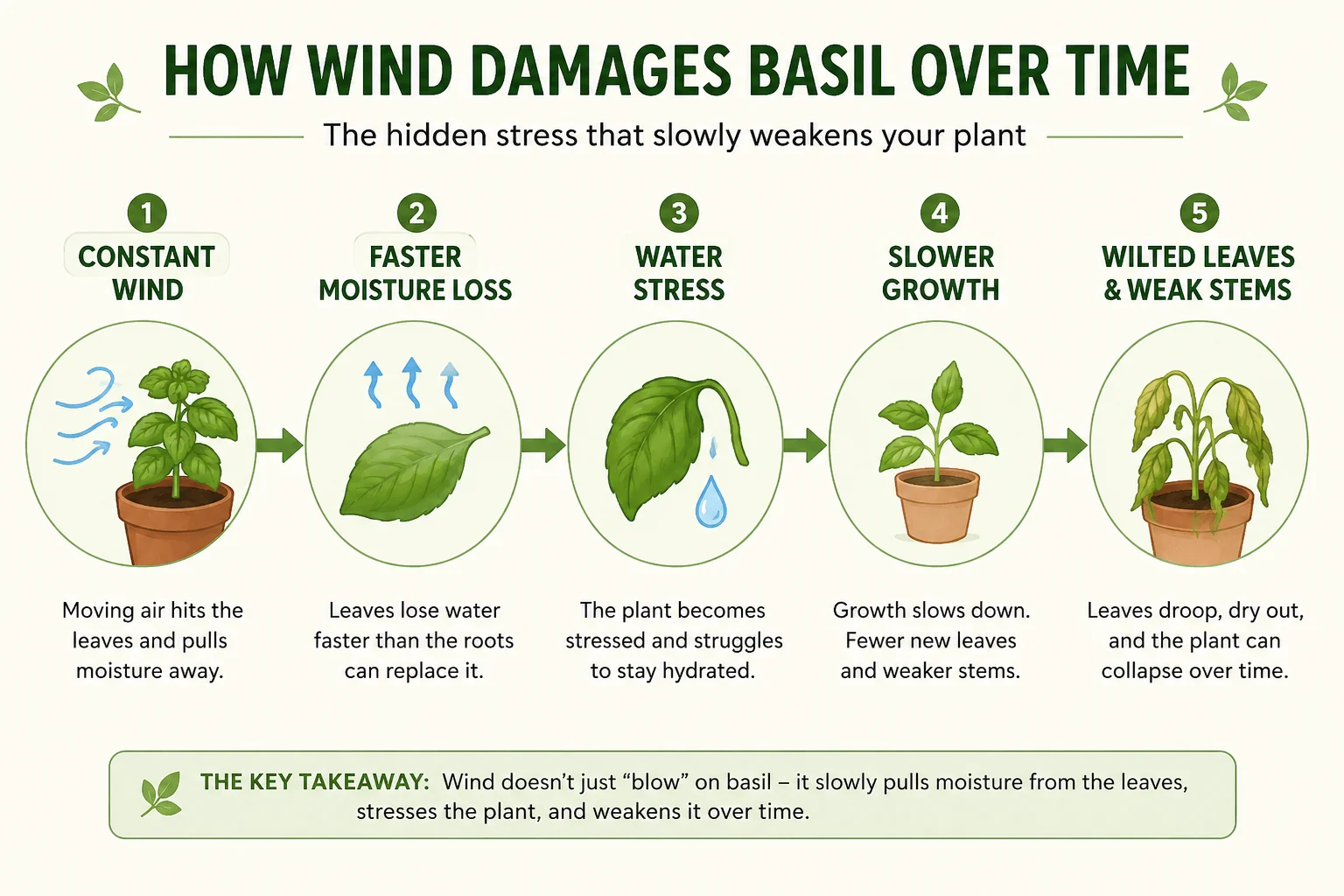
The simple table below shows how wind stress can appear at different stages.
| Wind Stress Stage | What You May Notice | What Is Usually Happening |
|---|---|---|
| Early stress | Leaves droop during or after windy periods | Leaves are losing moisture faster than usual. |
| Ongoing stress | Leaf edges curl, dry, or look dull | The plant is struggling to keep water balanced. |
| Structural stress | Stems bend, lean, or weaken | Constant movement is tiring the soft stems. |
| Severe stress | The plant collapses or stops growing | Roots, leaves, and stems can no longer recover fast enough. |
Wind Pulls Moisture From Basil Leaves
Basil leaves are soft and thin. They are useful for fast growth in warm, calm conditions, but they are not built for constant drying wind. When air keeps moving across the leaves, moisture leaves the plant faster.
This can make basil look underwatered even when the pot still contains some moisture. The leaves may droop because the plant cannot move water from the roots to the leaves quickly enough.
Small balcony pots make this worse because they hold less soil. Less soil means less stored moisture and less protection around the roots. In windy weather, a small pot can swing between damp and dry much faster than a larger container.
If several balcony plants are drying quickly, the issue may not be basil alone. This article on balcony soil drying out too fast explains why containers lose moisture quickly in exposed spaces.
Wind Weakens Soft Basil Stems
Basil stems are flexible, but they are still soft. A gentle breeze is usually not a problem. Constant movement is different. When the plant is pushed back and forth for long periods, the stems spend energy coping with movement instead of supporting steady growth.
This is why wind-damaged basil can look thin, tired, or unstable. The leaves may still be green, but the plant may lean or collapse because the stem structure has weakened.
This can be more noticeable when basil is tall and leggy. A compact basil plant is usually less exposed than a tall, stretched plant with many leaves catching the wind. The more leaf surface the plant has, the more the wind can pull, shake, and dry it.
Wind Cools the Plant More Than Expected
Basil likes warmth. It often grows best when the days and nights are comfortably warm. Wind can lower the temperature around the leaves and stems, especially during cool evenings, seasonal changes, or after rain.
This cooling effect can slow basil down. The plant may stop producing new leaves, grow smaller leaves, or look weak even when it is receiving enough daylight.
The problem is stronger when wind and shade happen together. A shaded windy balcony can feel much cooler to basil than it feels to a person standing there briefly. The plant stays in that microclimate for hours, so the effect builds over time.
Which Parts of a Balcony Are Riskiest for Basil?
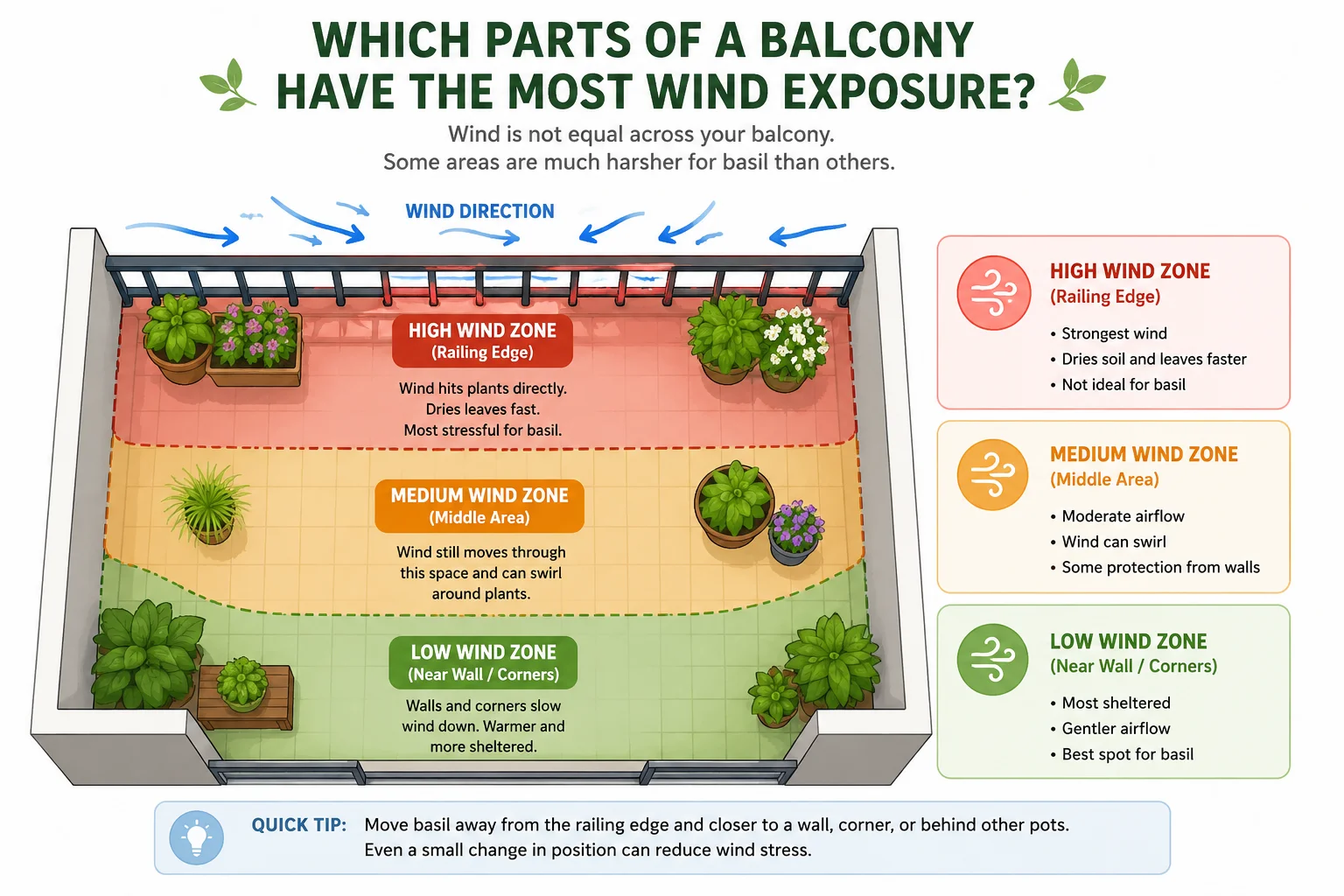
Wind is not equal across the whole balcony. One corner may be calm while another area is constantly exposed. This is why basil can fail in one spot but grow better only a metre away.
Railing edges are often the harshest position because moving air can hit the plant directly. Open corners can also be difficult because wind may enter from more than one direction. The centre of the balcony may feel calmer, but it can still receive swirling airflow depending on the building layout.
More sheltered areas are usually closer to walls, behind larger pots, or in corners where the air slows down. These places may still receive light, but with less direct wind pressure.
| Balcony Position | Wind Risk for Basil | Why It Matters |
|---|---|---|
| Railing edge | High | Wind often hits leaves directly and dries the plant faster. |
| Open corner | High to medium | Air can enter from different directions and swirl around the plant. |
| Middle of balcony | Medium | Wind may be reduced, but airflow can still move through the space. |
| Near a wall | Lower | The wall can slow wind and hold a little warmth. |
| Behind larger pots | Lower | Other containers can create a small wind buffer. |
For exposed balconies where pots move or tip in strong weather, this guide on protecting balcony pots from strong winds may help you think about wind safety as well as plant health.
Why Balcony Wind Is Different From Garden Wind
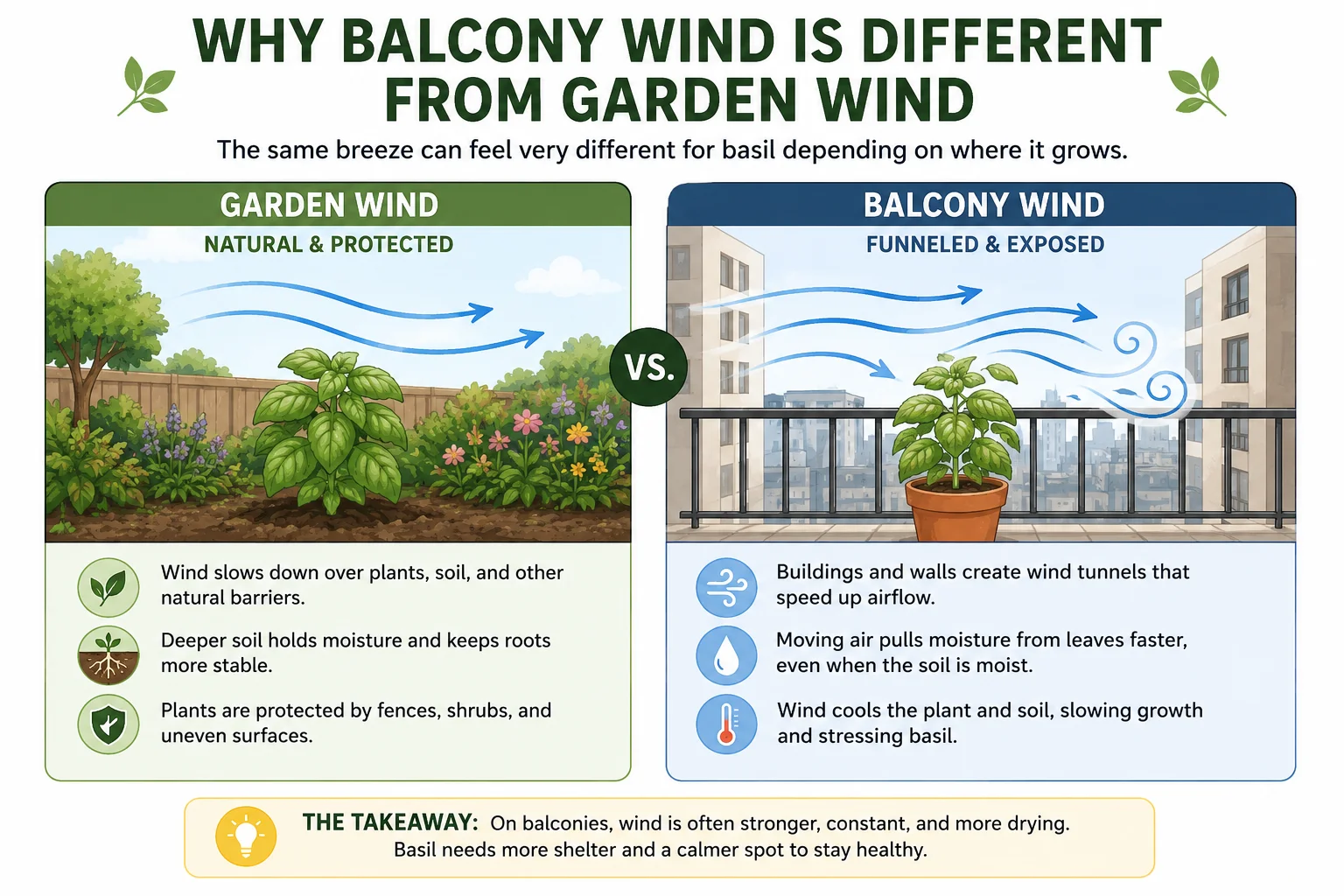
Wind in a garden and wind on a balcony can feel like the same thing, but plants experience them differently. A garden usually has deeper soil, nearby plants, fences, shrubs, and uneven surfaces that slow the air down.
A balcony is more exposed. Buildings can act like channels that push air through narrow gaps. Railings, glass panels, and open sides can change the direction of airflow. On higher floors, wind can also feel stronger and more constant than it does at ground level.
This is why basil may grow well in a backyard but struggle in an apartment pot. The plant is not only dealing with wind. It is dealing with wind plus shallow soil, fast-drying containers, reflected heat, sudden cooling, and limited shelter.
Can Basil Survive on a Windy Balcony?
Basil can survive on a windy balcony when the wind is light, occasional, or partly blocked. It is less likely to do well when the plant is exposed to strong airflow most days.
The difference is not only the strength of the wind. It is also how often the wind happens. A short breezy afternoon may not cause lasting damage. Several windy days in a row can place much more pressure on the plant.
| Wind Condition | Basil Success Chance | What It Usually Means |
|---|---|---|
| Light breeze | Usually good | Air movement is gentle and not constant enough to cause major stress. |
| Occasional windy days | Usually manageable | Basil may droop briefly but can recover if the pot and roots stay healthy. |
| Daily strong wind | Often difficult | Leaves lose moisture often, and stems may weaken over time. |
| Constant exposed wind | High risk | Basil is more likely to collapse unless the airflow is softened by shelter. |
Basil usually has a better chance when the pot is not too small, the soil holds moisture without staying soggy, and the plant sits in a warmer, calmer part of the balcony. It does not need a perfect environment, but it does need some protection from constant drying air.
If your balcony receives only a few hours of sun as well as wind, this guide on herbs for balconies with 3 hours of sun can help you compare basil with other herb options for limited light.
Practical Insights for Reducing Wind Stress
Small changes can reduce wind stress without turning the balcony into a closed space. The aim is usually to soften the airflow around basil rather than block all air completely.
- Railing-height positions are often harsher than lower, more sheltered positions.
- Walls and corners can reduce wind while also holding a little warmth.
- Larger or heavier pots usually protect roots better than very small containers.
- Grouped plants can create a softer microclimate around sensitive herbs.
- Clear screens or nearby taller plants may reduce direct wind without removing all light.
- Repeated drooping after windy days often says more about exposure than watering skill.
These changes are most helpful when they match the balcony. A high-rise balcony, a coastal balcony, and a small enclosed balcony may all need different levels of wind protection.
Common Misunderstandings About Wind-Damaged Basil
Wind damage is easy to misread because basil often shows symptoms that look like other problems. This can lead to extra watering, extra moving, or extra fertilising when the main issue is exposure.
- Drooping does not always mean the soil is dry.
- More water does not always solve wind stress.
- A sunny balcony is not automatically good for basil if it is also very windy.
- A plant can struggle from cool wind even when the daytime temperature feels warm.
- Small pots dry and cool faster than many beginner gardeners expect.
- Basil may fail in one balcony position but improve in a calmer nearby spot.
If several plants look stressed after windy nights or dry faster than expected, this article on why balcony plants dry out overnight may help explain how wind, pot size, and exposed air can work together.
Seasonal Considerations for Australian Balconies
In many Australian apartments, basil may grow well during warm, settled weather and then suddenly decline when wind patterns change. Spring and late summer can bring shifting conditions, while coastal areas and higher floors often experience stronger airflow than ground-level gardens.
Warm days followed by cool, windy nights can be especially hard on basil. The plant may lose moisture during the day, then recover poorly overnight because the moving air keeps the leaves and stems cooler than expected.
This is one reason basil can look healthy for several weeks and then struggle after only a few windy days. The care routine may not have changed, but the balcony microclimate has.
Balcony Haven Note: I have noticed that basil reacts more strongly to wind than many tougher balcony herbs. On some balconies, moving the pot slightly away from the railing can change how quickly the leaves droop. Results can still vary because every balcony has its own mix of wind, light, warmth, and shelter.
Frequently Asked Questions
Can basil handle any wind?
Basil can handle light, occasional breeze, especially when the plant is healthy and the pot is not drying out too quickly. Constant strong wind is different because it keeps pulling moisture from the leaves and moving the soft stems.
Why does my basil wilt even when the soil is wet?
This can happen when the leaves are losing moisture faster than the roots can move water upward. Wet soil does not always mean the plant is comfortable, especially if wind is drying the leaves at the same time.
Is basil better indoors or outdoors on a windy balcony?
Basil may do better indoors near a bright window if the balcony is constantly windy and cool. Outdoor basil can still work when the balcony has a warm, bright, partly sheltered spot.
Will wind-damaged basil recover?
Basil may recover if the stems are still firm and the roots are healthy. If the main stem has collapsed, dried out, or turned brittle, recovery is less likely.
Should basil be placed near the balcony railing?
The railing is often the windiest part of a balcony. Basil may grow better slightly lower, closer to a wall, or behind other pots where the airflow is softer.
Does wind make basil lose flavour?
Wind stress can slow growth and dry leaves, which may affect leaf quality. If basil is struggling to stay hydrated, the leaves may become smaller, tougher, or less useful for harvesting.
Final Thoughts
Basil dying on a windy balcony is usually a sign of environmental stress, not poor gardening skill. Wind changes how moisture, temperature, and plant strength work together, especially in small containers.
The most important thing to understand is that basil is a soft, warm-season herb. It can grow well on balconies, but it often needs more shelter than tougher herbs. A spot that feels only slightly breezy to a person may still be stressful for basil over many hours.
Once the wind pattern of the balcony becomes clearer, basil problems become easier to understand. Small changes in placement, pot size, and shelter can often make the plant less frustrating and much easier to grow.
Leave a Reply