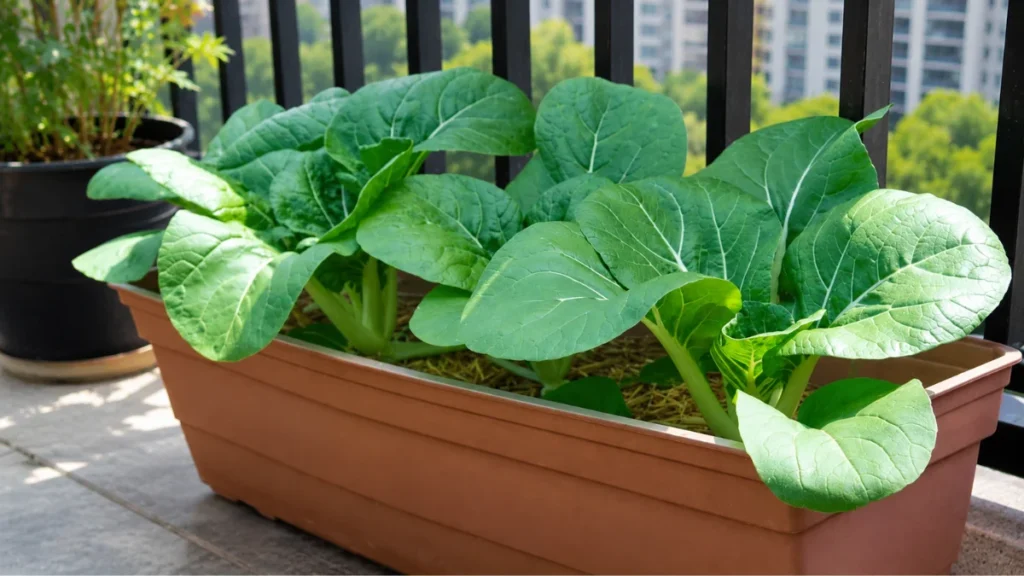
Apartment gardeners often ask, “Can Bok Choy Grow Successfully on a Balcony?” because the plant looks compact enough for a pot but also seems delicate in hot sun and strong wind. Bok choy is one of the more space-friendly Asian greens, although the conditions around its container usually matter more than the amount of balcony floor available.
Yes, bok choy can grow well on a balcony when it has a wide container, steady moisture, useful sunlight, and some protection from harsh afternoon heat. Compact or baby varieties are particularly suitable for small spaces because they can be harvested before they need much room.
The difficulty is that balcony conditions can change quickly. A planter may feel cool in the morning and become hot by afternoon. Wind can dry the soil even when the air does not feel warm, while a covered corner may stay damp for much longer. Readers with limited light may also find the guide to Plants for Balconies With 2–4 Hours Sun useful when judging whether their growing spot receives enough light for leafy vegetables.
This article explains what makes balcony-grown bok choy successful, which containers suit it, how heat and wind affect its growth, and why the same plant may behave differently in two positions only a few metres apart.
Why Bok Choy Behaves Differently on a Balcony
Bok choy, also called pak choi, is naturally compact, but that does not mean every balcony position suits it equally. The plant has broad, tender leaves that lose moisture more quickly than the firm leaves of rosemary, succulents, or many hardy ornamentals. In a garden bed, its roots can reach a larger area of soil. In a balcony planter, all available water and root space are held within one container.
A balcony can also contain several small climates. The floor near a glass door may receive reflected heat. A pot beside a solid wall may stay sheltered but warm. A railing planter can receive more light, yet it may also be exposed to constant wind. A position that appears bright and pleasant to a person may feel much harsher to a leafy green.
On many apartment balconies, the planter nearest the railing dries noticeably faster than a similar planter only a metre away beside a wall. The two containers may receive almost the same sunlight, but the exposed one loses moisture from more sides and is affected by moving air for longer.
Container weight and space are part of the decision too. Bok choy does not need an enormous tub, which makes it useful for renters and small-space gardeners. However, several plants packed into a tiny decorative pot may compete for moisture and produce narrow, weak growth rather than the fuller leaves expected.
The question is therefore not only whether bok choy fits on a balcony. It is whether the container can keep its roots reasonably cool, moist, drained, and uncrowded as balcony conditions change.
What Most Bok Choy Advice Misses
General gardening advice often describes bok choy as a cool-season vegetable that needs moist soil and sun. That description is useful, but it assumes the plant is growing in open ground where soil temperature and moisture usually change more slowly.
On a balcony, the container itself becomes part of the microclimate. A dark pot may absorb heat. A small planter can dry from its top, sides, and drainage holes. A lightweight container may also move slightly in repeated wind, disturbing young seedlings even when it does not fall over.
Generic advice also tends to treat sunlight as one simple measurement. On a balcony, four hours of gentle morning sun can feel very different from four hours of reflected western heat. The total number of hours matters, but so do the time of day, nearby walls, glass panels, flooring, and wind exposure.
Another overlooked point is that success does not have to mean producing a large supermarket-sized head. Baby bok choy, young pak choi leaves, and smaller mature plants can still provide a useful harvest. For a small balcony, a shorter and more flexible crop may be more practical than waiting for every plant to reach its largest possible size.
Is Bok Choy Suitable for a Small Balcony?
Bok choy is well suited to limited spaces because it does not climb, trail, or require a large support. Its roots are more manageable than those of tomatoes, cucumbers, or dwarf fruit trees, and several small plants can share a rectangular planter when they have sensible spacing.
It is also a relatively short-term container vegetable. The pot does not need to remain occupied for many months, which is useful on balconies where each sunny position is valuable. Once the plants are harvested, the planter can be reused for another leafy crop, herb, or seasonal vegetable.
Compact Asian greens are especially useful where a gardener wants an edible crop without filling the balcony with tall stakes, spreading vines, or very deep pots. A narrow planter can sit beside a wall or along a balcony edge while leaving the main walking area clear.
Its main limitation is not physical size but sensitivity to sudden stress. Dry soil, hot container walls, strong wind, overcrowding, or a sharp rise in temperature can make the plant grow less evenly. In some cases, it may begin producing a flower stalk before forming the leafy shape the gardener expected.
| Balcony Feature | How Well It Suits Bok Choy | What It May Mean |
|---|---|---|
| Limited floor space | Usually suitable | A rectangular planter can hold several compact plants. |
| Morning sunlight | Often favourable | Provides useful light without the strongest afternoon heat. |
| Harsh western exposure | More difficult in warm weather | Leaves and potting mix may lose moisture quickly. |
| Open windy railing | Possible with protection | Tender leaves and small containers can dry rapidly. |
| Bright covered balcony | Often suitable | The planter may receive protection from rain and strong wind. |
| Deep permanent shade | Less suitable | Plants may remain small, pale, or slow-growing. |
What a Successful Balcony Harvest Can Look Like
Many gardeners picture success as a planter filled with large, tightly formed bok choy heads that look exactly like supermarket produce. That result is possible, but it is not the only useful outcome for a small balcony.
A successful harvest may be several compact plants, a regular supply of young outer leaves, or baby bok choy collected before warm weather arrives. These smaller harvests can be easier to manage because the plants spend less time exposed to drying wind, hot pots, changing sun angles, and unexpected heat.
This is an important difference between balcony growing and growing in a large garden bed. A backyard gardener may have room to leave many plants until full size. A balcony gardener may gain more from harvesting a few plants early, opening space around the remaining ones, and using the container again sooner.
| Harvest Result | Does It Count as Success? | Why It Can Suit a Balcony |
|---|---|---|
| Baby leaves | Yes | Uses little space and provides an early harvest. |
| Compact whole plants | Yes | Balances useful size with a shorter growing period. |
| Several outer-leaf harvests | Yes | Fresh leaves can be taken without removing the plant immediately. |
| Large mature heads | Yes | Possible where space, temperature, and moisture remain suitable. |
| Early harvest before bolting | Yes | Prevents a stressed plant from becoming tough and less useful. |
What Container Does Balcony Bok Choy Need?
Bok choy generally benefits more from useful width than extreme depth. A wide planter gives the leaves room to spread and allows several plants to grow without occupying too much balcony floor space.
A container around 20 to 30 cm deep is enough for many balcony setups. Wider pots and rectangular planters are especially practical because bok choy plants can be arranged in a row rather than scattered across several small pots.
Very small pots create a narrow moisture margin. They may look suitable while the seedlings are young, but the soil can begin drying much faster once the plants develop broad leaves. A planter that holds a reasonable volume of potting mix is usually easier for a busy gardener to manage.
A useful observation is that the plant may still look small while its water use is already increasing. Once the leaves begin covering the soil surface, they can hide how quickly the potting mix beneath them is drying. This is one reason a container that seemed generous for seedlings can become difficult later.
Container depth still matters because a very shallow tray may dry too quickly or give mature plants too little support. The article on Deep vs Shallow Pots for Balcony Veggies explains how depth changes moisture storage, root space, and container stability.
| Container Type | Likely Use | Balcony Consideration |
|---|---|---|
| 20–25 cm individual pot | One compact bok choy plant | Easy to move, but moisture needs closer observation. |
| 30 cm or wider pot | One full plant or several baby plants | More potting mix gives a steadier moisture buffer. |
| Rectangular balcony planter | A short row of bok choy | Uses narrow spaces efficiently and makes spacing easier to see. |
| Railing planter | Baby leaves or compact plants | May dry quickly because it is exposed on several sides. |
| Fabric grow bag | Several plants in a flexible setup | Can lose moisture quickly in hot or windy positions. |
| Very shallow decorative bowl | Young leaves only | Less suitable for developing full-sized plants. |
How Much Space Does Bok Choy Need in a Planter?
Spacing changes what kind of harvest the container produces. Closely spaced plants can provide baby leaves or small bok choy. Wider spacing allows individual plants to develop broader stems and fuller heads.
This is useful on a balcony because there is no single correct arrangement. A gardener with one narrow planter may prefer several smaller plants. Someone with a larger container may leave more room around two or three plants and wait for them to become fuller.
Overcrowding becomes a problem when leaves overlap so heavily that the centre of the planter stays damp and hidden. The plants may compete for water, while limited airflow makes it harder to notice damaged leaves or small pests.
There is also a visual trap with young bok choy. Seedlings can appear comfortably spaced because their leaves are still upright and narrow. Once they develop broader outer leaves, the same planter can suddenly look crowded even though nothing has been added.
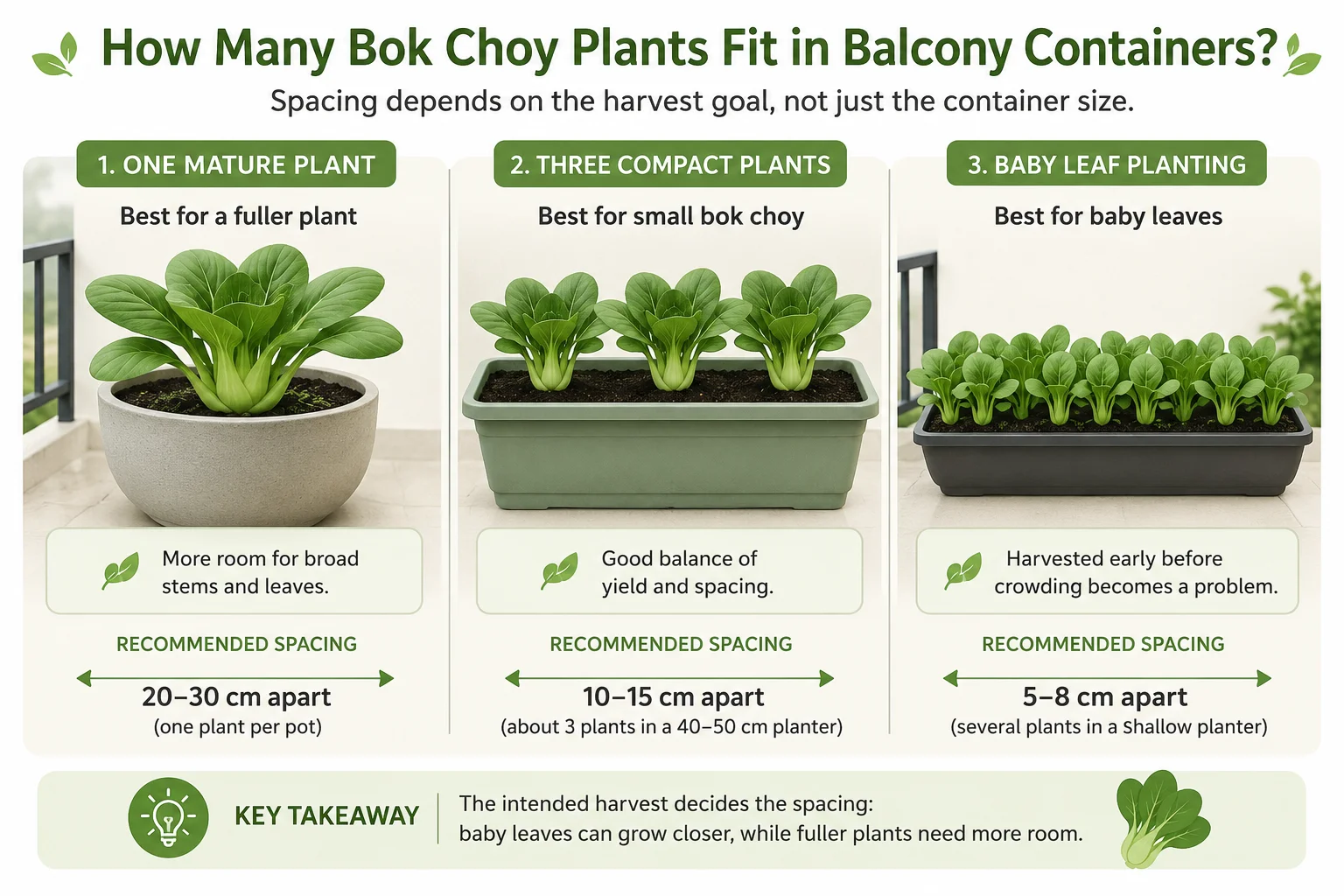
This diagram shows that container size alone does not decide how many plants will fit. The intended harvest matters too. Closely spaced plants suit baby leaves, while bok choy grown to a fuller size needs more room for its leaves and stems to spread.
| Growing Goal | Approximate Plant Spacing | Likely Result |
|---|---|---|
| Baby leaves | About 5–8 cm apart | More young leaves from a small area, harvested early. |
| Small bok choy | About 10–15 cm apart | Compact plants with useful stems and leaves. |
| Fuller mature plants | About 20–30 cm apart, depending on variety | Fewer plants, but more room for each one to spread. |
How Much Sun Does Balcony Bok Choy Need?
Bok choy grows best with bright light, but the quality and timing of that light matter. Several hours of morning sun can support useful leafy growth without exposing the container to the strongest heat of the day.
A balcony with gentle sun followed by bright shade may suit bok choy better in warm weather than an exposed western balcony receiving intense afternoon sun. This does not mean all afternoon sun is harmful. During cooler conditions, the same position may provide welcome warmth and light.
Very low light creates a different problem. Plants may remain small, stretch towards the brightest edge, or produce thin leaves. A bright covered balcony can still work if open sides allow plenty of daylight to reach the planter.
It is common for plants at one end of a long balcony planter to lean more than those at the other end. This can happen when light reaches the container from only one side, or when a wall, screen, or neighbouring building shades part of the planter.
Sunlight can also shift during the growing period as the season changes or nearby buildings cast longer shadows. The guide on How to Measure Sunlight on a Balcony helps separate direct sun from general brightness when assessing a growing position.
Why Heat Can Change Bok Choy Growth
Bok choy is generally treated as a cool-season vegetable. When it experiences strong heat or another sudden stress, it may move from leafy growth towards flowering. This process is commonly called bolting.
A bolting plant develops an upright central stalk rather than continuing to form the low, leafy shape expected. The leaves are still recognisable, but they may become smaller, stronger in flavour, or less tender as the flower stem develops.
Balcony gardeners can see this earlier than ground gardeners because pots warm quickly. The surrounding air may not seem extremely hot, yet direct sun can heat the container wall, dry the outer potting mix, and raise the temperature around the roots.
A planter sitting on pale tiles may behave differently from one pressed against a dark wall or glass panel. Reflected light and stored heat can continue affecting the plant even after direct sun has moved away.
A young plant can also respond to several smaller stresses happening together. Warm soil, missed watering, crowded roots, and hot wind may have a greater effect than any one condition on its own.
Where overheating containers are a regular problem, Overheating Balcony Pots in Summer explains why pot colour, material, size, and placement can change root temperatures.
| What You Notice | What May Be Happening | Balcony Context |
|---|---|---|
| Leaves droop only in the afternoon | The plant is losing water faster than its roots can replace it | Hot sun, reflected heat, or wind may be increasing moisture loss. |
| A tall centre stalk appears | The plant may be beginning to flower | Heat, age, or sudden stress can encourage bolting. |
| Leaves stay small despite bright light | Root space, moisture, or crowding may be limiting growth | A sunny position does not compensate for a tiny, dry container. |
| Leaf edges look dry | Moisture loss may be uneven | Wind can affect exposed leaves before the whole plant wilts. |
| Plants grow tall and loose | Light may be too weak or coming mainly from one direction | Covered balconies can appear bright to people but provide limited direct light. |
How Wind Affects Bok Choy in Pots
Bok choy does not usually become tall enough to blow over like a tomato plant, but its wide leaves still catch moving air. Constant wind increases water loss from both the leaves and the exposed surface of the potting mix.
The result may look like a watering problem even when the container was watered that morning. A railing planter can be especially affected because air moves around its front, sides, and bottom rather than only across the soil surface.
On exposed balconies, the leaves facing the open edge may look softer or drier before the leaves on the sheltered side show any change. This uneven response can make the whole planter seem confusing until wind direction is considered.
Young seedlings can also lean or move repeatedly in turbulent wind. A low position beside a solid balcony wall may offer calmer conditions than the outer railing, although the wall should not create a pocket of intense reflected heat.
Protection does not need to remove all airflow. A completely still, crowded corner can remain damp around overlapping leaves. The most useful position is often one with gentle air movement rather than either a strong wind tunnel or a closed, humid pocket.
For exposed apartments, Protecting Balcony Pots from Strong Winds covers practical ways containers and plants can be positioned more securely.
What Steady Watering Really Means
Bok choy grows best when its potting mix remains reasonably and evenly moist rather than moving repeatedly between very wet and very dry. This does not mean the soil needs to be permanently soaked.
On a balcony, a fixed watering schedule may be less useful than watching how the container behaves. One planter may need attention sooner because it receives wind. Another may stay moist because it sits on a shaded floor behind a solid wall.
The upper surface can also give a misleading impression. It may appear dry while the lower potting mix is still moist, or remain damp near the plant while the edges of the container have dried. The size and material of the pot influence how evenly water is stored.
In long rectangular planters, one end may dry faster than the other. This often happens when one side receives more sun or sits closer to the railing. Watering the whole planter as though every section behaves the same can leave one area wetter while another continues drying.
A sudden change in weather matters too. Bok choy that has been comfortable through several mild days may lose moisture much faster when a hot, dry wind arrives. The plant has not suddenly become difficult; the container’s water balance has changed.
Soil and Drainage in Balcony Containers
Bok choy needs potting mix that can hold useful moisture while still allowing extra water to drain. Dense garden soil is usually awkward in balcony containers because it can become heavy and compact, reducing the small air spaces around the roots.
A quality potting mix intended for vegetables or general container plants is a practical base. Bok choy produces leafy growth quickly, so extremely poor or exhausted mix may support only weak, pale plants. At the other extreme, an overly rich or constantly wet container does not guarantee healthier growth.
Drainage holes are important because a balcony pot cannot release excess water into surrounding ground. After heavy rain or generous watering, water needs a way to leave the root area.
The saucer below the container should be considered separately from the drainage hole. A saucer can protect the balcony floor and reduce dripping, but water left sitting in it for long periods may keep the lower potting mix wetter than expected.
A covered balcony can make this harder to notice because the top of the mix may dry slowly and the container may receive no natural flushing from rain. The soil can remain damp for much longer than it would in an open, breezy position.
The article on Drainage Tips for Small Balcony Containers provides more detail on balancing healthy drainage with the need to keep balcony floors and neighbours below dry.
Baby Bok Choy vs Full-Sized Bok Choy
For a small balcony, baby bok choy is often the more flexible option. The plants are harvested while compact, so they need less time, root space, and distance between neighbours.
Full-sized bok choy can still grow in containers, but each plant needs more room for its leaves to open. It also remains exposed to changing balcony conditions for longer, increasing the chance that a hot spell, dry weekend, or strong wind will affect its growth.
The choice does not have to be made before sowing. A crowded row of seedlings can provide early young leaves when some plants are removed, while the remaining plants gain space to continue growing. This turns thinning into a small harvest rather than waste.
For busy gardeners, baby pak choi can also provide a wider margin for timing. A compact crop can be harvested when it looks useful rather than waiting for a narrow idea of full maturity.
| Feature | Baby Bok Choy | Full-Sized Bok Choy |
|---|---|---|
| Space needed | Lower | Higher |
| Time in the container | Shorter | Longer |
| Number of plants per planter | More | Fewer |
| Exposure to changing weather | Lower because it is harvested earlier | Higher because it grows for longer |
| Suitable for very small balconies | Very suitable | Suitable with enough container width |
| Harvest style | Young leaves or compact whole plants | Fuller stems and larger heads |
How Different Balcony Positions Affect Growth
The same bok choy variety can grow differently in separate parts of one balcony. This is why moving a planter a short distance can sometimes change its behaviour more than changing fertiliser or buying a new variety.
A morning-sun position may encourage steady growth while keeping the pot cooler later in the day. An exposed outer corner may receive excellent light but lose moisture quickly. A sheltered corner may hold moisture longer, although deep shade can slow the plant.
It is also possible for two identical containers to need different care. One may sit where warm air collects beside glass, while the other receives a cooler breeze near the open side. Small placement differences can create noticeable changes in leaf size, moisture loss, and growth speed.
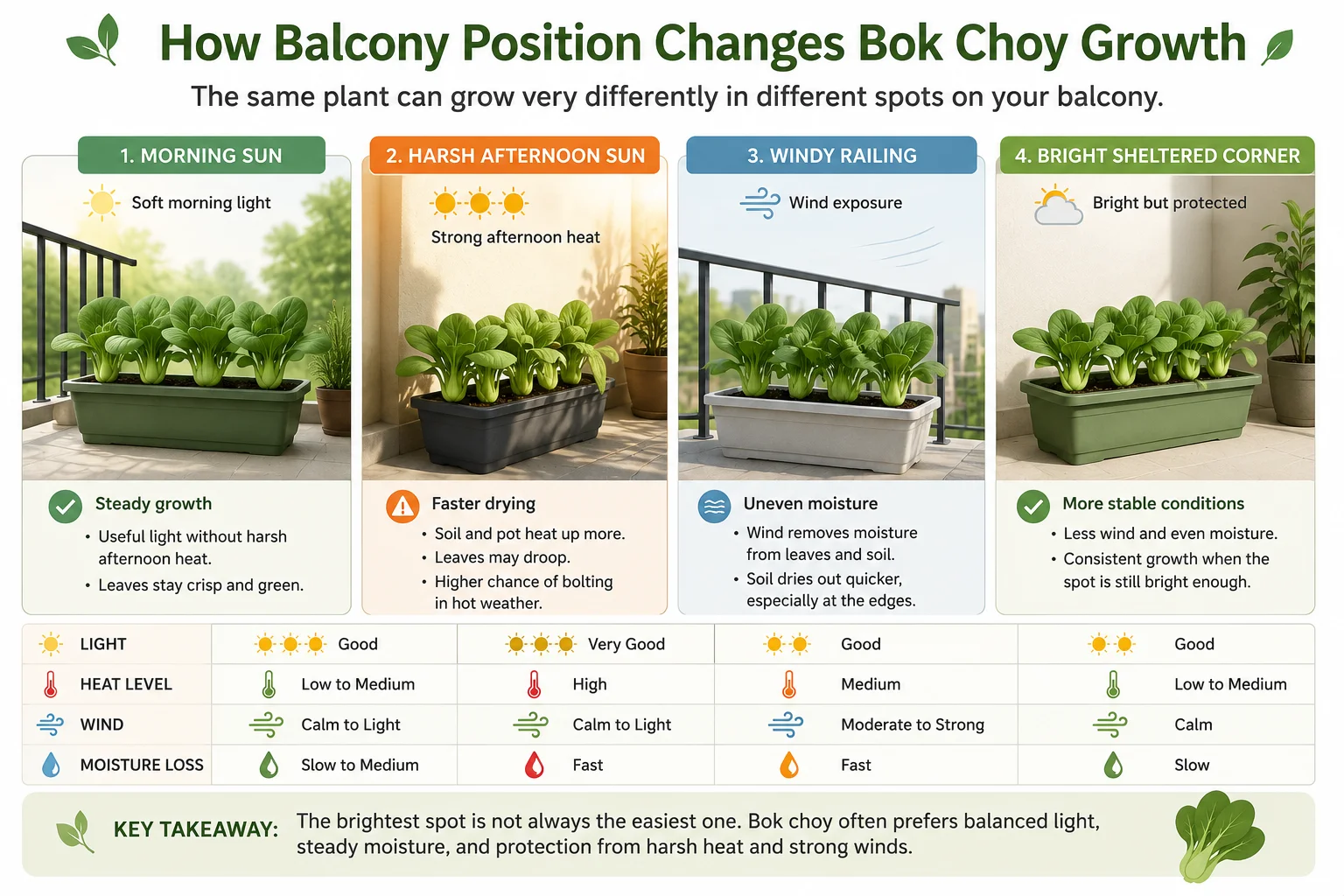
This diagram helps readers compare light with exposure rather than assuming the brightest position is automatically the most suitable. Morning sun may offer balanced conditions, while a bright sheltered position can work well if it is not deeply shaded or slow to drain.
| Balcony Position | Likely Growth Pattern | What Deserves Attention |
|---|---|---|
| Morning-sun edge | Steady leafy growth in mild conditions | Whether nearby buildings reduce light later in the season. |
| Hot western wall | Fast drying and possible early flowering | Reflected heat from walls, glass, and flooring. |
| Open railing | Good light but uneven moisture | Wind passing around the whole planter. |
| Bright sheltered corner | More even moisture and calmer leaves | Whether the position still receives enough useful light. |
| Covered inner wall | Slower drying and possibly slower growth | Deep shade, poor airflow, and water remaining in saucers. |
Harvesting Bok Choy in a Small Space
Bok choy does not have to reach one fixed size before it becomes useful. Young leaves can be harvested early, compact plants can be removed whole, or selected outer leaves can be taken while the centre continues growing for a time.
Early harvesting can be practical on hot balconies because it reduces the need to keep every plant growing until full maturity. It also frees space in a crowded planter and allows the remaining plants to spread.
Once a firm flower stalk begins rising from the centre, the plant is changing from leaf production to flowering. It can still be harvested, but waiting longer may not create the broad head originally expected.
This makes bok choy forgiving in a small space. A plant affected by rising temperatures does not automatically become a complete loss. The harvest may simply be earlier or smaller than planned.
That flexibility is one reason bok choy can suit apartment gardeners. It provides several useful stopping points rather than requiring one perfect harvest date.
Practical Insights for Balcony Growers
These points summarise the balcony conditions that tend to make the greatest difference without turning bok choy growing into a complicated routine.
- A wide planter is generally more useful than a very deep, narrow pot.
- Baby varieties create more flexibility where space or sunlight is limited.
- Morning light is often easier to manage than harsh summer afternoon sun.
- Wind can dry a railing planter even when the weather feels mild.
- Steady moisture matters more than following one fixed watering timetable.
- Early harvesting can still count as a successful balcony crop.
Common Bok Choy Misunderstandings
Many disappointing results come from expectations based on garden beds or supermarket produce rather than the reality of a balcony container.
- “Bok choy needs a large garden bed.” Compact plants can grow in pots and rectangular planters.
- “More direct sun always means more growth.” Strong heat can increase moisture stress and early flowering.
- “Small plants only need tiny pots.” A tiny pot may not hold enough moisture once the leaves expand.
- “Every plant needs to become full-sized.” Baby leaves and compact heads are useful balcony harvests.
- “Drooping means the plant needs more water immediately.” Heat stress and wet roots can also produce drooping.
- “One watering schedule works all season.” Sun angle, wind, temperature, and plant size continually change water use.
Australian Seasonal Context
In many Australian areas, bok choy is easier to grow during milder parts of the year than through the hottest summer weather. The exact growing window varies because coastal, inland, tropical, subtropical, and cool-climate balconies experience very different conditions.
In warm regions, a bright position with relief from harsh afternoon heat may extend the useful growing period. In cooler regions, a sunny balcony may provide enough warmth for good growth during seasons when an exposed garden feels cold.
Apartment buildings also modify local conditions. Concrete, brick, glass, and sheltered walls can hold warmth after sunset. A balcony several floors above ground may receive more wind than nearby weather reports suggest. Local observation therefore matters more than following a national planting calendar without adjustment.
This is why bok choy can behave like a cool-season vegetable on one balcony while struggling during the same month on another balcony nearby. Building direction, height, shade, reflected heat, and wind can matter as much as the wider regional climate.
Balcony Haven Note: I have noticed that leafy vegetables can look comfortable in one balcony corner and strained in another, even when both positions seem equally bright. The difference often appears to be a mix of wind, reflected warmth, and how quickly each container dries. Every balcony creates its own version of these conditions.
Frequently Asked Questions
Can bok choy grow in pots on an apartment balcony?
Yes. Bok choy is a compact container vegetable that can grow in individual pots, rectangular planters, and some railing containers. A wider pot that holds moisture steadily is generally easier to manage than a very small decorative container.
Are bok choy and pak choi the same plant?
Bok choy and pak choi are commonly used names for closely related forms of the same Asian green. Seed packets may use either name, and varieties can differ in size, stem colour, and the shape of their leaves.
How deep should a pot be for bok choy?
A container around 20 to 30 cm deep is suitable for many bok choy varieties. Width and spacing are also important because the leaves spread outward as the plant develops.
Can bok choy grow with only morning sun?
Morning sun can provide useful light while avoiding the strongest afternoon heat. Growth may be slower where the total light is limited, but a bright morning position can work well for leafy greens, especially during warm weather.
Why is my balcony bok choy flowering early?
Early flowering can be a response to heat, dry soil, sudden weather changes, crowding, or the natural age of the plant. Balcony pots can warm and dry more quickly than garden beds, so several small stresses may occur together.
Can several bok choy plants grow in one planter?
Yes. Several plants can share a rectangular planter when their spacing matches the intended harvest. Closely spaced plants suit baby leaves, while plants grown to a fuller size need more room around them.
Final Thoughts
So, can bok choy grow successfully on a balcony? It can, and its compact shape makes it one of the more practical leafy vegetables for apartment containers. Its success depends less on having a large space and more on finding a workable balance of light, moisture, airflow, and container room.
A wide planter, useful spacing, and protection from the harshest heat can make this Asian green easier to manage. Baby bok choy also gives small-space gardeners the option of harvesting earlier instead of waiting for large supermarket-sized heads.
A successful balcony harvest does not have to be the largest bok choy possible. It may be a handful of tender leaves, several compact pak choi plants, or an early harvest taken before hot weather changes their growth.
What matters most is that the crop suits the balcony and remains manageable within the available space and time. When the container, position, and harvest goal work together, even a small balcony can provide a fresh and worthwhile crop.
Leave a Reply