Measuring sunlight on a balcony can feel confusing because balconies do not receive light the same way open gardens do. The sun may only reach one corner, nearby buildings may block it early, and the balcony can still look bright even when no direct sunlight is touching your plants.
You can measure sunlight on a balcony by checking when direct sun first reaches your balcony, tracking how long it stays, and noting which areas receive sharp shadows during the day. You do not need special tools. A simple hourly check, shadow tracking, and a few notes are usually enough to understand your balcony’s real sunlight pattern.
This matters because plants do not respond to brightness the same way people do. A balcony can feel bright to your eyes but still give plants very little usable sun. When this happens, herbs may grow slowly, vegetables may produce less, and flowering plants may stay leafy but fail to bloom.
This guide explains how to measure balcony sunlight in a simple way, what counts as real sunlight for plants, how balcony direction affects sun hours, and how to use your results to choose better plants for your space.
Why Measuring Balcony Sunlight Matters
Measuring sunlight helps you understand what your balcony can realistically grow. Many balcony plant problems begin when the plant choice does not match the light level.
A tomato plant may look healthy for a while, but if it only receives two hours of direct sun, it may struggle to produce fruit. A herb plant may survive in bright shade but lose flavour if it does not receive enough light. A flowering plant may grow leaves but produce very few flowers.
When you know your balcony’s sunlight hours, plant choices become much easier. Instead of guessing, you can choose plants that match the real conditions of your space.
If your balcony only receives a few hours of direct sun, this guide on plants for balconies with 2–4 hours sun may help you choose more realistic options after measuring your light.
Why Balcony Sunlight Is Different From Garden Sunlight
Balcony sunlight is often broken into small patches. One side of the balcony may receive strong sun while another side stays shaded all day. Pots near the railing may get more light than pots near the wall. A hanging basket may receive different light from a pot sitting on the floor.
Balconies also have barriers that normal garden beds do not have. Railings, balcony walls, roof covers, privacy screens, glass panels, and neighbouring buildings can all change how sunlight reaches the space.
This is why balcony gardeners should measure sunlight in the actual growing spots, not just look at the balcony from inside the apartment. A balcony may look bright from the room, but the plant shelf or pot corner may still receive very little direct sun.
What Counts as Sunlight for Plants?
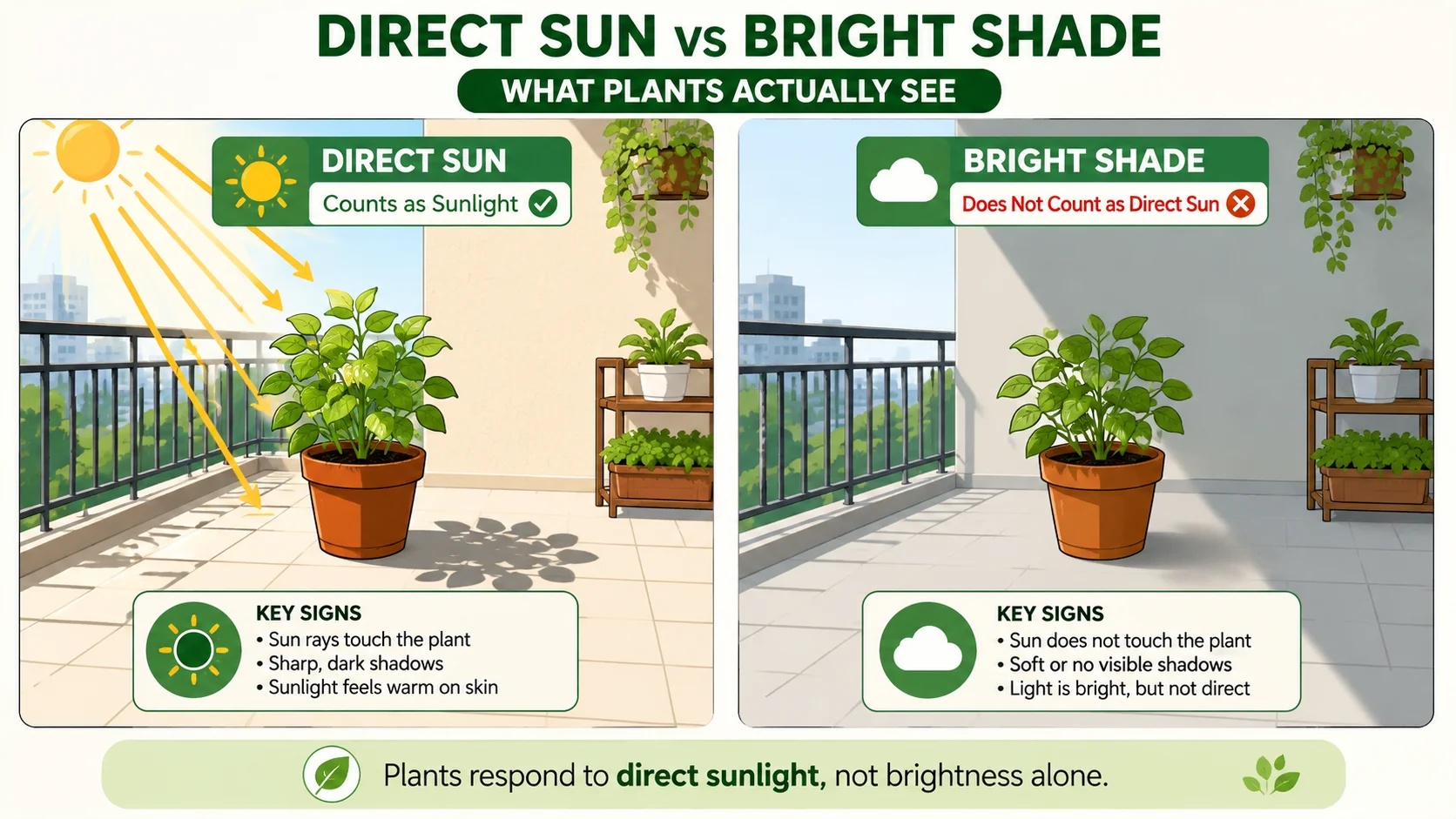
For most balcony plants, sunlight means direct sunlight. Direct sunlight happens when the sun shines straight onto the plant leaves, balcony floor, railing, or wall without being blocked by another object.
A simple way to check this is to look for shadows. If an object casts a clear, sharp shadow, that area is receiving direct sun. If the space looks bright but shadows are soft, weak, or missing, the light is probably indirect.
Indirect light can still help some plants grow, especially shade-tolerant plants. But it is not the same as direct sun for vegetables, herbs, fruiting plants, and many flowering plants.
Direct Sun vs Bright Shade vs Reflected Light
One of the easiest mistakes is assuming that a bright balcony is automatically a sunny balcony. The table below shows the difference between the main light types balcony gardeners usually see.
| Light Type | What It Looks Like | Does It Count as Sunlight? | What It Means for Plants |
|---|---|---|---|
| Direct sun | Sun touches the plant or balcony surface and creates sharp shadows. | Yes | Best for sun-loving herbs, vegetables, flowers, and fruiting plants. |
| Bright shade | The balcony looks bright, but the sun is not directly touching the plant. | Usually no | Useful for shade-tolerant plants, leafy greens, and some herbs. |
| Reflected light | Light bounces from walls, windows, pale floors, or nearby buildings. | Partly, but weaker | Can help plants grow, but may not be enough for strong flowering or fruiting. |
| Filtered sun | Sun passes through mesh, shade cloth, leaves, or balcony screens. | Partly | Helpful for plants that dislike harsh heat but still need some sun. |
| Deep shade | The space stays dim most of the day with no clear shadows. | No | Best suited to very shade-tolerant plants, not most vegetables or fruiting plants. |
If your balcony has almost no direct sunlight, this article on gardening on balconies with no direct sun may be more useful than trying to force full-sun plants into the space.
How to Measure Sunlight on a Balcony Without Tools
The simplest way to measure sunlight is to observe your balcony through the day. You do not need a sunlight meter or special app. What matters most is recording when direct sun starts, when it ends, and where it lands.
Choose a normal clear day if possible. Cloudy days can make sunlight harder to judge, especially if you are trying to learn the difference between direct sun and bright shade.
Step 1: Choose the Main Growing Spots
Start by choosing the places where you actually keep plants. This may include the railing area, a back wall shelf, a corner pot, a hanging planter, or a vertical garden frame.
Do not measure only the middle of the balcony if your plants do not grow there. A small balcony can have several different light zones, even within a few steps.
Step 2: Check When Direct Sun First Appears
Look at your balcony in the morning and note the first time direct sun touches each growing spot. Write down the time and the area that receives sun.
For example, you might notice that direct sun reaches the railing at 8:00am but does not reach the floor pots until 9:30am.
Step 3: Check Every Hour
Check your balcony every hour if you can. You do not need perfect timing, but regular checks help you see how the sun moves across the space.
Each time, note whether the plant area is receiving direct sun, bright shade, or no useful light. Photos can help if you do not want to write everything down.
Step 4: Record When Direct Sun Ends
Direct sun often disappears earlier than expected on balconies. A nearby building, roof cover, or balcony wall may block the sun before the general daylight ends.
Write down the time when direct sunlight leaves each growing spot. This gives you a more accurate total than guessing from sunrise and sunset times.
Step 5: Add the Direct Sun Hours
Once you know when direct sun starts and ends, add the total hours. If the railing receives sun from 8:00am to 12:00pm, that area receives about four hours of direct sun.
If the back wall only receives sun from 10:00am to 11:30am, that area receives about one and a half hours. These two spaces should not be treated the same, even though they are on the same balcony.
| Time Checked | Railing Area | Back Wall Area | Floor Pots |
|---|---|---|---|
| 8:00am | Direct sun | Shade | Shade |
| 9:00am | Direct sun | Bright shade | Direct sun |
| 10:00am | Direct sun | Direct sun | Direct sun |
| 11:00am | Direct sun | Direct sun | Bright shade |
| 12:00pm | Bright shade | Shade | Shade |
This kind of simple record is often more useful than guessing. It also shows which part of the balcony is best for plants that need more sun.
Using Shadow Tracking to Measure Sunlight
Shadow tracking is one of the easiest ways to confirm whether your balcony is receiving real direct sun. You can use a small pot, chair, stick, watering can, or any object that creates a shadow.
Place the object in the area where you want to grow plants. If the object casts a clear shadow, that spot has direct sun. If the shadow is soft, weak, or missing, the spot is probably in indirect light.
This method works well on balconies because sunlight can be uneven. A small railing planter might receive direct sun while a pot only one metre behind it stays shaded.
Shadow tracking is especially helpful when your balcony looks bright but plants still grow slowly. It helps you see whether the brightness is actually usable sunlight or just reflected light.
How to Measure Remaining Sunlight During the Day
Measuring remaining sunlight is useful when you are moving pots, watering plants, or deciding where to place heat-sensitive plants later in the day.
Watch how the sun patch moves across your balcony. When the sunny area becomes smaller, shadows grow longer, or sunlight starts sliding off the floor and walls, direct sun may be ending soon.
On many balconies, remaining sunlight is not based on sunset. It is based on when another building, balcony wall, roof, or railing blocks the sun. This is why a balcony can lose usable light at 2:00pm even though the day still looks bright outside.
How Balcony Direction Affects Sunlight Hours
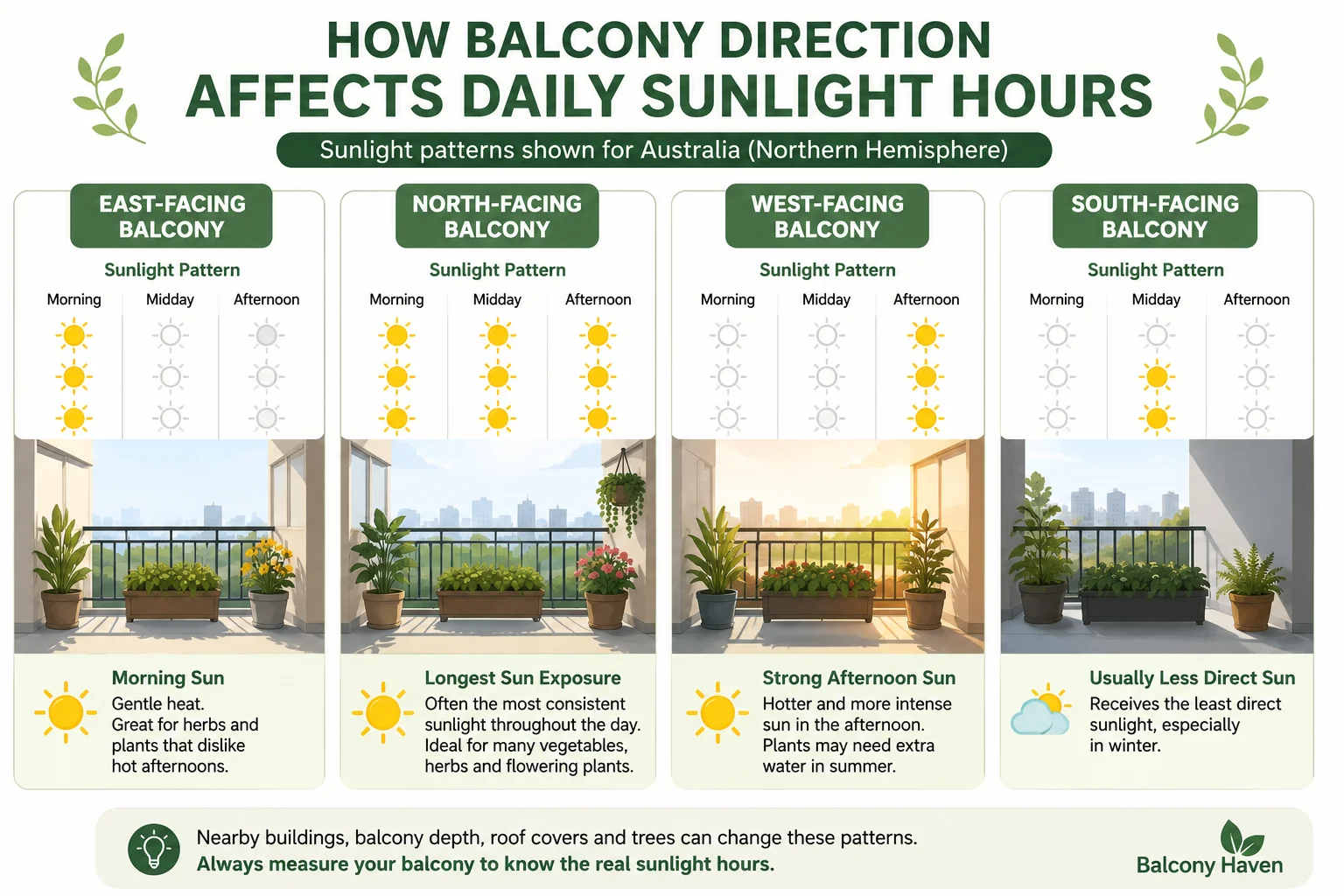
Your balcony direction gives a helpful starting point, but it does not tell the full story. Direction explains when sunlight is likely to arrive, while observation tells you how much sunlight your balcony actually receives.
In Australia, north-facing balconies often receive the most consistent sunlight, especially when they are open and not blocked by nearby buildings. East-facing balconies usually receive gentler morning sun. West-facing balconies often receive stronger afternoon sun. South-facing balconies usually receive less direct sun, especially in winter.
Still, nearby buildings can change everything. A north-facing balcony blocked by another apartment tower may receive less useful sun than an east-facing balcony with a clear open view.
| Balcony Direction | Typical Sun Pattern | What It Often Means for Plants |
|---|---|---|
| East-facing | Morning sun, softer heat | Good for herbs, leafy greens, and plants that dislike harsh afternoon heat. |
| North-facing | Often the longest useful sun in Australia | Can suit many vegetables, herbs, and flowers if not heavily blocked. |
| West-facing | Afternoon sun, stronger heat | Useful for sun-loving plants but can dry pots quickly in summer. |
| South-facing | Usually less direct sun | Better for shade-tolerant plants, especially if the balcony stays bright. |
If your balcony receives gentle morning light, you may find best plants for east-facing balconies helpful. If your balcony receives longer light from the north, this guide on best plants for a north facing balcony may suit your space better.
How to Judge Sunlight Intensity
Sunlight hours are important, but intensity also matters. Two balconies can both receive four hours of direct sun, but the results may be different if one gets gentle morning sun and the other gets strong afternoon sun.
Strong sun usually feels warm on your skin, creates sharp shadows, and heats balcony surfaces quickly. Gentle sun may still be direct, but it usually feels softer and is less likely to scorch leaves or dry pots quickly.
West-facing balconies often have stronger afternoon sun. This can be useful for full-sun plants, but it can also cause heat stress, especially in small pots. If your plants wilt badly in late-day sun, this guide on why balcony plants wilt in the afternoon sun may help you understand what is happening.
Intensity is one reason short hours of strong sun may sometimes support plants better than longer hours of weak light. It is also why hot balconies need careful pot choice, watering, and placement.
How Much Sun Do Common Balcony Plants Need?
After measuring sunlight, the next step is matching plants to your real sun hours. This is where your notes become useful.
The table below gives a simple guide. These are not strict rules, but they can help you avoid choosing plants that need much more light than your balcony can provide.
| Plant Type | Helpful Sunlight Range | Best Balcony Situation | Realistic Expectation |
|---|---|---|---|
| Ferns and shade foliage | 0–2 hours direct sun or bright shade | Shaded, covered, or south-facing balconies | Can grow well if the balcony is bright enough and not too dry. |
| Leafy greens | 3–5 hours | Morning sun or bright partial shade | Often more realistic than fruiting vegetables in lower light. |
| Soft herbs | 3–6 hours | East-facing or bright partial-sun balconies | Can grow well, but flavour and growth may change with light level. |
| Flowering annuals | 4–6+ hours depending on plant | Bright balconies with some direct sun | May bloom less in lower light, even if leaves look healthy. |
| Tomatoes and fruiting vegetables | 6+ hours | Open sunny balconies | Usually need stronger direct sun to flower and fruit well. |
| Succulents and full-sun plants | 5–8 hours | Sunny balconies with good airflow | Often struggle in deep shade but can thrive in bright, dry spots. |
If your balcony receives strong sun for much of the day, you may want to compare your options with balcony plants for full sun. If the measured sun is limited, choose plants that naturally handle gentler light instead.
Quick Sunlight Summary for Balcony Plants
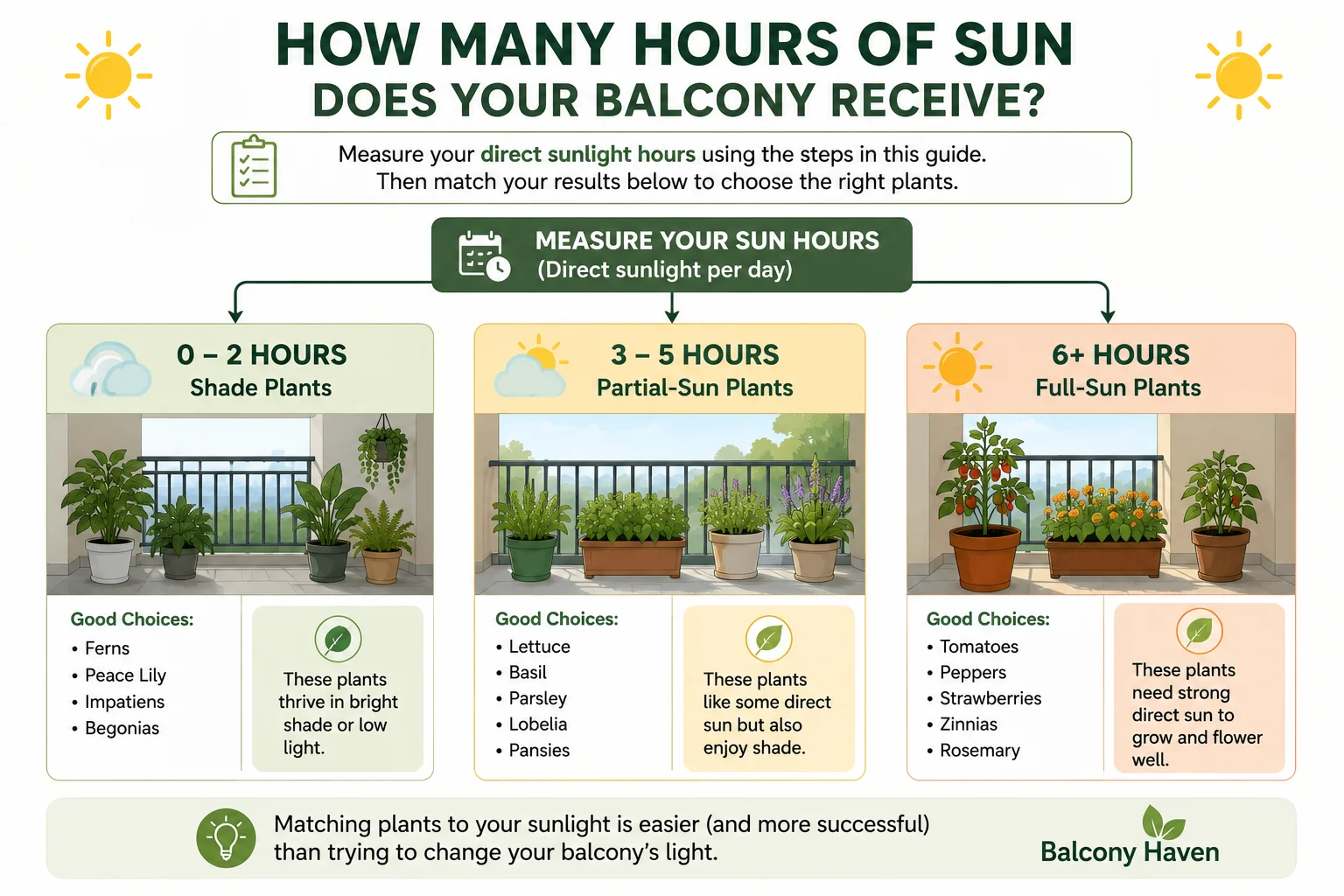
If you only remember one thing from this guide, remember this: measure the direct sun first, then choose plants that naturally match those hours.
| Measured Direct Sun | Typical Plant Group | Good Starting Choices |
|---|---|---|
| 0–2 hours | Shade plants | Ferns, peace lily, impatiens, begonias, shade foliage |
| 3–5 hours | Partial-sun plants | Lettuce, parsley, basil, lobelia, pansies, leafy greens |
| 6+ hours | Full-sun plants | Tomatoes, peppers, strawberries, rosemary, many flowering plants |
This summary is a starting point, not a strict rule. A balcony with three hours of gentle morning sun will behave differently from a balcony with three hours of hot afternoon sun. But it still gives you a simple way to narrow your plant choices.
Practical Tips for Tracking Balcony Sunlight
Sunlight tracking does not need to be perfect. The goal is to understand your balcony well enough to make better plant choices.
- Check sunlight at the same times for one or two clear days.
- Measure the actual plant locations, not just the open floor.
- Take photos from the same angle so you can compare sun movement.
- Watch the railing area because it often receives more sun than the back wall.
- Track morning and afternoon light separately because they affect plants differently.
- Repeat the check in another season if your plants suddenly slow down.
If you already know which parts of your balcony get the most light, this article on how to organise pots for maximum sunlight can help you place plants more effectively.
Common Mistakes When Measuring Balcony Sunlight
Most sunlight measuring mistakes happen because balconies look brighter than they really are for plants. These mistakes are easy to make, especially when you are new to balcony gardening.
- Assuming bright daylight is the same as direct sunlight.
- Checking the balcony only once during the day.
- Measuring the sunniest spot instead of where the pots actually sit.
- Ignoring shade from railings, walls, privacy screens, and roof covers.
- Using plant labels without checking whether your balcony has enough sun.
- Forgetting that sunlight changes between summer and winter.
A plant label may say “full sun”, but that usually means several hours of direct sunlight, not just a bright-looking balcony. Matching the label to your measured sun hours is much more useful than guessing.
Seasonal Sunlight Changes on Apartment Balconies
Balcony sunlight changes through the year. In Australia, the sun sits higher in summer and lower in winter. This changes how sunlight enters balconies, especially those with roof covers, deep walls, or nearby buildings.
A balcony that receives good summer sun may become much shadier in winter. Another balcony may receive gentler winter sun but become too hot in summer. These changes are normal and do not mean you are doing anything wrong.
This is why it helps to recheck sunlight when plant behaviour changes. If herbs slow down, flowers stop blooming, or vegetables produce less, the season may have changed the amount of usable light reaching your pots.
Balcony Haven Note: I have noticed that balcony sunlight can be quite different from what it looks like at first glance. A balcony may feel bright when standing outside, but the actual direct sun may only touch one railing corner for a few hours. Small details like walls, balcony depth, and nearby buildings can make a big difference.
Frequently Asked Questions
Is there a way to measure sunlight accurately on a balcony?
Yes. The most practical way is to track direct sunlight hours in the actual places where your plants grow. Check when direct sun starts, when it ends, and whether the area creates clear shadows. Doing this over a few clear days gives a realistic picture of your balcony’s usable sunlight.
Can I use a phone app to measure balcony sunlight?
Yes, a phone app can help as a rough guide, especially for checking sun direction or estimating light levels. But for balcony gardening, simple observation is often more useful because apps may not account for nearby buildings, railings, roof covers, or the exact spot where your pots sit.
How do you measure remaining sunlight during the day?
Watch how the sun patch and shadows move across your balcony. When the sunny area becomes smaller, shadows stretch longer, or sunlight starts leaving the floor and walls, direct sunlight is probably ending soon. On balconies, nearby buildings often end direct sun before sunset.
How do you calculate the sun position on a balcony?
You usually do not need technical calculations. Start with your balcony direction, then observe where the sun appears, where it lands, and when it disappears. East-facing balconies usually receive morning sun, west-facing balconies receive afternoon sun, north-facing balconies often receive longer sun in Australia, and south-facing balconies usually receive less direct sun.
How do you measure sunlight intensity?
You can judge sunlight intensity by shadow sharpness and surface warmth. Strong direct sun creates clear shadows and warms balcony surfaces quickly. Softer light may still be bright, but it usually creates weaker shadows and less heat.
Does bright shade count as sunlight for plants?
Bright shade helps some plants grow, but it is not the same as direct sunlight. Shade-tolerant plants may do well in bright shade, while tomatoes, many herbs, succulents, and full-sun flowers usually need stronger direct sun to grow well.
How many days should I track balcony sunlight?
One clear day gives a useful starting point, but two or three clear days are better. This helps you avoid judging your balcony from one unusual weather day or one quick check.
Final Thoughts
Measuring sunlight on a balcony is not about being technical. It is about noticing when direct sun reaches your plants, how long it stays, and which parts of your balcony receive the best light.
Once you understand your sunlight pattern, plant choices become much less confusing. You can place sun-loving plants in the brightest areas, use shaded corners for gentler plants, and stop expecting every part of the balcony to behave the same way.
Start with simple observation. Check your balcony through the day, look for clear shadows, and write down what you see. Over time, your balcony will show you what it can support, and your gardening decisions will feel calmer and more realistic.
Leave a Reply