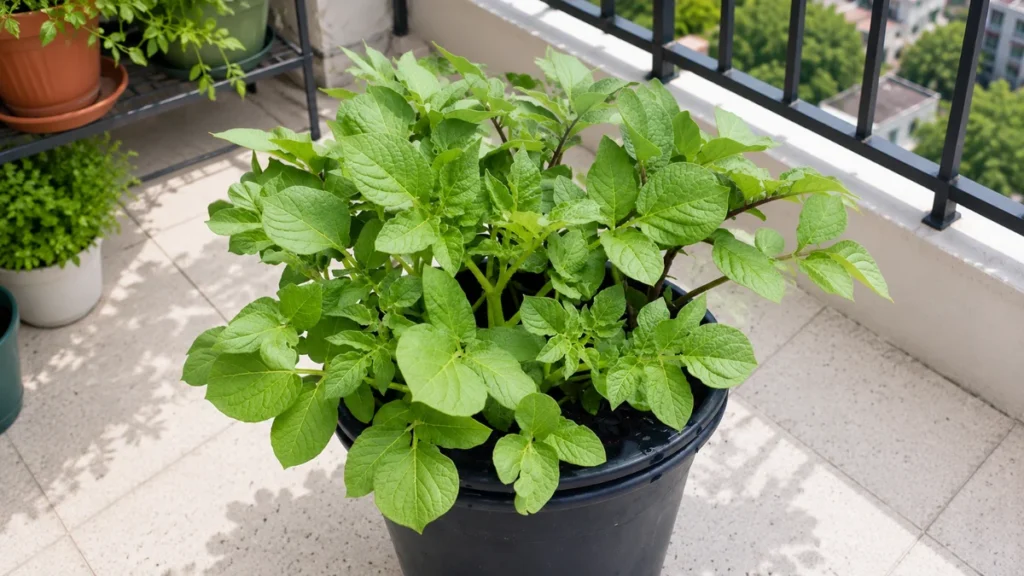
Growing potatoes in balcony buckets can sound a little unusual at first. Potatoes are often shown growing in garden beds, farm rows, or large backyard patches, so it is natural to wonder whether a simple bucket on an apartment balcony can really produce anything worthwhile.
Potatoes can grow well in balcony buckets when the container is deep enough, the potting mix drains properly, and the plant receives steady light and moisture. The harvest is usually smaller than a backyard garden bed, but a good bucket setup can still produce a useful and satisfying crop for small-space gardeners.
Some balcony gardeners harvest only a handful of potatoes from one bucket, while others are surprised by how productive a single container can become. The difference is usually not luck. It often comes down to bucket depth, sunlight, moisture, heat, and how the balcony itself behaves.
This article explains when potatoes are realistic in balcony buckets, why some buckets produce better harvests than others, what kind of harvest to expect, and what balcony gardeners should understand before expecting a large crop.
Why Balcony Buckets Are Different From Garden Beds
A potato bucket on a balcony does not behave like soil in the ground. The bucket controls almost everything around the plant, including root space, moisture storage, drainage, and soil temperature.
In a garden bed, soil temperature changes slowly. In a balcony bucket, the potting mix can heat up quickly during a hot afternoon, especially if the bucket is dark, placed near concrete, or sitting beside a wall that reflects heat.
Wind also matters. A balcony can act like a small wind tunnel between buildings. This can dry the top layer of potting mix faster than expected, even when the plant still looks green.
Weight and space are also real balcony issues. A large bucket filled with moist potting mix can become heavy. For renters and apartment dwellers, the best potato bucket is not always the biggest one. It is the one that fits the space, drains safely, and can be managed without creating problems on the balcony.
What Most Potato Advice Misses
Most potato-growing advice assumes the gardener has a backyard, open soil, and room to spread. That advice can still be useful, but it does not always match balcony conditions.
On a balcony, the question is not only whether potatoes can grow. The better question is whether the bucket can stay deep enough, moist enough, cool enough, and stable enough for the plant to produce tubers below the surface.
Another thing many guides miss is that balcony gardeners often have different goals. A renter with one or two buckets may not be trying to grow months of potatoes. They may simply want a small edible harvest from a space that would otherwise hold only a chair, a herb pot, or a storage box.
Why Potatoes Can Work Well in Buckets
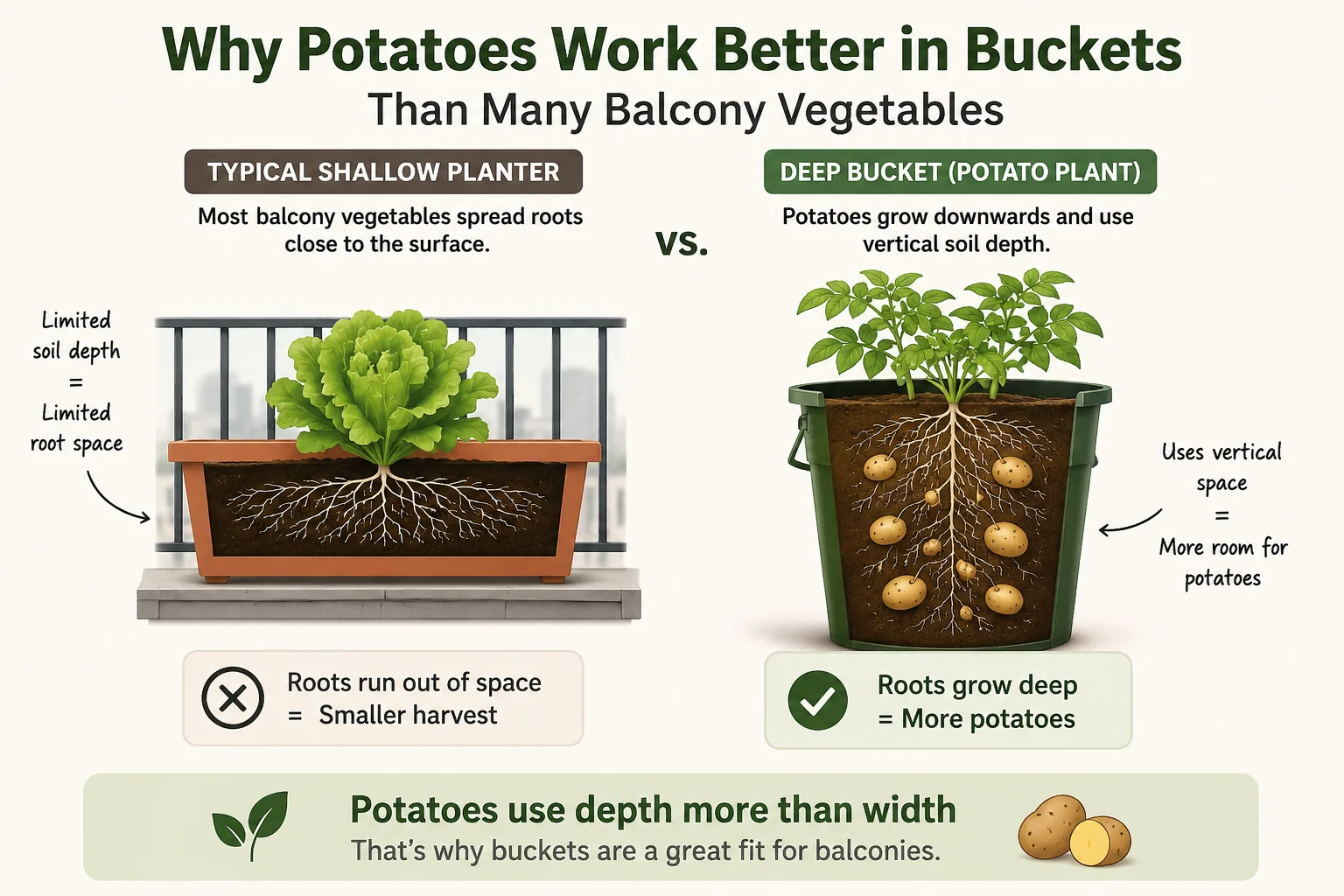
Can Potatoes Grow Successfully in Balcony Buckets? Yes, they can, because potatoes use depth more than wide ground space. This makes them more suitable for buckets than many people expect.
The useful part of a potato plant develops below the soil. When the bucket has enough depth, the plant has room to grow roots and form potatoes inside the container. This is different from spreading vegetables that need more sideways space.
A bucket also gives the gardener control over the growing mix. This can be helpful if old balcony soil has become hard, heavy, or tired. If this is something you have noticed before, our article on why balcony soil becomes hard and compact over time explains why container soil changes as it ages.
How Bucket Size Changes the Harvest
Bucket size has a strong effect on how many potatoes the plant can produce. A small bucket may grow a healthy-looking plant, but it may not have enough soil volume for a strong harvest.
Medium and larger buckets usually give better results because they hold more potting mix, dry out more slowly, and provide more space for potatoes to form. This does not mean every balcony needs the largest container possible. It means the bucket needs to be realistic for both the plant and the balcony.
This same idea also applies to other balcony vegetables. The article on best pot size for balcony tomatoes explains how container size can change the final harvest more than many beginners expect.
| Bucket Size | Balcony Suitability | Likely Potato Result | Main Limitation |
|---|---|---|---|
| Small bucket | Useful for very tight spaces | Can grow foliage, but harvest may be small | Limited soil depth and faster drying |
| Medium bucket | Suitable for many apartment balconies | Often gives a more worthwhile small harvest | Still needs steady moisture |
| Large bucket | Best for larger or stronger balcony spaces | Usually offers the best harvest potential | Can become heavy when wet |
What Harvest Can You Expect From One Balcony Bucket?
A balcony bucket is not likely to produce the same amount as a backyard potato patch. That does not mean it has failed. For many apartment gardeners, success may look like a small bowl of homegrown potatoes rather than a large storage harvest.
The most realistic expectation is that the harvest will depend on the size of the bucket and how stable the growing conditions were. A small bucket may give a modest result, while a deeper bucket in a bright, steady spot has a better chance of producing a more useful harvest.
| Bucket Setup | Realistic Harvest Expectation | Best For |
|---|---|---|
| Small bucket in a tight space | A small, modest harvest | Trying potatoes without using much balcony space |
| Medium bucket with steady light | A useful small household harvest | Most beginner balcony gardeners |
| Large deep bucket with stable moisture | The best chance of a larger container harvest | Balconies with more space and safe weight capacity |
This is why potato buckets are often more rewarding when treated as a small-space harvest project rather than a way to replace store-bought potatoes completely. The value is not only the amount harvested, but also the experience of growing food in a small balcony space.
How Sunlight Affects Balcony Potatoes
Potatoes usually perform better with a good amount of light, but balcony sunlight is not always simple. Morning sun, afternoon sun, reflected heat, and shade from nearby buildings can all affect the bucket differently.
A balcony with gentle morning sun may support steady growth without overheating the potting mix. A balcony with harsh afternoon sun may give stronger light but also create more heat stress around the bucket.
Reflected heat can make this even more noticeable. If your balcony sits near pale walls, glass panels, or hot concrete surfaces, the bucket may become warmer than expected. Our article on plants for balconies that get reflected heat explains this balcony problem in more detail.
For potatoes, the best spot is often bright and steady rather than simply the hottest or sunniest part of the balcony.
Why Moisture Matters More Than Many Expect
Many people focus first on fertiliser, but moisture often has a bigger effect on balcony potatoes. A bucket can swing from wet to dry faster than a garden bed, especially in warm weather or constant wind.
Potatoes usually dislike uneven moisture. If the mix dries out too often, the plant may keep growing but produce fewer or smaller potatoes. If the bucket stays too wet, the roots may struggle, especially if drainage is poor.
This is why drainage and watering habits matter together. A bucket should not hold stale water at the bottom, but it also should not dry out so quickly that the plant is stressed every afternoon.
If your balcony containers dry out too fast, the article on balcony soil drying out too fast may help you understand why it happens. For a broader watering view, you may also find best balcony watering methods for beginners useful.
Why Two Potato Buckets Can Produce Different Harvests
One of the most useful things to understand is that two potato buckets can look similar above the soil but produce very different harvests below the soil.
A bucket in morning sun with steady moisture may produce a better harvest than a bucket in hotter afternoon sun that dries out quickly. A deeper bucket may support more potatoes than a shallow one, even if both plants look leafy and green.
This is why a healthy-looking potato plant does not always guarantee a large harvest. Leaves show that the plant is growing, but the harvest depends on what has been happening inside the bucket.
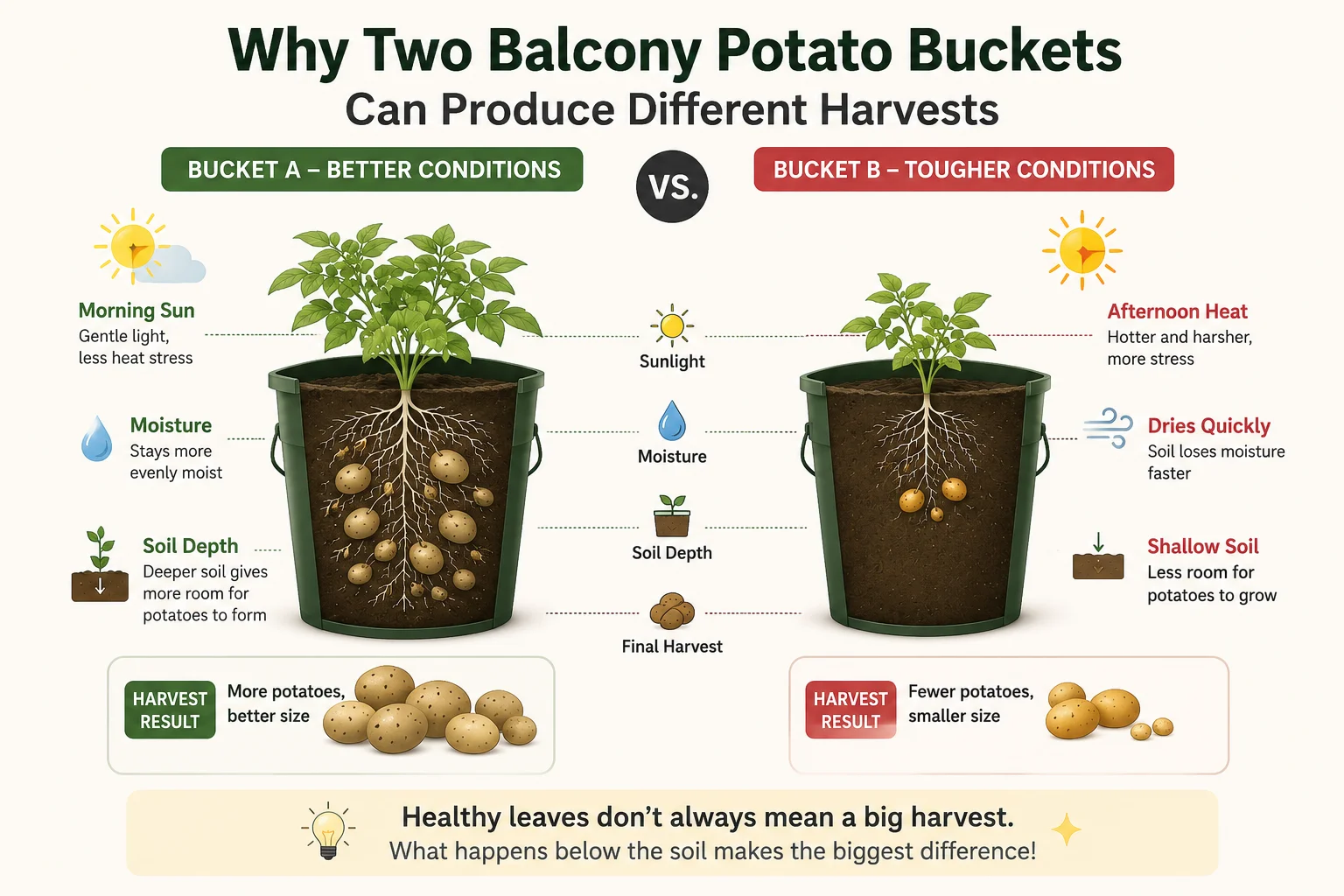
| Growing Condition | Bucket A | Bucket B | Likely Difference |
|---|---|---|---|
| Sunlight | Gentle morning sun | Hot afternoon sun | Bucket A may stay less stressed |
| Soil depth | Deeper soil | Shallower soil | Bucket A has more tuber space |
| Moisture | More stable | Dries quickly | Bucket A may produce more evenly |
| Harvest | More likely to be worthwhile | More likely to be small | Same plant type, different balcony result |
How Balcony Layout Affects Potato Growth
The shape and exposure of the balcony can change how potatoes behave in buckets. Open balconies usually receive more wind and stronger drying. Semi-enclosed balconies may feel more stable. Covered balconies may protect the bucket but reduce usable light.
None of these layouts is automatically good or bad. The important point is that each layout creates a different growing environment.
If you grow other vegetables in tight balcony conditions, this idea may feel familiar. Our article on whether zucchini can grow on a small balcony also shows how space, light, and container conditions can shape the final result.
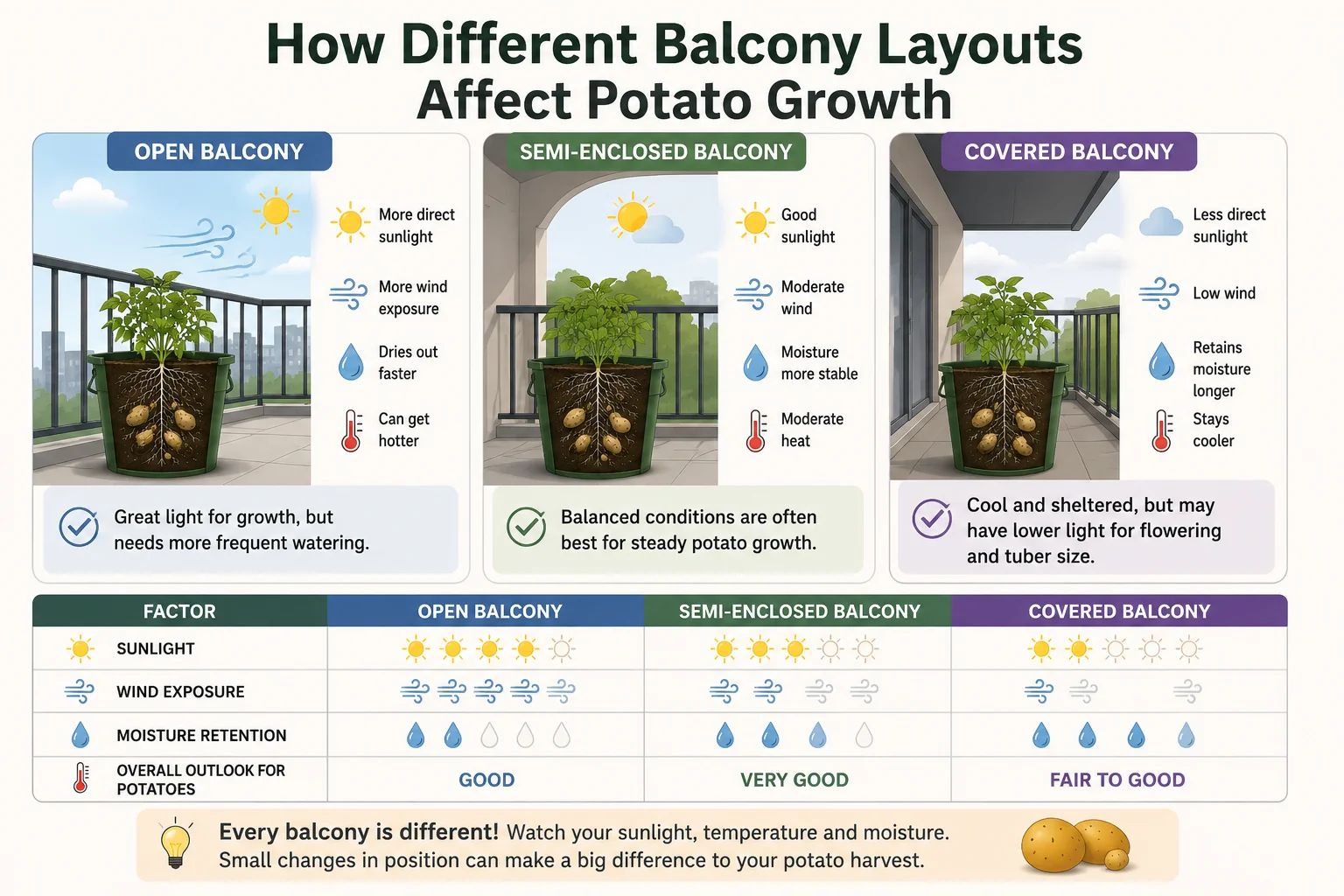
| Balcony Type | Typical Strength | Typical Challenge | Potato Bucket Outlook |
|---|---|---|---|
| Open balcony | More light and airflow | Faster drying and more wind | Can work well if moisture stays steady |
| Semi-enclosed balcony | More stable conditions | May have less airflow in hot weather | Often a good balance for bucket potatoes |
| Covered balcony | Protection from rain and harsh exposure | May receive less direct light | Can work if the balcony is still bright enough |
Practical Insights for Balcony Potato Buckets
Potatoes in buckets become easier to understand when you focus on the small balcony factors that change the root zone.
- Deeper buckets usually give potatoes more room to form.
- Stable moisture often matters more than heavy feeding.
- Morning sun can be gentler than strong afternoon heat.
- Dark buckets may heat up faster on exposed balconies.
- Open balconies usually dry containers faster than protected balconies.
- A leafy potato plant does not always mean a large harvest below the soil.
The best results usually come from matching the bucket to the balcony, rather than copying advice meant for backyard garden beds.
Common Misunderstandings
Many problems with balcony potatoes come from expectations that do not quite match container growing.
- Potatoes do not need a backyard, but they do need enough bucket depth.
- A small bucket can grow potatoes, but the harvest may be limited.
- More sun is not always better if the bucket overheats.
- Fertiliser cannot make up for poor drainage or very shallow soil.
- Healthy leaves do not always mean many potatoes are forming below.
- Two balconies in the same building can produce different results.
This is why balcony potato growing is often more about observation than perfection. Small changes in light, heat, wind, and moisture can make a noticeable difference.
Seasonal Context for Australian Balconies
In many Australian apartments, potatoes are often easier when the weather is not extremely hot. Mild conditions help the bucket hold moisture longer and reduce heat stress around the root zone.
Warm climates can still grow potatoes in buckets, but the balcony position matters more. A west-facing balcony with strong afternoon heat may need more care than an east-facing balcony with gentler morning sun.
Cooler regions may have slower growth at certain times of year, while hotter regions may need more attention to drying soil and reflected heat. This is why local balcony conditions often matter more than general planting advice.
Balcony Haven Note: I have noticed that potatoes feel like one of those balcony crops where the plant can look quiet for a long time before it becomes interesting. The part people care about is hidden under the soil, so it can be hard to judge success from leaves alone. I also find this topic connects naturally with using grow bags on balconies, because both buckets and grow bags depend so much on depth, moisture, and balcony exposure.
Frequently Asked Questions
Can potatoes grow in buckets on a balcony?
Yes, potatoes can grow in buckets on a balcony if the bucket is deep enough, drains well, and receives enough light. The harvest is usually smaller than a garden bed, but it can still be worthwhile for small spaces.
How deep should a balcony bucket be for potatoes?
A deeper bucket is usually better because potatoes need room below the surface to form. Very shallow containers may grow leaves but often limit the final harvest.
Do potatoes need full sun on a balcony?
Potatoes usually grow better with good light, but harsh afternoon heat can stress balcony buckets. Bright, steady light is often more useful than the hottest part of the balcony.
Are buckets or grow bags better for balcony potatoes?
Both can work. Buckets may hold moisture longer, while grow bags often allow more airflow around the root zone. The better choice depends on your balcony’s heat, wind, space, and watering routine.
Why did my potato plant grow leaves but only a few potatoes?
This can happen when the bucket is too small, the soil dries unevenly, the plant receives too much heat, or there is not enough space below the surface for potatoes to develop.
Can renters grow potatoes in balcony buckets?
Yes, renters can grow potatoes in buckets if the balcony allows plants and the container is safe, stable, and not too heavy. It is also important to manage drainage so water does not drip onto lower balconies.
Final Thoughts
Can Potatoes Grow Successfully in Balcony Buckets? In many cases, yes. Potatoes are one of the more realistic edible crops for small balconies because they use container depth instead of needing a wide garden bed.
The harvest depends less on perfect gardening skill and more on bucket size, steady moisture, usable light, and the balcony’s own microclimate. A deep bucket in a bright, stable spot can perform much better than a small bucket exposed to harsh heat and drying wind.
For many apartment gardeners, potatoes are one of the few edible crops that make excellent use of vertical container space. When the bucket matches the balcony conditions, even a small harvest can feel useful, satisfying, and surprisingly rewarding to grow.
Leave a Reply