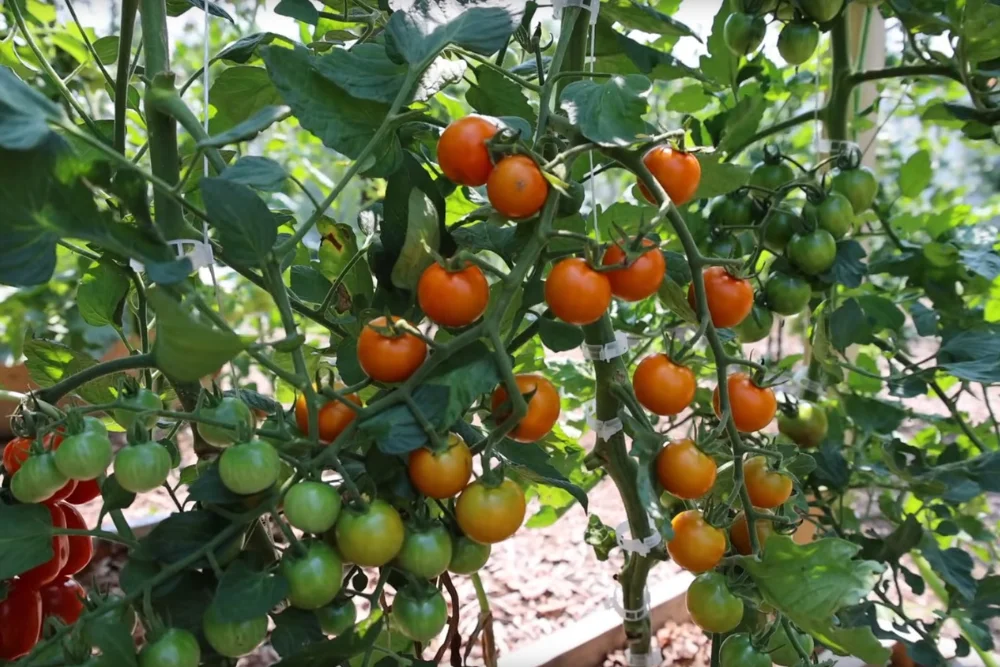
Many people assume tomatoes need a backyard to produce a worthwhile harvest. Yet some apartment gardeners harvest bowls of cherry tomatoes from balconies barely larger than a small outdoor table. The difference is usually not the size of the balcony itself, but how well the growing setup matches the available sunlight, container space, and balcony conditions.
You can grow tomatoes on a tiny balcony if the space has enough usable sunlight, a deep enough container, steady moisture, and support for the plant. The harvest may be smaller than it would be in a garden, but compact tomato varieties can still grow well in small balcony spaces when the setup matches the conditions.
Most problems happen when a balcony tomato plant is treated like a garden tomato. Tiny balconies have less soil volume, fewer placement options, stronger reflected heat, and pots that dry out faster than garden beds. A tomato may survive in these conditions, but fruiting depends on how well the space supports the plant.
This article explains what actually matters when growing tomatoes on a tiny balcony, which tomato types are most realistic, what kind of pot setup works better, and why some small balcony tomatoes grow well while others struggle.
The Tiny Balcony Reality for Tomatoes
A tiny balcony is not just a smaller version of a garden. It has its own growing conditions. Light may only reach one side of the balcony. Wind may move strongly between buildings. Walls, railings, and floors can reflect heat back onto the plant. Containers may dry out faster than expected.
Tomatoes can grow in pots, but they still need enough room for roots, enough light for flowers, and enough moisture stability to keep growing through warm days. When one of these is missing, the plant may stay alive but produce very few tomatoes.
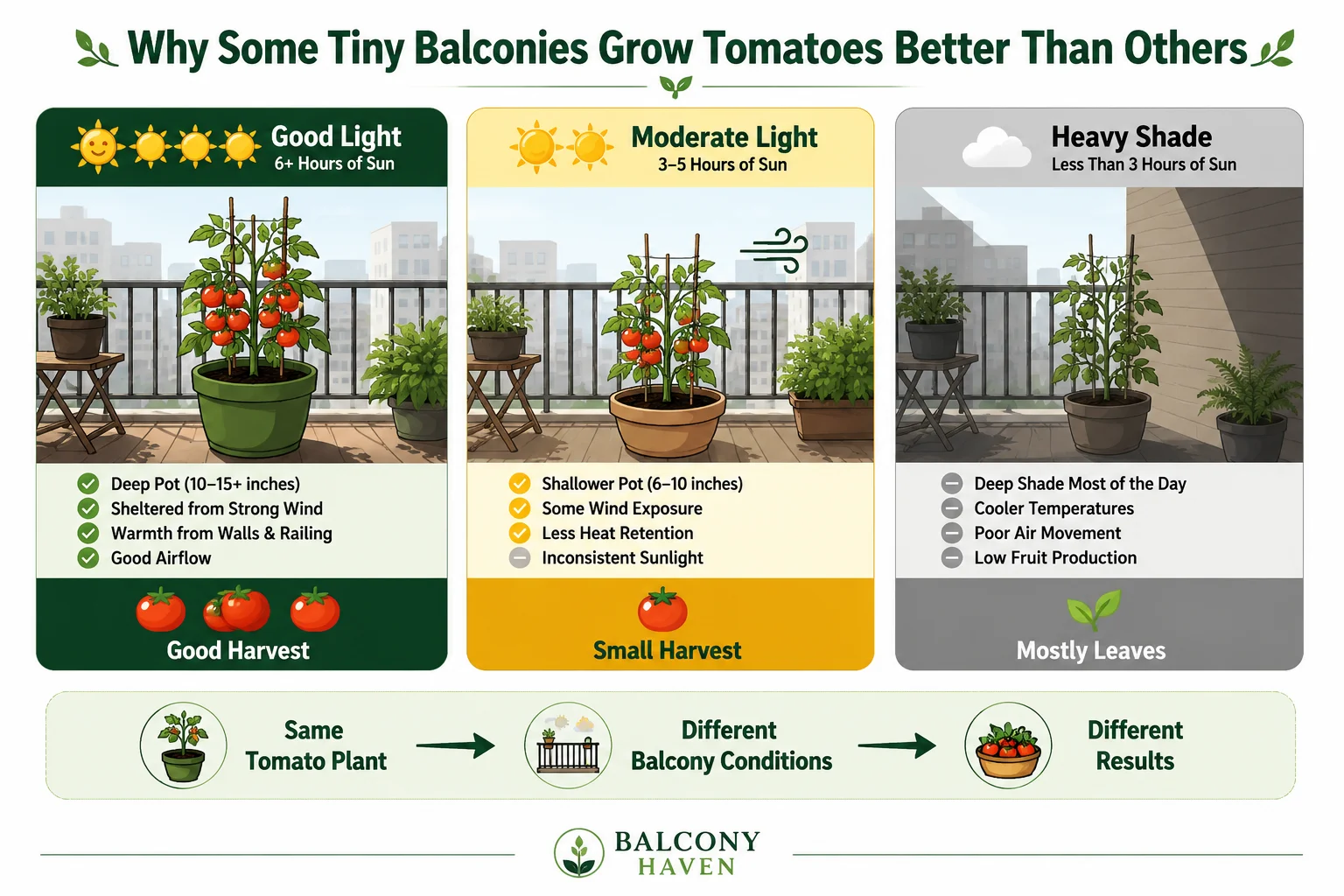
This is why two people can grow the same tomato variety on two different balconies and get very different results. One balcony may have bright morning sun and a sheltered corner. Another may be windy, shaded, or too hot near the railing.
What Most Tomato Advice Misses
A lot of tomato advice is written for gardens, patios, or larger outdoor spaces. That advice often assumes there is enough soil, room, sunlight, and airflow. On a tiny balcony, those assumptions do not always fit.
A large tomato plant may be easy to support in a backyard, but it can feel awkward on a narrow balcony. A pot that works well on the ground may become too heavy or too wide for an apartment space. A sunny garden position may stay open all day, while a balcony may only receive direct sun for a short part of the day.
This does not mean balcony tomatoes are a bad idea. It means the setup has to be more realistic. The best tomato for a tiny balcony is usually not the biggest or most impressive variety. It is the one that fits the balcony’s light, pot size, and available space.
Best Tomato Types for Tiny Balconies
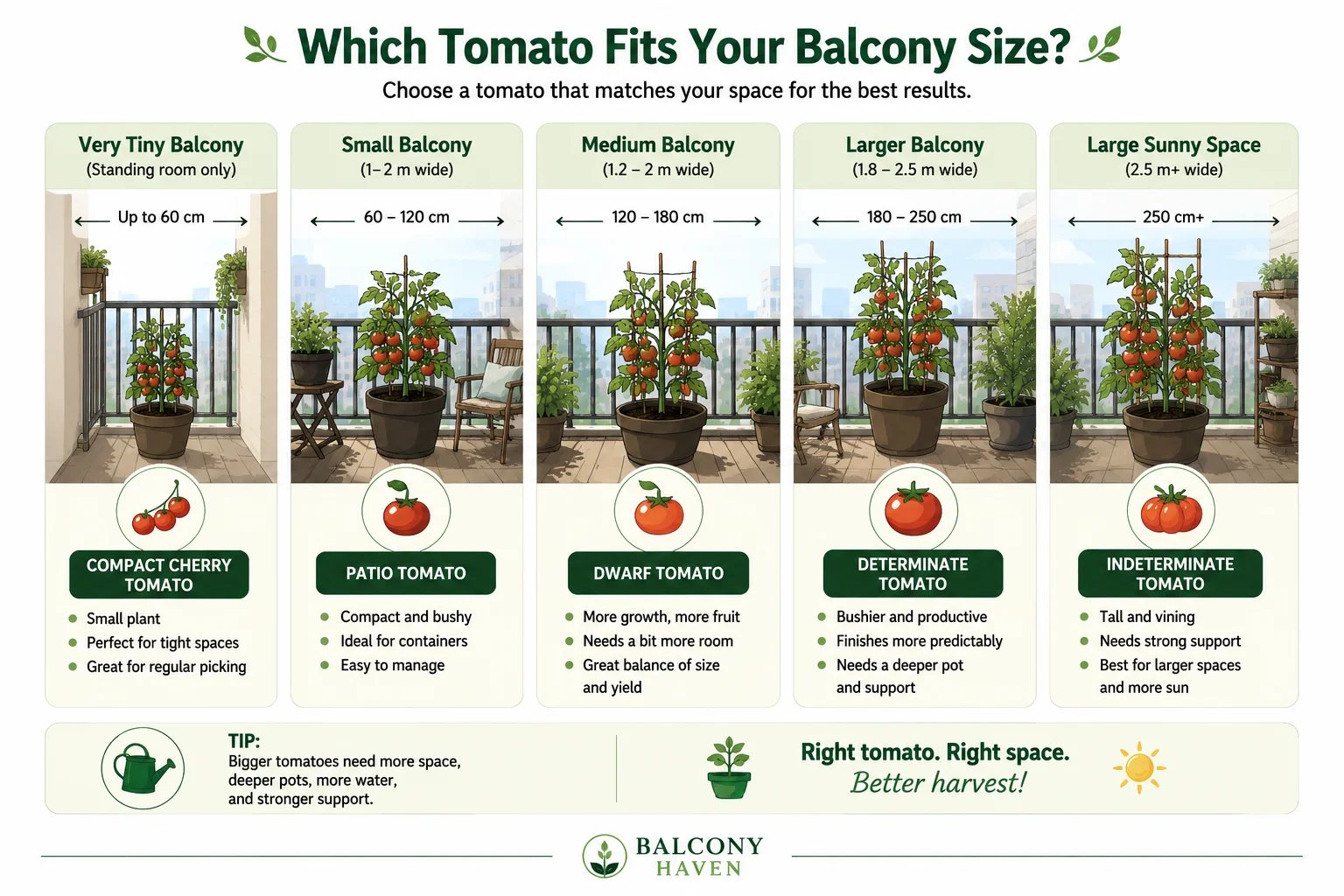
The easiest tomatoes for tiny balconies are usually compact cherry, patio, dwarf, or determinate types. These plants stay more manageable and are easier to support in containers.
Indeterminate tomatoes can still grow in pots, but they keep growing taller through the season. On a tiny balcony, this can become difficult because the plant may need stronger support, more pruning, more water, and more space than the balcony can comfortably provide.
| Tomato Type | Best Balcony Fit | Container Need | Realistic Expectation |
|---|---|---|---|
| Compact cherry tomato | Very small balconies | Medium to deep pot | Usually the easiest option for small spaces and regular picking. |
| Patio tomato | Small balcony corners | Medium pot | Designed to stay smaller and easier to manage in containers. |
| Dwarf tomato | Narrow balconies | Medium to deep pot | Can give a better balance between plant size and fruiting. |
| Determinate tomato | Balconies with a little more room | Deep stable pot | Grows bushier and finishes more predictably than tall vine types. |
| Indeterminate tomato | Larger or very sunny balconies | Large deep pot | Can produce well, but often becomes too large for tiny balconies. |
If the balcony is extremely narrow, one compact tomato plant is usually more realistic than several plants squeezed into the same space. A single healthy plant often performs better than two or three crowded plants competing for light, water, and airflow.
What Size Pot Do Balcony Tomatoes Need?
Tomatoes need more container space than many beginner balcony gardeners expect. A small pot can keep a tomato alive for a while, but it often becomes difficult once the plant starts growing quickly, flowering, and using more water.
For tiny balconies, the best pot is usually the largest practical container the space can safely hold. This does not mean choosing an oversized pot that makes the balcony crowded or hard to use. It means avoiding very small pots that dry out quickly and restrict the roots too early.
Compact tomato plants may grow in medium containers, while larger tomato types usually need deeper and wider pots. The article on best pot size for balcony tomatoes explains this more closely because pot volume affects water, root space, and plant stability.
| Container Size | What It Can Usually Support | Balcony Concern |
|---|---|---|
| Very small pot | Seedlings or temporary growth | Dries quickly and limits fruiting. |
| Medium deep pot | Compact cherry, patio, or dwarf tomato | Often the most realistic tiny balcony choice. |
| Large deep pot | Determinate or stronger tomato plants | Better stability, but takes more floor space. |
| Very large container | Bigger tomato varieties | Can become heavy and awkward on small balconies. |
Why Soil Depth Matters in Small Balcony Pots
Soil depth is one of the quiet reasons balcony tomatoes either settle in well or struggle early. Tomatoes have active root systems, and shallow soil gives them less room to search for moisture and nutrients.
On a hot balcony, shallow pots also heat up and dry out quickly. This can stress the roots even when the plant looks fine in the morning. By afternoon, the same plant may wilt, drop flowers, or stop growing strongly.
Deeper containers give the roots more stable conditions. They hold moisture more evenly and protect the root zone from sudden temperature changes. This matters on balconies because containers are exposed on more sides than garden soil.
For more general vegetable container depth, this guide on the best soil depth for balcony vegetable pots may help you compare tomatoes with other edible balcony plants.
How Much Sunlight Do Balcony Tomatoes Need?
Tomatoes need good light to produce flowers and fruit. A balcony may look bright, but usable sunlight can be limited by walls, roofs, railings, neighbouring buildings, and the direction the balcony faces.
A balcony with several hours of direct sun is usually more reliable for tomatoes than a balcony that only receives bright shade. Some compact tomatoes may still grow in less-than-perfect light, but fruiting tends to be slower and less predictable.
If your balcony receives only a few hours of direct morning sun, you may find this guide on best plants for east-facing balconies useful for comparing tomatoes with other plants that enjoy similar conditions.
The important thing is not just how bright the balcony feels, but how many hours of direct or strong light the plant actually receives. A tomato near the railing may receive more useful light than one placed against the back wall. A pot moved only half a metre can sometimes behave differently.
If the light pattern is unclear, this guide on how to measure sunlight on a balcony can help explain why some bright-looking balconies still do not give plants enough direct sun.
| Balcony Condition | What Usually Happens to Tomatoes | What It Means |
|---|---|---|
| Strong morning sun | Often supports steady growth and fruiting. | Usually one of the easier balcony conditions for tomatoes. |
| Bright shade | Leaves may grow, but fruiting can be limited. | The plant may survive without producing much. |
| Deep shade | Weak flowering and poor harvests are common. | Tomatoes may not be the best edible choice for that spot. |
| Windy balcony | Pots dry faster and flowers may drop more easily. | Moisture and support become more important. |
| Hot reflected heat | Plants may wilt, dry quickly, or slow down. | The pot and roots may be hotter than the air feels. |
| Covered but bright | Can work if enough strong light still reaches the plant. | Better than deep shade, but still depends on sun access. |
Can Tomatoes Grow on a Covered Balcony?
Tomatoes can grow on a covered balcony if enough light still reaches the plant. A roof or balcony above can protect the plant from heavy rain and harsh afternoon heat, but it can also block important sunlight.
A covered balcony with strong morning sun or bright open light may still support compact tomatoes. A deep covered balcony that stays shaded most of the day may grow leaves but struggle to produce flowers and fruit.
Covered balconies can also change watering needs. Pots may not receive rain, but they can still dry out from wind, heat, and warm air around the building. This can make the plant look thirsty even though the balcony feels shaded.
If your covered space is bright but not sunny for long, this article on best plants for covered balconies with light may help you compare tomatoes with other balcony plant options.
What a Tiny Balcony Tomato Setup Actually Looks Like
A realistic tiny balcony tomato setup is usually simple. It often means one compact tomato plant, one deep container, one support stake or small cage, and the brightest safe spot available.
The plant does not need a large garden area around it, but it does need room for airflow and enough space so leaves are not pressed tightly against walls, furniture, or other pots. Crowded leaves dry more slowly after watering and can make the plant harder to manage.
| Balcony Size | Realistic Tomato Setup | Expectation |
|---|---|---|
| Very tiny balcony | One compact cherry tomato in a deep pot. | Small but useful harvest if the light is good. |
| Narrow balcony | One dwarf or patio tomato near the brightest edge. | Works best when there is still walking space and airflow. |
| Small balcony with good sun | One determinate tomato in a deeper stable container. | More growth and fruit, but more water demand. |
| Covered balcony with light | One compact tomato in the brightest position. | Possible, but fruiting depends on how much strong light reaches the plant. |
| Tiny shaded balcony | Tomatoes may not be the most reliable choice. | Leafy herbs or shade-tolerant plants may be more realistic. |
A small balcony tomato setup may not look dramatic, but it is often more productive than trying to squeeze too many plants into the same space. If the goal is edible growing in very limited space, this guide to best edible plants for tiny balconies can also help compare tomatoes with other compact food plants.
Many beginners assume that growing more tomato plants will automatically produce a larger harvest. On a tiny balcony, the opposite is often true. Crowded plants compete for sunlight, airflow, water, and growing space. A single healthy tomato plant in a suitable container often produces better results than several plants squeezed into the same area.
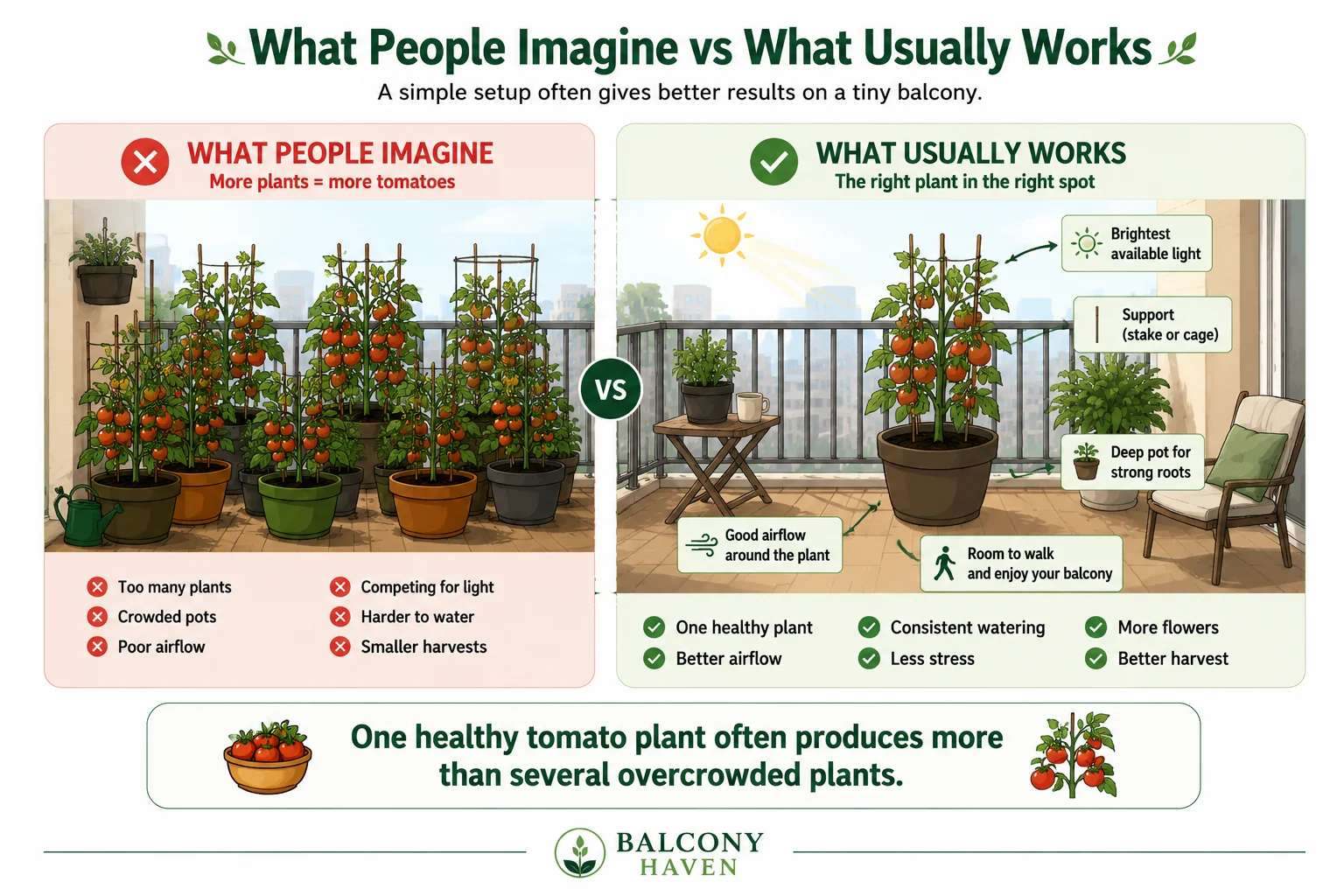
When space is limited, simplicity often works better. One well-positioned tomato plant can be easier to water, easier to support, and easier to monitor than several crowded plants. It also leaves room to enjoy the balcony itself rather than turning every available space into a growing area.
Common Mistakes on Very Small Balconies
Most tomato problems on tiny balconies come from mismatched expectations. The plant may be healthy enough to grow, but the balcony may not support the size, water demand, or light needs of the variety chosen.
- Choosing tall tomato varieties for a very narrow balcony.
- Using shallow pots that dry out too quickly.
- Growing too many tomato plants in one small area.
- Placing the pot in a bright-looking but low-sun corner.
- Ignoring wind because the balcony seems sheltered.
- Expecting garden-sized harvests from a small container setup.
These mistakes are common because tomato plants can look strong early on. Problems often appear later, when the plant starts flowering and needs more water, light, root space, and stability.
Seasonal Context for Australian Balconies
In many Australian apartments, balcony tomato growing changes through the year. Spring can bring useful warmth and increasing light, but wind may still be strong. Summer can bring faster growth, but it also increases heat stress, pot drying, and reflected heat from walls and floors.
Tiny balconies often magnify these conditions. A container near a hot railing can heat up quickly. A dark pot in afternoon sun can become much warmer than expected. A covered balcony may reduce heat slightly, but it may also reduce the light tomatoes need for strong fruiting.
This is why the same tomato plant may behave differently from one season to another. The routine may stay similar, but the balcony itself changes with sun angle, heat, wind, and daylight length.
Balcony Haven Note: In my own balcony growing, I have noticed that tomatoes are less forgiving than chillies when the pot is too small or the light is uneven. Some balconies can grow a compact tomato well in one bright corner, while another spot only a short distance away may keep the plant alive but slow down flowering. Small balcony differences often matter more than they first appear.
Frequently Asked Questions
Can tomatoes grow on a tiny balcony?
Yes, tomatoes can grow on a tiny balcony if the plant receives enough usable light, has a deep enough container, and is supported properly. Compact tomato varieties are usually more realistic than large vine tomatoes in very small spaces.
What is the best tomato for a small balcony?
Compact cherry, patio, dwarf, and determinate tomatoes are usually better for small balconies. They stay more manageable in pots and are easier to support than tall indeterminate tomato plants.
Is a 10-litre pot big enough for tomatoes?
A 10-litre pot may support a small tomato plant for a while, but it can restrict long-term growth and fruiting. Moisture also changes quickly in smaller pots, especially during warm or windy balcony conditions.
Do tomatoes need full sun on a balcony?
Tomatoes usually fruit better with several hours of direct or strong sunlight each day. They may still grow leaves in lower light, but flowering and fruit production are usually weaker when the balcony is too shaded.
Can tomatoes grow on a covered balcony?
Tomatoes can grow on a covered balcony if the space still receives enough bright light or direct sun. A covered balcony that stays deeply shaded may keep the plant alive, but fruiting can be slow or unreliable.
How many tomato plants should I grow on a tiny balcony?
One healthy compact tomato plant is often more realistic than several crowded plants. Too many tomato plants in a small space can reduce airflow, increase watering stress, and make each plant compete for light.
Can tomatoes grow on an east-facing balcony?
Yes, east-facing balconies are often one of the better locations for tomatoes because they receive gentler morning sunlight. While the total hours of direct sun vary between buildings and seasons, many compact tomato varieties grow well when they receive several hours of morning light and are planted in deep containers.
Final Thoughts
Growing tomatoes on a tiny balcony is often more realistic than many people expect. The key is not trying to recreate a backyard garden in a small space. It is choosing a tomato variety, container, and position that fit the balcony you actually have.
Many successful balcony gardeners grow only one or two tomato plants. A compact variety in a deep container, placed in the brightest available location, can often produce a surprisingly worthwhile harvest without taking over the entire balcony.
Every balcony has its own mix of sunlight, heat, wind, and available space. Once you learn how those conditions affect your plants, growing tomatoes becomes less about guesswork and more about making small adjustments that suit your particular balcony.
Leave a Reply