Working out how much sunlight a balcony receives can be surprisingly difficult. Nearby buildings, balcony roofs, railings, walls and seasonal changes can all affect when direct sun reaches your plants.
Most balcony gardens can grow something useful with two to six hours of direct sunlight per day. Less than two hours usually suits shade-tolerant foliage plants and some leafy greens, while four to six hours opens the door to many herbs, flowers and compact vegetables. The strength and timing of the sun matter as much as the total number of hours.
A balcony that receives four gentle hours in the morning may be easier to garden on than one receiving four intense hours late in the afternoon. Containers heat and dry faster than garden beds, so direct sun affects the roots as well as the leaves.
This guide explains how much sun your balcony garden needs, how to judge the light you actually receive, why balcony direction does not tell the whole story, and how to choose plants that match your real conditions.
A Quick Guide to Balcony Sunlight Hours
As a general guide, less than two hours of direct sun suits shade-tolerant plants, two to four hours suits many leafy plants and herbs, four to six hours suits a wider range of vegetables and flowers, and six or more hours suits many sun-loving plants.
Plant labels often use terms such as full sun, partial sun and shade. These labels are useful starting points, but they were not always written with apartment balconies in mind.
On a balcony, the same number of sunlight hours can create different growing conditions depending on heat, wind, reflected light, pot size and the time of day.
| Direct Sun Per Day | Typical Balcony Conditions | Plants That May Suit | Main Thing to Watch |
|---|---|---|---|
| Less than 2 hours | Mostly shaded, covered or blocked by buildings | Ferns, pothos, peace lily, mint and some leafy greens | Slow growth and potting mix staying wet for too long |
| 2–4 hours | Partial sun, often morning light or short periods between shadows | Lettuce, spinach, parsley, chives, begonias and some strawberries | Whether the sunlight is gentle morning sun or strong afternoon sun |
| 4–6 hours | A useful middle range for many balcony gardens | Basil, beans, chillies, compact tomatoes, flowers and herbs | Fruiting plants may still produce less than they would in stronger light |
| 6 or more hours | Sunny, exposed and often warmer around pots and walls | Tomatoes, eggplants, rosemary, succulents and many flowering plants | Hot roots, rapid drying, leaf scorch and strong afternoon heat |
These ranges are not strict rules. A plant may grow with less light than expected, but it may grow more slowly, produce fewer flowers or stretch towards the brightest part of the balcony.
If your space falls within the middle range, the guide to plants for balconies with 2–4 hours of sun gives more specific options for balconies that receive only a short daily window of direct light.
Quick Sunlight Decision Guide:
- Less than 2 hours: Start with foliage plants, shade-tolerant herbs and leafy greens.
- 2–4 hours: Choose lettuce, spinach, parsley, mint, begonias and other partial-sun plants.
- 4–6 hours: Try basil, beans, chillies, strawberries, compact tomatoes and flowers.
- 6 or more hours: Choose sun-loving plants, but watch for overheating pots and fast-drying soil.
If the sun arrives mainly in the late afternoon, choose plants that tolerate heat and check potting mix more often.
Why Sunlight Works Differently on a Balcony
Balcony sunlight is shaped by roofs, walls, railings, nearby buildings and reflected heat, so the direction your balcony faces does not always reveal how much useful sun your plants receive.
A backyard garden usually receives light from a wide area of open sky. A balcony receives light through a smaller opening surrounded by walls, ceilings, railings and nearby buildings.
This means a balcony can face a sunny direction but still receive very little direct sun. A deep roof may shade the back of the balcony, while only the railing edge receives sunlight. A neighbouring apartment tower may block the sun during part of the day. Frosted glass can brighten the space without allowing strong direct light onto the leaves.
The floor and walls can also change how the sun feels. Light-coloured walls may reflect useful brightness into a covered area. Dark tiles, concrete and glass can hold heat and make a few hours of sun feel much harsher.
Containers add another difference. Roots in the ground are protected by a large volume of soil. Roots in a balcony pot are surrounded by a thin container that may heat quickly when sunlight reaches it. A plant may therefore receive a suitable amount of leaf sunlight while its root area becomes too hot.
How to Measure Sunlight on Your Balcony
To measure balcony sunlight, observe the exact plant position several times during a clear day and record when direct sunlight first reaches it and when the area returns to shade.
The most reliable way to understand balcony light is to observe where direct sun lands during the day. Do not judge it from one quick look in the morning or afternoon.
Choose a clear day and check the balcony several times. A simple observation every hour or two is usually enough. Record whether each growing area receives direct sun, bright shade or deep shade.
Pay attention to individual locations rather than treating the whole balcony as one space. The railing may receive five hours of sun while the wall behind it receives only one. A shelf may be bright at midday while pots on the floor remain shaded.
When measuring, count only the time when direct sunlight reaches the plant or the place where its leaves will sit. General outdoor brightness does not always count as direct sun.
For a more detailed measuring method, including a simple sunlight record, see how to measure sunlight on a balcony.
What to write down
You do not need special equipment. A short note on your phone can include:
- The time direct sunlight first reaches the balcony.
- The time the growing area returns to shade.
- Which pots or shelves receive the most light.
- Whether the sun feels gentle, warm or intensely hot.
- Whether nearby walls or glass reflect extra heat.
- Whether wind causes pots to dry faster during sunny periods.
Decision moment: If different parts of your balcony receive different sunlight hours, treat them as separate planting zones. Put fruiting plants in the brightest safe area and foliage plants in the more protected spots.
Repeat the check in another season if possible. The sunlight path changes through the year, and a balcony that is shaded in winter may receive much more direct sun in summer.
Direct Sun, Bright Shade and Filtered Light
Direct sun reaches the leaves without being blocked, while bright shade gives plants useful outdoor light without direct rays. Filtered light sits between these conditions, and deep shade receives the least useful light.
Balcony gardeners often underestimate bright shade. A covered balcony can be well lit even when direct sun does not touch the plants. This light may support many foliage plants, herbs and leafy vegetables, although it may not be enough for heavy flowering or fruit production.
Direct sun means sunlight reaches the leaves without being blocked by a roof, wall, building, screen or tree canopy.
Bright shade means the area is clearly illuminated by open sky or reflected light, but the sun itself does not shine directly onto the leaves.
Filtered light passes through something such as a shade screen, tree leaves, frosted panel or light curtain. It may be stronger than shade but gentler than full direct sun.
Deep shade is a darker area with little open-sky exposure. It is common at the back of deep balconies or behind solid walls and large furniture.
A plant in bright shade may grow well even though your sunlight count is low. A plant in deep shade may struggle despite being described as shade tolerant. Shade-tolerant does not mean that a plant needs no useful light.
Choose based on what you see: If the space is bright enough to read comfortably during the day but direct sun does not touch the leaves, treat it as bright shade. If the area looks dim even during the middle of the day, use plants that tolerate deeper shade.
For balconies where direct rays never reach the plants, gardening on a balcony with no direct sun explains how to make better use of bright indirect light.
Why the Time of Day Matters
Four hours of morning sun is usually gentler than four hours of afternoon sun because afternoon heat warms the air, containers, floors and walls before sunlight reaches the plants.
Two balconies can each receive four hours of direct sun and still behave very differently.
Morning sunlight is generally gentler. Pots have had the night to cool, and the air is often less intense. Plants receive useful light without being pushed immediately into the hottest part of the day.
Afternoon sunlight is usually stronger and warmer, especially on west-facing balconies. Pots, floors, walls and glass may already be holding heat. This can increase water loss and make leaves wilt even when the total number of sun hours appears suitable.
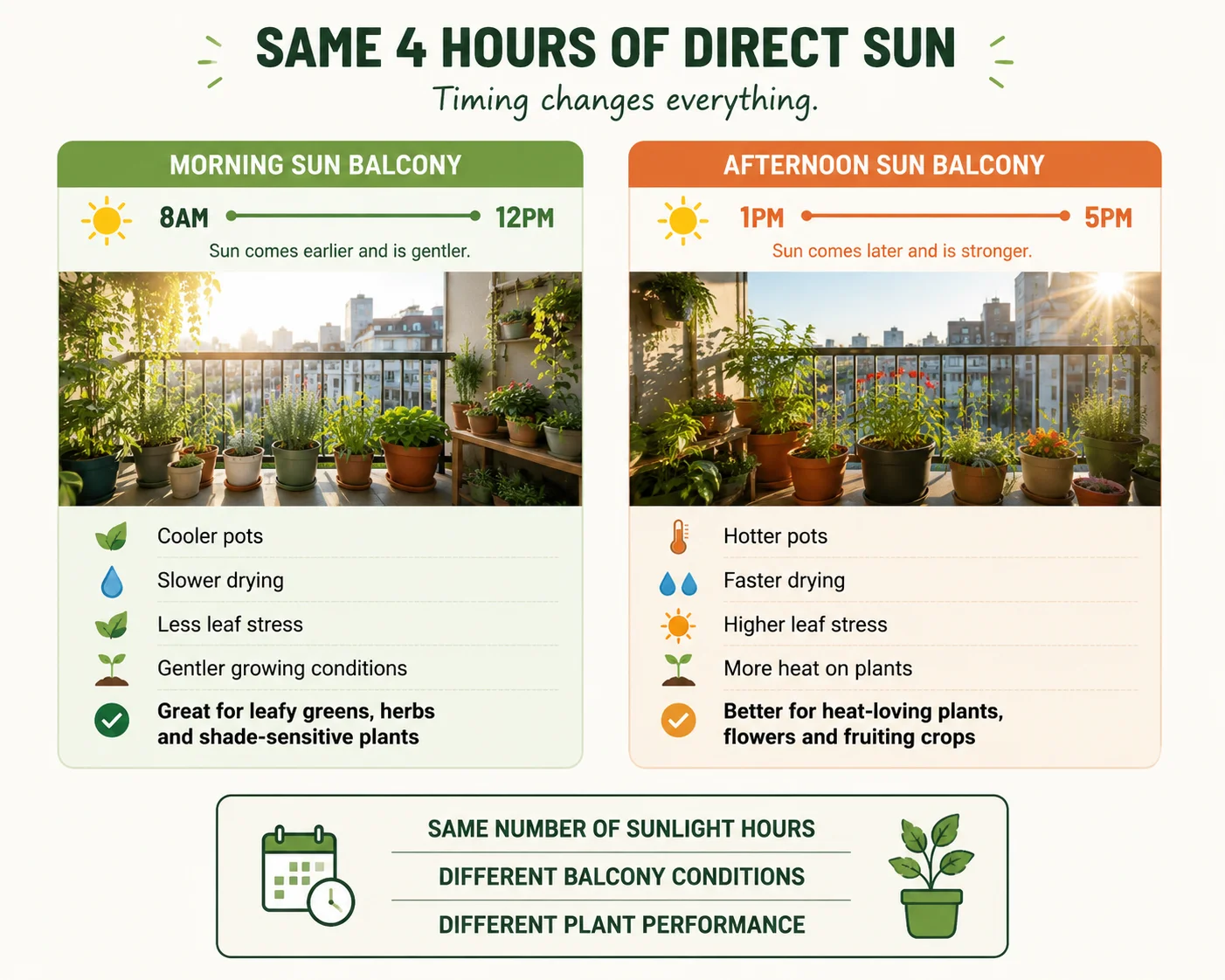
This is why a plant labelled for partial sun may cope well with four hours from 8 am to midday but struggle with four hours from 1 pm to 5 pm.
Decision moment: If your balcony receives mostly morning sun, choose plants based mainly on the number of sunlight hours. If it receives strong afternoon sun, also consider heat tolerance, pot colour, container size and watering speed.
Plants that naturally enjoy gentler light may be better suited to the early part of the day. The guide to potted plants that like morning sun includes options for these softer balcony conditions.
How Buildings Change Balcony Sunlight
Nearby buildings can shorten, block or redirect direct sunlight, creating several light zones on the same balcony throughout the day.
Balcony direction gives a useful clue, but surrounding buildings can be more important than the compass direction alone.
An east-facing balcony may be expected to receive morning sun. However, a tower directly across from it may block the early light. A north-facing balcony in Australia may have good sun exposure, but a deep roof can prevent that light from reaching pots placed near the apartment door.
Building shadows also move. A section beside the railing may receive direct sun at 9 am, become shaded at midday, then receive reflected brightness from another wall later in the day.
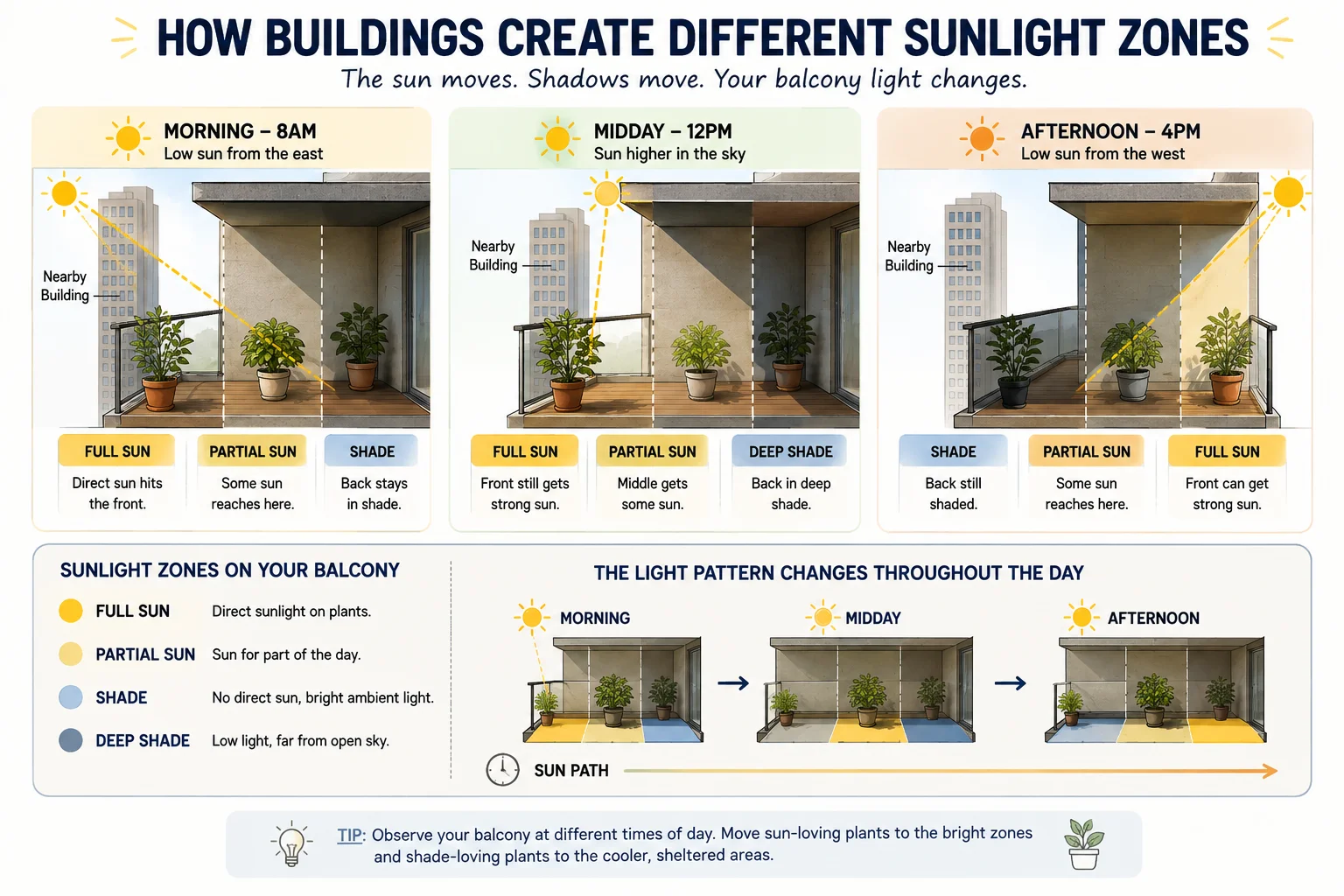
The useful lesson is that a balcony does not always have one fixed light level. It can contain several small sunlight zones. Recognising these zones allows you to place plants more carefully instead of expecting every pot to handle the same conditions.
Quick placement choice: Use the railing edge for plants needing more direct sun, the middle area for partial-sun plants, and the sheltered back for foliage plants that prefer bright shade.
What to Grow at Each Sunlight Level
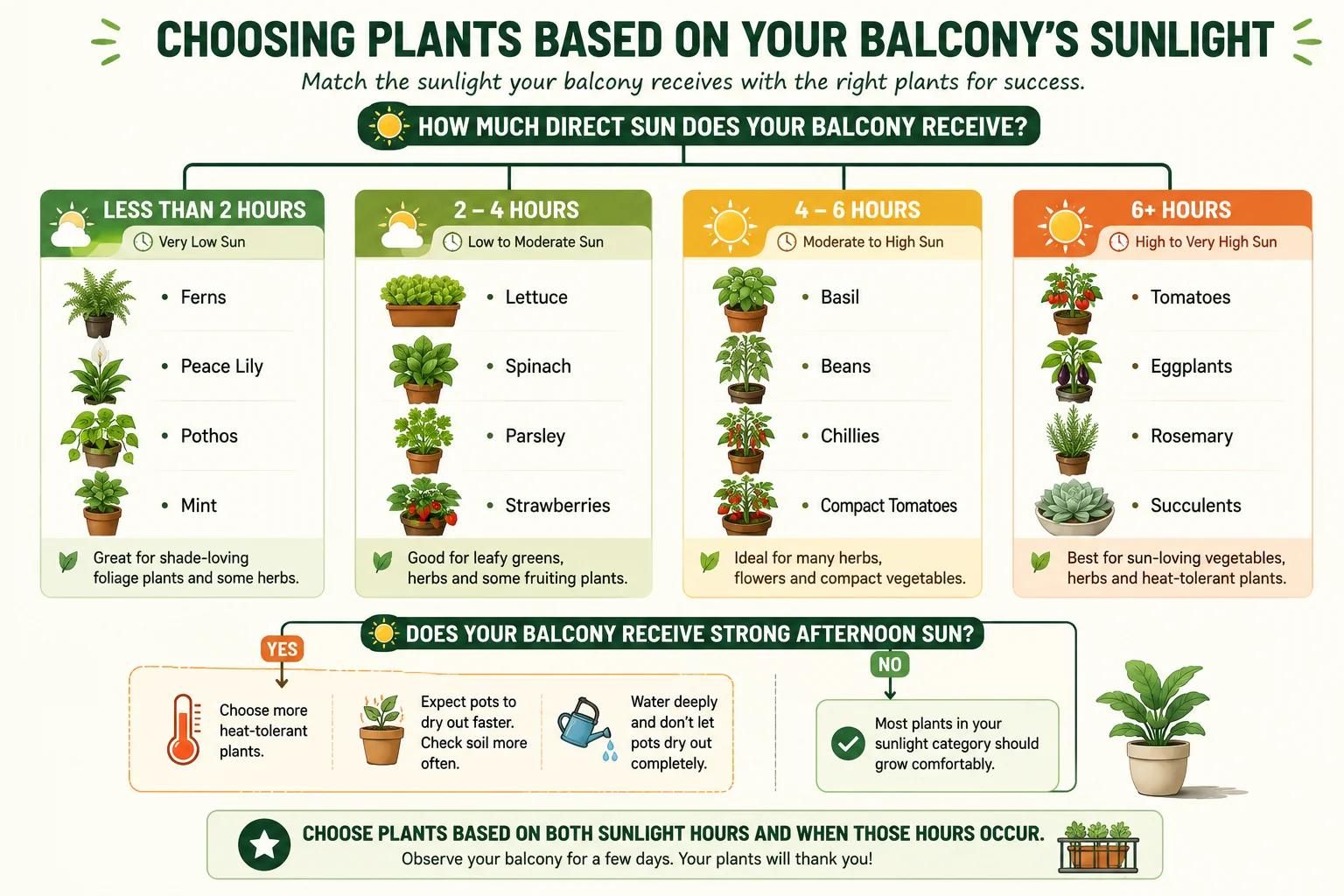
Choose foliage plants for very low sun, leafy vegetables and herbs for two to four hours, compact vegetables and flowers for four to six hours, and sun-loving crops for six or more hours.
When people ask, “How Much Sun Does My Balcony Garden Need?”, the most useful answer depends on what they want to grow. A foliage garden, herb garden and fruiting vegetable garden do not need exactly the same conditions.
Less than two hours of direct sun
With less than two hours of direct sun, focus mainly on foliage plants, shade-tolerant herbs and leafy greens rather than heavy-flowering or fruiting crops.
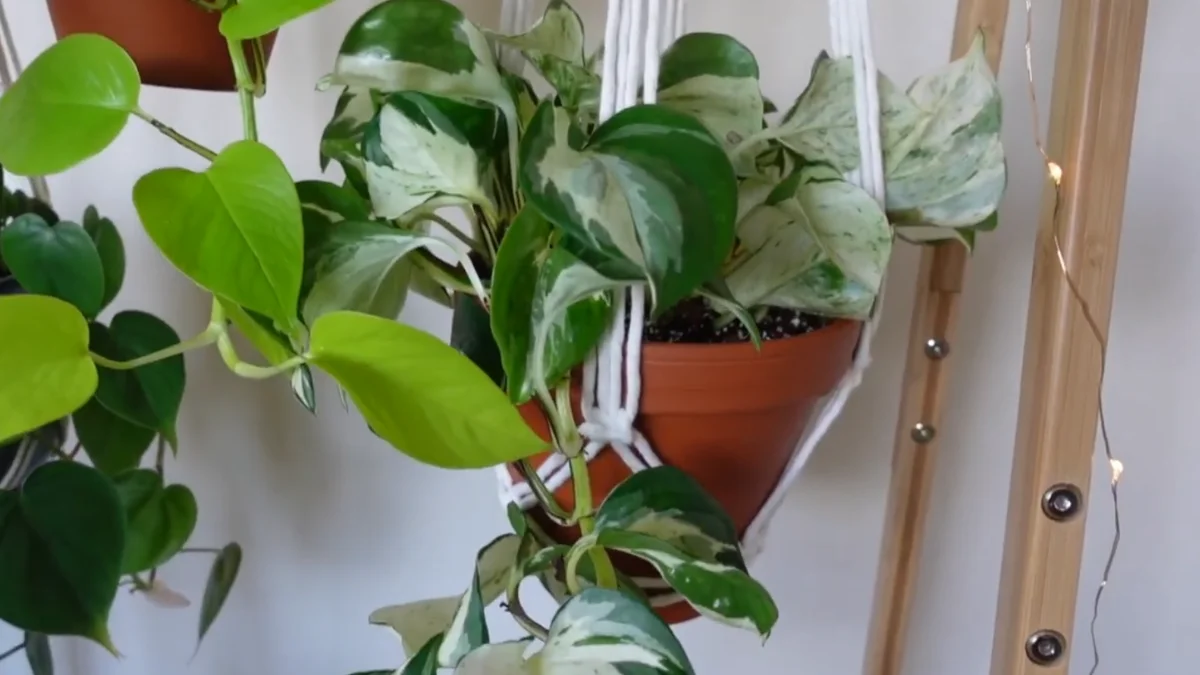
Ferns, pothos, peace lilies, cast iron plants and some other foliage plants can be realistic choices where outdoor brightness is still good.
Mint, parsley and some leafy greens may also grow, although they may be slower and less dense. Deep, dark shade will be harder than a bright covered balcony with a wide view of the sky.
Two to four hours of direct sun
Two to four hours of direct sun can be enough for lettuce, spinach, parsley, mint, chives, begonias and some strawberries, especially when the light arrives in the morning.
This range can support a useful small balcony garden, particularly when the sunlight arrives in the morning.
Basil may grow if the space is bright and warm, but it may become stretched if the light is weak. Fruiting vegetables may produce leaves without producing many flowers or fruit.
Four to six hours of direct sun
Four to six hours of direct sun suits many herbs, flowers, beans, chillies, strawberries and compact tomato varieties.
This is a flexible range for many balcony plants. These plants can grow well when pot size, watering, temperature and airflow are also suitable.
Tomatoes and other fruiting plants may still produce less than plants receiving longer sun, particularly if buildings block much of the bright sky around them. Positioning them near the brightest safe edge can help.
Six or more hours of direct sun
Six or more hours of direct sun can suit tomatoes, eggplants, chillies, rosemary, thyme, succulents and many flowering plants, but containers may dry and overheat quickly.
More sun is not always easier on a balcony.
Containers may need closer watering checks, especially in summer. Black plastic pots, thin metal containers and small hanging baskets can become hot quickly. Strong wind can increase drying even further.
The article on balcony plants for full sun includes options that are better matched to exposed, sunny spaces.
Choose your next plant:
- If you want foliage, you can usually work with lower light.
- If you want herbs and leafy vegetables, aim for at least two to four useful hours.
- If you want flowers, chillies or compact tomatoes, aim for around four to six hours.
- If you want strong tomato or eggplant production, use the brightest safe position available.
A reader with four hours of gentle morning sun can usually follow the partial-sun plant path. Someone with four hours of harsh west-facing sun should also consider heat-tolerant plants and faster pot drying.
What Your Plants Can Tell You About the Light
Plants may need more light when they grow tall and weak, lean strongly towards one side or produce healthy leaves but very few flowers. Brown patches and afternoon wilting may point to excessive heat or sudden sun exposure.
Sunlight measurements are useful, but plants also provide clues. A single symptom does not always prove that the light is wrong, so consider water, roots, heat and pests as well.
| What You Notice | Possible Light Meaning | What Else to Check | Practical Response |
|---|---|---|---|
| Long, weak stems leaning towards one side | The plant may be reaching for stronger light | Overcrowding and excess fertiliser | Move it gradually towards a brighter position |
| Healthy leaves but very few flowers | The plant may not receive enough useful direct sun | Plant age, feeding and season | Use the brightest available spot and avoid heavy shade |
| Brown or pale patches on exposed leaves | The sunlight may be too sudden or intense | Hot glass, dry soil and reflected heat | Add gentle shade or move the plant back from the hottest edge |
| Leaves wilt mainly in the afternoon | Heat and water loss may be stronger than the plant can manage | Pot size, root health and wind | Check the soil before watering and protect the pot from intense heat |
| Potting mix remains wet for many days | The position may be too shaded or cool for quick drying | Blocked drainage and an oversized pot | Reduce watering frequency rather than watering by schedule |
| Leaves look green but growth is very slow | The plant may be surviving rather than actively growing | Cold weather, compacted soil and limited root space | Compare growth after moving it to brighter indirect light |
Simple decision: If growth is stretched or flowering is poor, try a brighter position. If leaves burn, fade or wilt during the hottest part of the day, move the plant slightly back or provide gentle afternoon protection.
A plant growing tall and thin may be receiving enough light to remain alive but not enough to develop strong, compact growth. This is explained further in why balcony plants grow tall but weak.
Different Balcony Situations
The best plant position depends on whether the balcony is covered, glass-fronted, open, semi-enclosed or surrounded by nearby buildings.
The best sunlight approach depends on the shape and exposure of the balcony, not only its direction.
Deep covered balconies
The railing edge may receive useful sun while the back remains in shade. Taller plants near the front can accidentally shade smaller plants behind them. Use the brightest edge for plants needing direct sun and the protected back area for shade-tolerant foliage.
Glass-fronted balconies
Clear glass can allow sunlight through while reducing airflow. The space may become warmer than expected. Frosted or tinted glass may soften direct light, but it can still reflect heat around pots.
Small open balconies
These spaces may receive strong light and wind together. Plants can dry quickly because both leaves and pots lose moisture. A larger container may stay more stable than several tiny pots.
Semi-enclosed balconies
These balconies often contain strong contrasts. One side may be warm and bright while another stays cool and still. Treat them as several small growing zones rather than one uniform space.
Balconies surrounded by buildings
Direct sun may arrive only during a short gap between buildings. The balcony can still be bright through reflected light, but fruiting plants may not receive enough direct energy for strong production.
Choose by balcony type: Covered balconies usually need shade-tolerant choices near the back. Open balconies need plants that tolerate sun and wind. Glass-fronted balconies need plants that can handle heat. Semi-enclosed balconies often benefit from using several different plant zones.
Practical Ways to Use the Sun You Have
You can improve plant light without changing the balcony by moving pots to better positions, using height carefully and preventing taller plants from shading smaller ones.
You do not need to rebuild the balcony to improve how plants use available light. Small placement changes can make a noticeable difference.
- Place fruiting and flowering plants in the brightest safe position.
- Keep shorter plants in front of taller plants so they are not shaded.
- Use shelves to lift sun-loving pots above a solid railing.
- Move heat-sensitive plants slightly back during harsh summer afternoons.
- Rotate pots occasionally if growth leans strongly towards one direction.
- Use light-coloured surfaces carefully to improve brightness without creating intense reflected heat.
- Check the potting mix rather than increasing water automatically when sunlight changes.
When floor space is limited, good arrangement can help each plant receive a more suitable amount of light. The guide on organising balcony pots for maximum sunlight explains how height and spacing can reduce accidental shade.
Common Sunlight Mistakes
The most common balcony sunlight mistakes are counting general brightness as direct sun, judging the entire balcony from one spot and assuming that more sun is always better.
Sunlight mistakes often happen because balcony conditions are judged using simple garden labels. The labels are helpful, but they do not describe the entire balcony microclimate.
- Counting outdoor brightness as direct sun. A balcony can look bright while the sun never touches the leaves.
- Judging the whole balcony from one spot. The railing, floor, shelves and back wall may all receive different amounts of light.
- Ignoring the time of day. Four hours of morning sun can feel very different from four hours of late-afternoon sun.
- Assuming more sun is always better. Intense sun can overheat containers and increase water stress.
- Following the balcony direction alone. Roof depth, neighbouring buildings and walls may completely change the expected light.
- Moving a shaded plant straight into strong sun. Leaves that developed in shade may burn when exposed too suddenly.
When changing a plant’s position, move it gradually where possible. A few days in a brighter protected area can be gentler than placing it immediately beside a hot west-facing railing.
How Balcony Sun Changes With the Seasons
Balcony sunlight changes through the year because the sun’s angle changes, affecting how far direct light reaches under roofs and between nearby buildings.
The sun sits higher or lower in the sky at different times of year. This changes how far sunlight reaches under the balcony roof.
In summer, the sun may sit high enough for the roof above to shade much of a deep balcony. At the same time, the railing edge can become intensely hot. In winter, the lower sun angle may reach further into the balcony even though the weather is cooler.
Nearby trees can also change the pattern. A deciduous tree may create shade during warmer months but allow more light through after losing its leaves.
Because of these changes, do not assume a sunlight measurement made in one month will remain exact all year. You do not need to measure constantly, but it is useful to check again when a season brings noticeable changes in plant growth, drying speed or heat.
Seasonal decision: Recheck your sunlight pattern when plants suddenly stretch, stop flowering, dry much faster or begin receiving direct sun in a place that was previously shaded.
Balcony Haven Note: I have noticed that the brightest-looking part of a balcony is not always the place receiving the most useful direct sun. Sometimes a narrow strip beside the railing gets several strong hours while the rest stays in bright shade, so I find it more helpful to observe each plant position separately.
Frequently Asked Questions
How Much Sun Does My Balcony Garden Need?
Many balcony gardens can grow successfully with two to six hours of direct sunlight per day. Leafy plants and shade-tolerant foliage may manage with less, while tomatoes, eggplants and other fruiting plants usually perform better with four to six hours or more. Sun intensity, heat and time of day also matter.
Is four hours of sun enough for a balcony garden?
Four hours can be enough for herbs, leafy vegetables, strawberries, flowers and some compact fruiting plants. Gentle morning sun is usually easier to manage than four hours of strong afternoon heat. Fruiting plants may grow but produce less than they would in longer sunlight.
Does indirect sunlight count for balcony plants?
Bright indirect light is useful, especially for foliage plants and shade-tolerant herbs. However, it does not provide the same growing conditions as direct sun. Plants that need strong flowering or fruit production usually benefit from some direct sunlight.
Can I grow vegetables on a balcony with only morning sun?
Yes. Leafy vegetables, herbs, spring onions, lettuce and spinach can be realistic choices. Chillies, beans, strawberries and small tomatoes may also grow when the morning light lasts several hours and the balcony remains bright afterwards.
How can I tell whether my balcony gets full sun?
Observe the exact growing position throughout a clear day. If direct sunlight reaches that spot for about six hours or more, it can generally be treated as full sun. Also consider whether the light is gentle, intensely hot or increased by reflected heat.
Why do my balcony plants struggle even though they get enough sun?
Sunlight is only one part of the balcony microclimate. Plants may also struggle because of hot pots, strong wind, reflected heat, poor drainage, limited root space, crowded placement or watering that does not match the drying speed.
Final Thoughts
How much sun a balcony garden needs depends on the plants you want to grow and the type of sunlight your balcony receives. A shaded foliage garden can need far less direct sun than a balcony filled with tomatoes, chillies and flowering plants.
As a practical starting point, less than two hours suits shade-tolerant choices, two to four hours can support leafy plants and many herbs, four to six hours gives you more vegetable and flower options, and six or more hours suits many sun-loving plants when heat and watering are managed carefully.
The most useful step is to observe the actual growing positions rather than relying only on balcony direction or plant-label wording. Notice where the sun lands, when it arrives, how hot the pots become and how quickly the potting mix dries.
Your balcony does not need an ideal amount of sunlight to become a useful garden. It needs plants that match the light it already has. Once you understand the different sunlight zones within your space, plant choice and placement become much easier, and small changes can lead to healthier, more reliable growth.
Leave a Reply