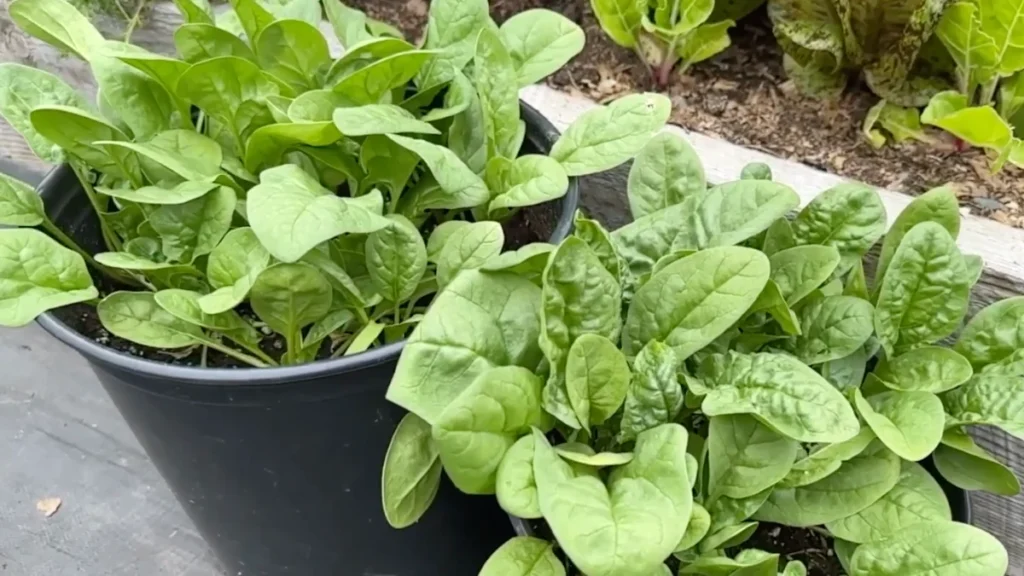
Spinach for low light balconies can feel confusing because many growing guides are written for open gardens, sunny raised beds, or vegetable patches with steady daylight. A balcony is different. It may look bright during the day, but the actual light reaching the plant can be much weaker than it first appears.
Spinach can grow on a low-light balcony when the space receives bright indirect light, gentle partial shade, or a few hours of soft sun. It usually grows slower than spinach in full sun, and the leaves may stay smaller, but it can still give useful harvests when the balcony stays cool, bright enough, and evenly moist.
Most problems happen when low light is mistaken for no light. Spinach can cope with less sun than fruiting vegetables, but it still needs enough brightness to make leaves. If the balcony is dim, enclosed, or shaded for most of the day, growth may become weak or very slow.
This article explains what actually works for spinach in low-light balcony spaces, how to understand your balcony light, where to place pots, and what expectations are realistic for small apartment gardens.
Why Low-Light Balconies Behave Differently
Low-light balconies are not all the same. Some receive bright open-sky light for most of the day, even without direct sun. Others are shaded by roof overhangs, privacy screens, neighbouring buildings, glass barriers, or nearby trees.
This matters because spinach responds to the amount of usable light reaching its leaves, not just the direction the balcony faces. A balcony can feel bright to a person but still be weak for plant growth if the light is mostly blocked or scattered.
Balconies also have other limits that change how spinach grows. Pots hold less soil than garden beds, wind can dry leaves quickly, and shaded corners may stay damp for longer than expected. These small conditions work together, so slow spinach growth is not always caused by light alone.
If your balcony receives very little direct sun, this guide on gardening on balconies with no direct sun can help you understand the wider growing conditions beyond spinach.
What Most Spinach Advice Misses
Many spinach guides say that spinach tolerates shade, but they do not always explain what kind of shade. This is where balcony gardeners can feel disappointed. Bright shade, partial shade, and deep shade are very different growing conditions.
In a garden bed, spinach may receive open sky, reflected light, and some morning or afternoon sun. On a balcony, the plant may sit under a roof, behind a railing, beside a wall, or several metres back from the balcony edge. The same plant can grow very differently depending on where the pot sits.
Another missed point is that low light changes expectations. Spinach may still grow, but it may take longer to reach harvest size. The leaves may be smaller, softer, and slower to replace after picking. That does not mean the plant is failing. It means the balcony is shaping the growth pattern.
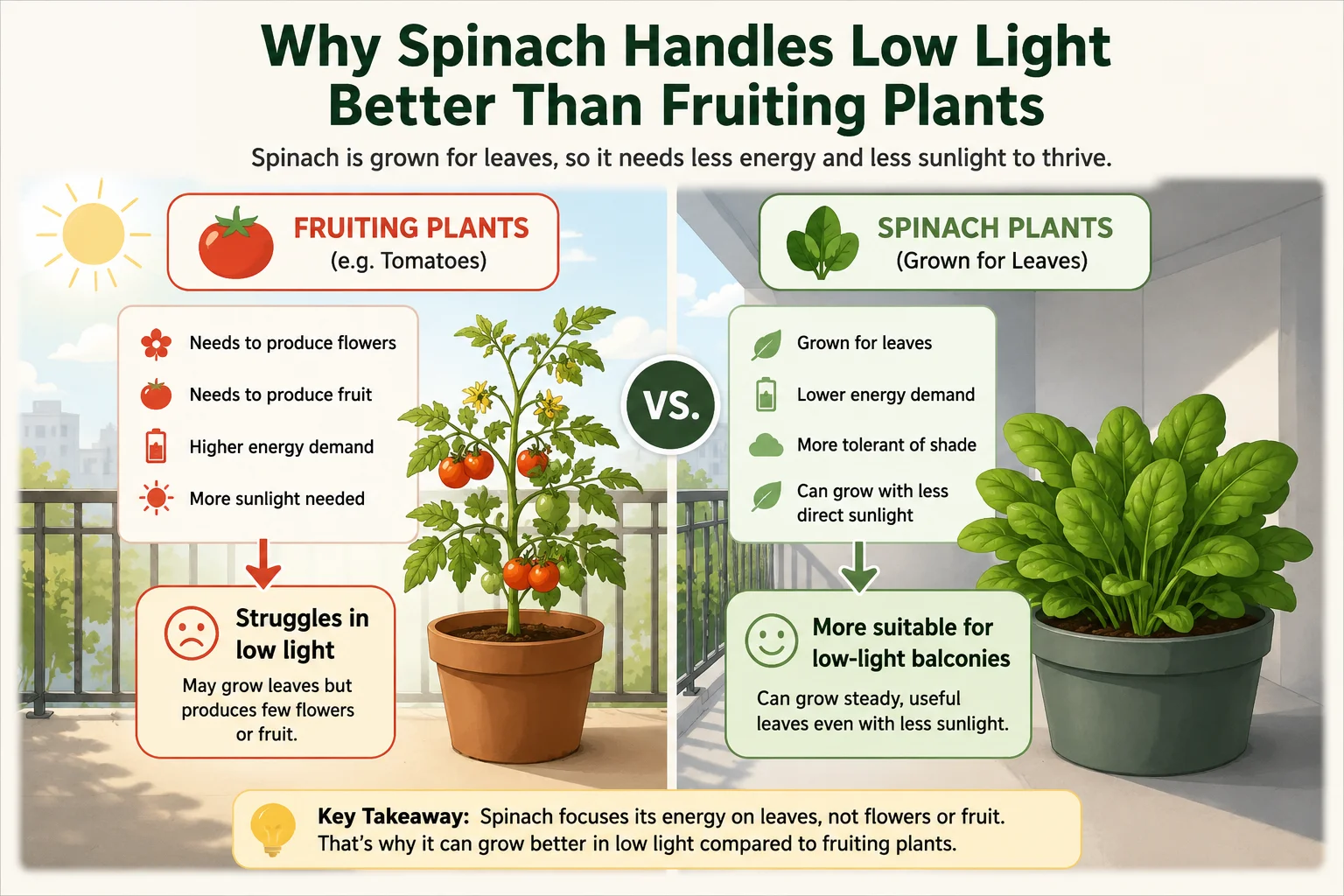
Why Spinach Handles Lower Light Better Than Fruiting Plants
Spinach is one of the better edible plants for low-light balconies because it is grown for leaves. It does not need to produce flowers, fruit, or large stems before it becomes useful.
This gives spinach an advantage over crops like tomatoes, cucumbers, eggplants, and strawberries. Fruiting plants need more energy because they must grow leaves first, then flowers, then fruit. Spinach only needs enough energy to keep producing usable leaves.
This does not mean spinach grows well in darkness. It still needs light to make food for itself. But compared with many balcony vegetables, spinach is more forgiving when the light is bright but not sunny.
Bright Indirect Light vs Partial Shade vs Deep Shade
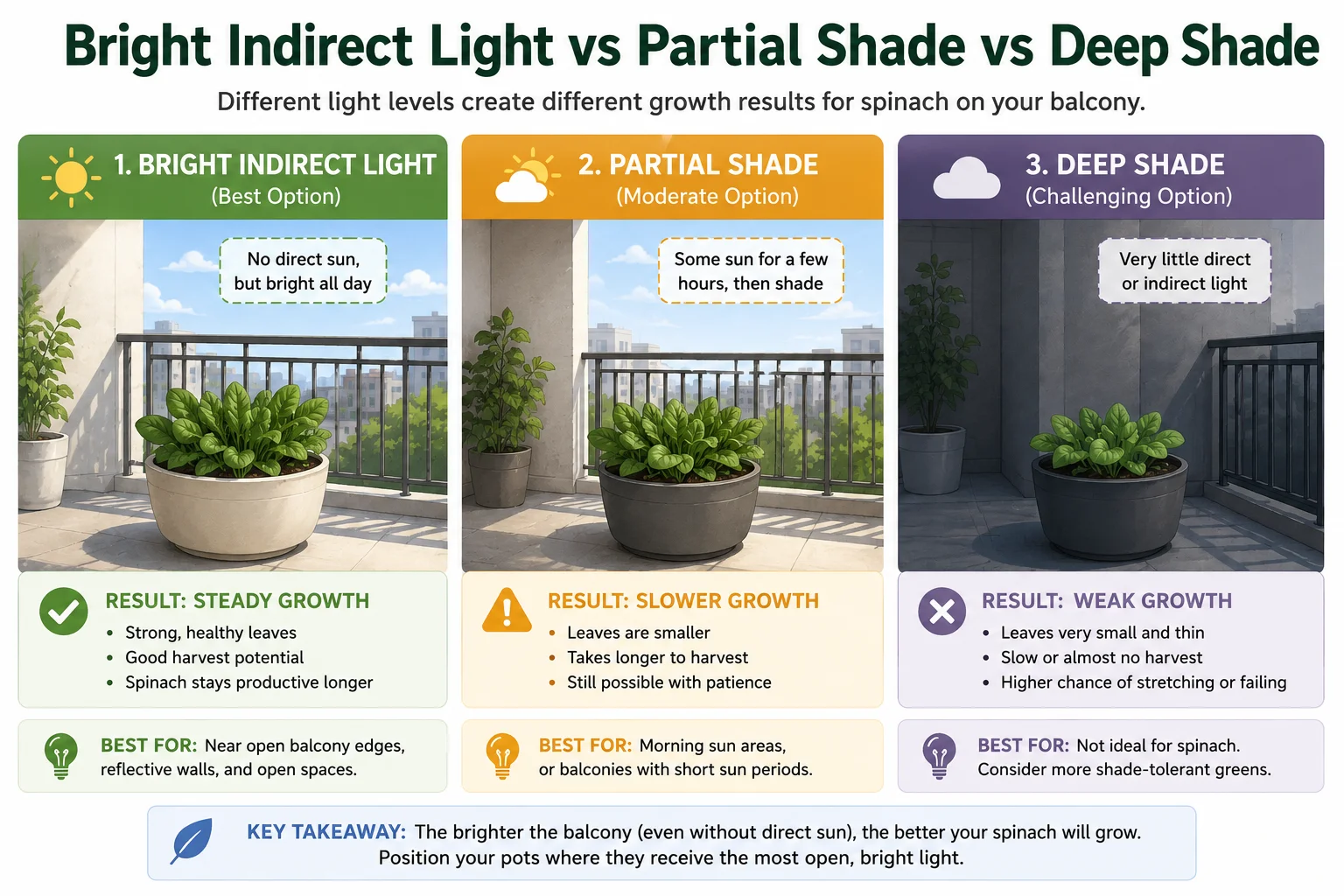
One of the most useful things to understand is the difference between bright indirect light, partial shade, and deep shade.
Bright indirect light means the balcony is not receiving strong direct sun, but the space still feels open and bright for much of the day. This often happens when light reflects from pale walls, nearby windows, open sky, or bright flooring.
Partial shade usually means the balcony gets some direct or filtered sun, often for a short period, then shade for the rest of the day. Spinach can often manage this well, especially when the sun is gentle morning light rather than harsh afternoon heat.
Deep shade is different. This is when the balcony stays dim most of the day, often because it is enclosed, heavily covered, surrounded by buildings, or blocked by screens. Spinach may survive in deep shade for a while, but it often grows weak, thin, and slow.
If you are unsure which light type your balcony has, this article on how to measure sunlight on a balcony can help you judge the space more clearly.
How Balcony Light Levels Affect Spinach Growth
Spinach can grow across different balcony light levels, but the result will not be the same in every spot. The table below gives a realistic guide to what low-light balcony gardeners can expect.
| Balcony Light Level | What It Usually Means | Spinach Growth Result | Realistic Expectation |
|---|---|---|---|
| 3–4 hours gentle direct sun | Often morning sun or soft seasonal sun | Strongest growth | Larger leaves and faster harvests. |
| Bright indirect light most of the day | No direct sun, but the balcony stays bright | Steady growth | Smaller but usable leaves with patience. |
| Partial shade | Short sun period or filtered light | Moderate to slow growth | Good results if the balcony stays cool and bright. |
| Mixed shade with brief light | Some light reaches the plant, but not consistently | Slow growth | Harvests may be small and take longer. |
| Deep shade | Dim, enclosed, or blocked light most of the day | Weak growth | Spinach may struggle to produce useful leaves. |
This is why two people can grow spinach on balconies and get very different results. The word “shade” may be the same, but the actual amount of usable light can be very different.
Best Balcony Locations for Growing Spinach
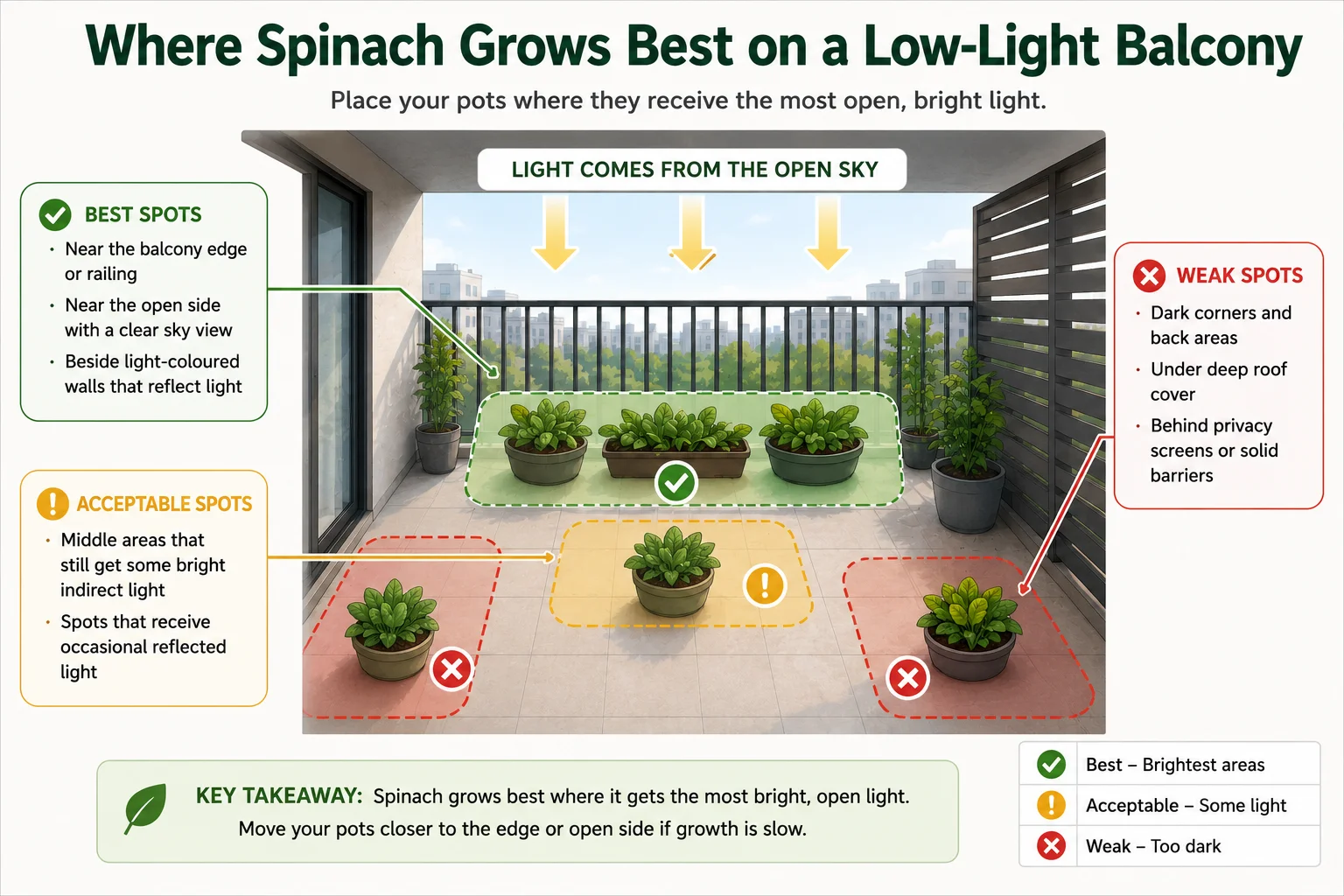
On a low-light balcony, pot placement can matter as much as the plant itself. A spinach pot near the balcony edge may receive more open-sky light than the same pot pushed against a back wall.
The brightest area is often near the railing, beside a pale wall, or close to the open side of the balcony. These spots may catch more reflected daylight and airflow. Spinach placed in these areas usually has a better chance of steady growth than spinach placed in a dark corner.
Balcony orientation can also influence results. North-facing balconies often receive stronger light in many Australian apartments, while south-facing balconies may stay cooler and receive less direct sun. However, the actual amount of light reaching the spinach matters more than direction alone because nearby buildings, walls, coverings, and privacy screens can change the growing conditions significantly.
Covered balconies can still work if the front of the balcony is bright. The deeper the pot sits under the cover, the weaker the light usually becomes. On enclosed balconies, airflow also matters because damp soil and still air can slow growth or encourage fungal problems.
If your balcony is covered but still bright, this guide on best plants for covered balconies with light may help you compare other plants that cope with similar conditions.
Choosing Containers for Low-Light Spinach
Container depth becomes more important when light is limited. Spinach does not need a huge pot, but it does need enough soil depth to hold steady moisture and support healthy roots.
A shallow pot can dry unevenly, especially near balcony edges where wind moves across the soil. A deeper container gives roots a more stable space, which helps the plant cope better when growth is already slowed by lower light.
For most balcony spinach, a pot around 20–25 cm deep is a useful starting point. Wider planters can also work well because spinach can be spaced without overcrowding. Good spacing helps leaves receive more light and keeps airflow moving between plants.
For a deeper look at container depth, this article on deep vs shallow pots for balcony veggies explains why pot depth affects root comfort, moisture, and growth in small spaces.
Soil and Moisture in Shaded Balcony Pots
Low-light balconies often dry more slowly than sunny balconies. This can help spinach because it prefers even moisture, but it can also create problems when soil stays wet for too long.
Overwatering is easy in shaded spaces because the top of the soil may look dry while the lower part of the pot is still damp. Constantly wet soil reduces air around the roots and can make spinach grow slower, even if the leaves look green.
A free-draining potting mix is useful because it holds enough moisture without becoming heavy and waterlogged. Drainage holes also matter because water needs somewhere to go after rain or watering.
If your balcony pots often stay wet or dry unevenly, this guide on drainage tips for small balcony containers can help you understand how water behaves inside balcony pots.
How Spinach Compares With Other Low-Light Balcony Crops
Spinach is not the only edible plant that can cope with lower light. Leafy greens and some herbs usually have a better chance than fruiting plants because they do not need as much energy to produce a useful harvest.
| Plant | Low-Light Tolerance | Growth Speed in Low Light | Best Balcony Use |
|---|---|---|---|
| Spinach | High | Moderate | Cool, bright shade or partial shade. |
| Lettuce | High | Fast to moderate | Shaded planters and gentle light. |
| Silverbeet | High | Moderate | Deeper pots and steady moisture. |
| Kale | Medium | Moderate to slow | Cooler balconies with brighter light. |
| Parsley | Medium to high | Moderate | Bright shade and small herb pots. |
| Basil | Lower | Slow in shade | Better with brighter warmth and some sun. |
| Tomatoes | Low | Poor in low light | Needs stronger sun for flowers and fruit. |
For more shade-friendly plant options, the article on best plants for shaded apartment balconies gives a broader view of plants that usually cope better in low-light apartment spaces. If your balcony is shaded because of its direction, this guide on best plants for a north facing balcony may also help you compare realistic plant choices for bright shade and cooler balcony conditions.
Practical Insights for Low-Light Spinach
Spinach is more forgiving than many balcony crops, but small conditions still make a noticeable difference when light is limited.
- Bright shade is usually better than a dark corner.
- Gentle morning sun is often more useful than harsh afternoon heat.
- Even moisture helps more than frequent watering.
- Good airflow matters because shaded pots can stay damp longer.
- Regular small harvests are more realistic than waiting for very large leaves.
- Slow growth is normal when the balcony receives less usable light.
These are not strict rules. They are simple patterns that often show up when spinach is grown in small, shaded balcony spaces.
Common Misunderstandings About Spinach in Shade
Most confusion comes from expecting low-light spinach to behave the same way as spinach grown in a bright garden bed.
- “Low light” does not mean “no light.” Spinach still needs brightness.
- Healthy green leaves do not always mean fast growth is coming.
- Small leaves are not always a sign of poor care in shaded spaces.
- More water does not fix slow growth caused by weak light.
- Fertiliser cannot replace missing daylight.
- A shaded balcony can still become hot if airflow is poor.
These misunderstandings can lead to overwatering, moving pots too often, or giving up too early. In low light, spinach often needs more patience than intervention.
Seasonal Considerations for Australian Balconies
In many Australian apartments, spinach is easier during the cooler parts of the year. Autumn, winter, and early spring can suit spinach because the plant prefers mild conditions and is less likely to bolt quickly.
A low-light balcony may even become useful during warmer months because it protects spinach from harsh sun. However, shaded summer balconies can still become humid, warm, and still. When this happens, airflow and drainage become more important.
Seasonal changes can also shift where the brightest spot is. A pot that grows well in one season may need a brighter position later as the sun angle changes.
Balcony Haven Note: I have noticed that spinach can be surprisingly forgiving in low-light balcony spaces, but the difference between bright shade and dim shade is very noticeable. On some balconies, moving a pot closer to the open edge can make the plant look steadier, while another balcony may still feel too enclosed for strong growth.
Frequently Asked Questions
Can spinach grow on a balcony without direct sunlight?
Spinach can grow without direct sunlight if the balcony still receives bright indirect light for much of the day. If the space is dim or heavily enclosed, growth may be weak and harvests may be small.
How much sun does spinach need on a balcony?
Spinach usually grows best with a few hours of gentle sun or strong bright shade. It does not need full sun like many fruiting vegetables, but it still needs enough light to produce steady leaves.
Why is my balcony spinach growing slowly?
Slow growth is common when light is limited. It can also happen when pots stay too wet, containers are too shallow, plants are overcrowded, or the balcony has poor airflow.
Is spinach better than lettuce for low-light balconies?
Spinach and lettuce can both work well in low-light balcony spaces. Lettuce may grow faster in some conditions, while spinach often handles cooler shaded areas well and can provide repeated small harvests.
Can spinach grow on a north-facing balcony?
Spinach can grow on a north-facing balcony if the space is bright enough. An open north-facing balcony with bright shade is more suitable than a deep, enclosed, or heavily covered balcony.
Does spinach need a deep pot on a balcony?
Spinach does not need a very large pot, but a container around 20–25 cm deep usually gives the roots more stable moisture and space than a very shallow tray.
Final Thoughts
Spinach for low light balconies works best when expectations match the space. It is one of the more realistic edible plants for shaded apartments, but it still needs brightness, airflow, steady moisture, and enough container depth to grow well.
A low-light balcony does not have to be a failed growing space. It simply behaves differently from a sunny garden bed. Spinach may grow slower, produce smaller leaves, and need more patience, but it can still be worthwhile when the balcony is bright enough.
While spinach may not grow as quickly as it would in a sunny garden bed, it remains one of the most realistic edible crops for apartment gardeners working with limited sunlight.
The most helpful approach is to observe where the light is strongest, understand the difference between bright shade and deep shade, and treat slow growth as information rather than failure. Once the plant matches the balcony conditions, spinach becomes much easier to understand.
Leave a Reply