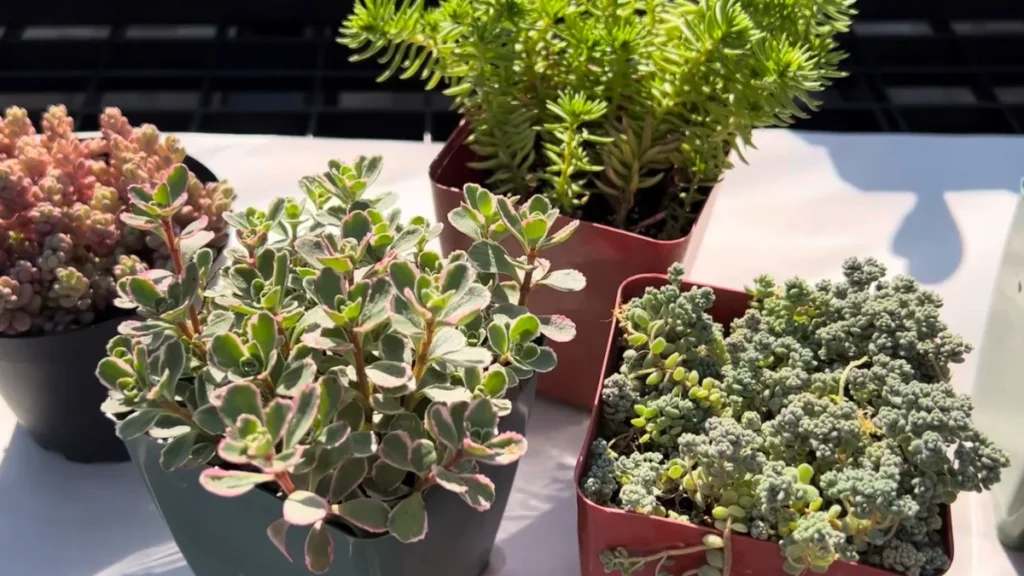
Succulents are often described as easy outdoor plants, which can make balcony gardening feel simple at first. They store water, tolerate dry soil, and usually cope better with neglect than many leafy plants. But a balcony is not the same as a garden bed, and that difference matters more than many people expect.
Many succulents can stay outside on a balcony when they have bright light, fast-draining soil, and containers that do not stay wet for too long. Aloe, sedum, echeveria, jade plants, and sempervivum are some of the most realistic outdoor balcony succulents because they can handle sun, dry soil, and changing container conditions better than many delicate varieties.
The difficult part is not simply choosing a plant labelled “succulent.” It is matching the plant to the way your balcony behaves. A hot west-facing balcony, a windy high-rise balcony, and a cool shaded balcony can all affect succulents differently.
This article explains what succulents can stay outside on a balcony, how balcony conditions affect them, which types are worth choosing, and what common mistakes make outdoor succulents struggle in small containers.
Why Balconies Are Different for Succulents
Succulents naturally cope with dry conditions, but balconies add extra pressure that is easy to miss. The plant may be outdoors, but its roots are not in open ground. They are sitting inside a container that heats, cools, dries, and drains differently from garden soil.
A pot on a balcony can heat quickly during the day, especially if it sits near a wall, glass door, dark floor, or metal railing. The soil may dry on top while the lower part of the pot still holds moisture. This can confuse watering because the surface may look dry even when the root zone is not ready for more water.
Wind also changes the way succulents behave outside. A high balcony or exposed apartment corner may dry pots faster than expected. It may also tip over light containers or damage shallow-rooted plants. If your balcony gets regular gusts, this guide on the best plants for a windy balcony can help you compare plants that cope better with airflow.
Light is another important difference. Some balconies receive hot afternoon sun, while others receive bright but indirect light. A succulent that looks strong in a nursery may stretch, fade, or burn if the balcony light does not match what it needs.
What Most Succulent Advice Misses
Most succulent advice assumes the plant is growing in a garden, rockery, sunny patio, or large outdoor space. That advice can still be useful, but it does not always explain what happens when the same plant grows in a small balcony pot.
In the ground, surrounding soil protects roots from sudden temperature changes. On a balcony, the whole root system sits inside a container. This means the roots can warm quickly in strong sun, cool quickly overnight, and stay wetter than expected after rain if the potting mix is too dense.
This is why a succulent that can “stay outside” may still fail on one balcony and do well on another. The difference is often not the plant label. It is the mix of light, wind, drainage, reflected heat, and container size.
Succulents That Can Stay Outside on a Balcony
The best balcony succulents are usually the ones that tolerate outdoor light, dry soil, and container life without needing constant attention. They still need the right setup, but they are more forgiving than many delicate or rare succulents.
The table below gives a simple overview of five practical choices for outdoor balcony containers.
| Succulent | Best Balcony Light | Balcony Strength | Why It Works Outside |
|---|---|---|---|
| Aloe | Full sun to partial sun | Heat tolerant | Stores water well and adapts to outdoor containers. |
| Sedum | Full sun to bright light | Wind tolerant | Naturally suits rocky, exposed, fast-draining conditions. |
| Echeveria | Bright light or morning sun | Compact growth | Fits small pots and grows slowly in balcony spaces. |
| Jade Plant | Full sun to partial sun | Durable leaves | Handles dry periods and becomes sturdy over time. |
| Sempervivum | Full sun | Temperature resilient | Handles outdoor changes better than many soft succulents. |
Aloe
Aloe is one of the most practical succulents for outdoor balcony pots. It grows upright, stores water in thick leaves, and usually handles bright light better than many soft-leaved indoor plants.
Aloe can suit sunny balconies, warm balconies, and apartments where watering may not happen on a strict schedule. Its shape also helps in small spaces because it grows upward rather than spreading across the floor.
Strong sun can sometimes turn aloe leaves reddish, brownish, or slightly stressed-looking. This does not always mean the plant is dying. It can be a sign that the plant is reacting to stronger outdoor light. If your balcony is cool rather than hot, this article on growing aloe vera on a cold-facing balcony gives more specific context.
Sedum
Sedum is a strong choice for balconies because many types naturally grow in exposed, rocky, dry places. This makes them useful for containers that dry quickly or receive strong light.
Some sedum varieties stay low and compact, while others trail over the edge of planters. Trailing sedum can be especially useful on small balconies because it adds greenery without needing a deep or wide container.
Sedum is also one of the better choices for windy balconies. Its growth is often low and flexible, so it is less likely to behave like a tall plant catching wind.
Echeveria
Echeveria is popular because of its neat rosette shape. It suits small balcony containers because it grows slowly and does not usually need much space.
It often does best with bright light, morning sun, or gentle direct sun. Very harsh afternoon sun can sometimes mark or stress the leaves, especially if the plant was moved outside too quickly.
Echeveria is a good option for balconies where space is limited and the plant can sit in a bright, open position without being battered by strong wind or heavy rain.
Jade Plant
Jade plant is often treated as an indoor plant, but it can grow well outdoors in balcony containers when the conditions are suitable. It has thick leaves, strong stems, and a slow-growing habit that suits apartment spaces.
Over time, jade can become more shrub-like, which gives a balcony planting area some structure. It is also forgiving if watering is sometimes a little irregular.
Jade plants can become top-heavy as they grow, so the pot matters. A slightly heavier container can help keep the plant stable, especially in windy spaces.
Sempervivum
Sempervivum, often called hens and chicks, is one of the toughest outdoor succulents. It naturally handles changing temperatures better than many soft succulents.
It grows in small rosettes and slowly fills the pot by producing offsets. This makes it useful for shallow containers, bowl planters, and small balcony arrangements.
Sempervivum usually prefers good light and excellent drainage. It can cope with outdoor changes, but it may struggle if the pot stays wet for too long after rain.
Which Succulent Matches Your Balcony Conditions?
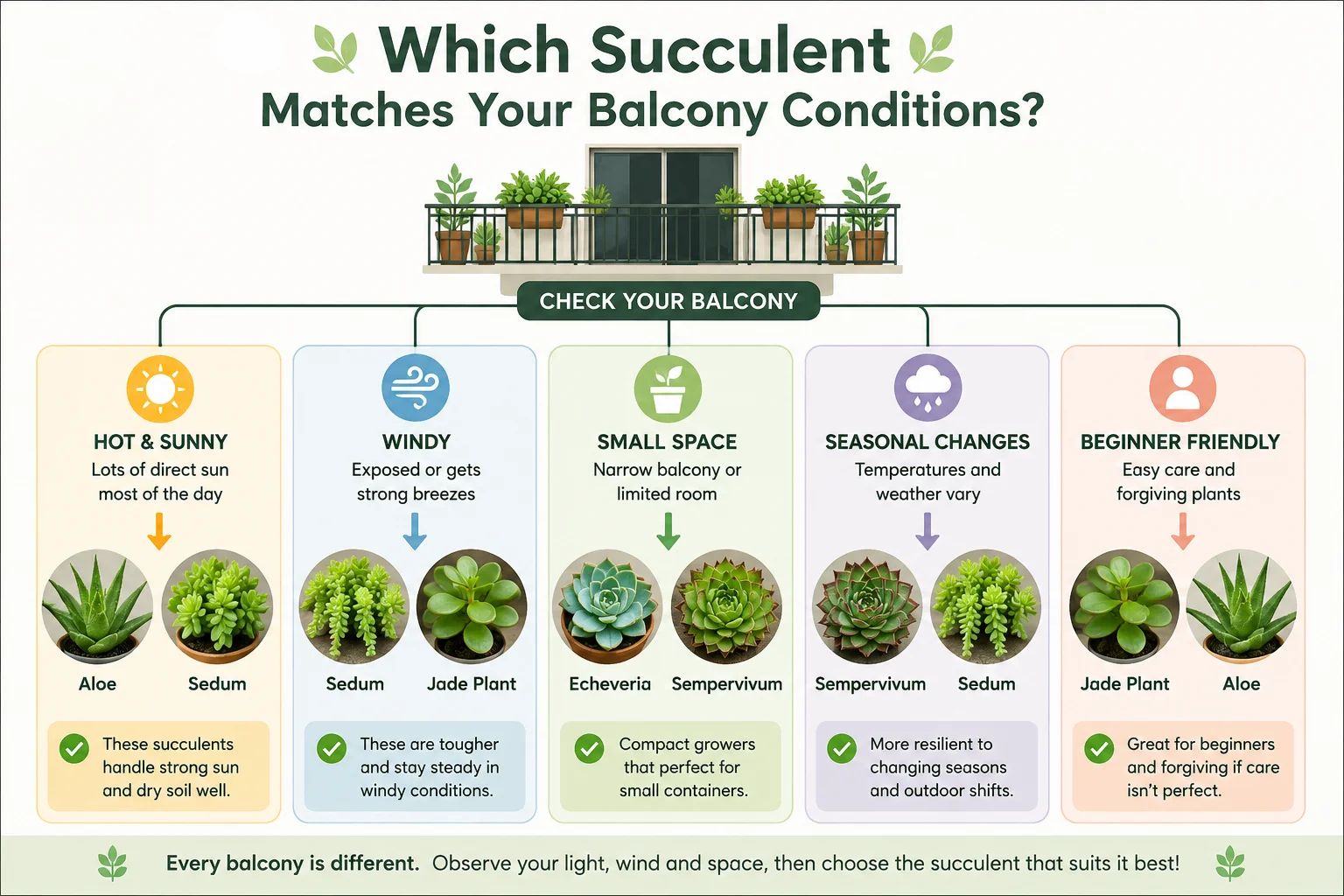
Choosing the right succulent becomes easier when you start with your balcony conditions rather than the plant name. A succulent that suits a hot, open balcony may not be the best choice for a cool, covered balcony.
| If Your Balcony Is… | Succulents That Usually Adapt Well | Why They Suit That Space |
|---|---|---|
| Hot and sunny | Aloe, Sedum | They handle strong light and dry soil better than many soft succulents. |
| Windy or exposed | Sedum, Jade Plant | Sedum stays low, while jade becomes sturdy in a stable pot. |
| Small and narrow | Echeveria, Sempervivum | They stay compact and suit shallow or small containers. |
| Bright but not very hot | Echeveria, Jade Plant | They can manage bright outdoor light without needing extreme heat. |
| Seasonally changeable | Sempervivum, Sedum | They are more tolerant of outdoor shifts than many delicate succulents. |
| Beginner-friendly setup | Jade Plant, Aloe | They are forgiving and give visible signs when conditions change. |
If your balcony receives strong sun for much of the day, this guide on drought-tolerant plants for hot balconies can help you compare succulents with other heat-friendly plants.
How Balcony Conditions Affect Succulent Survival
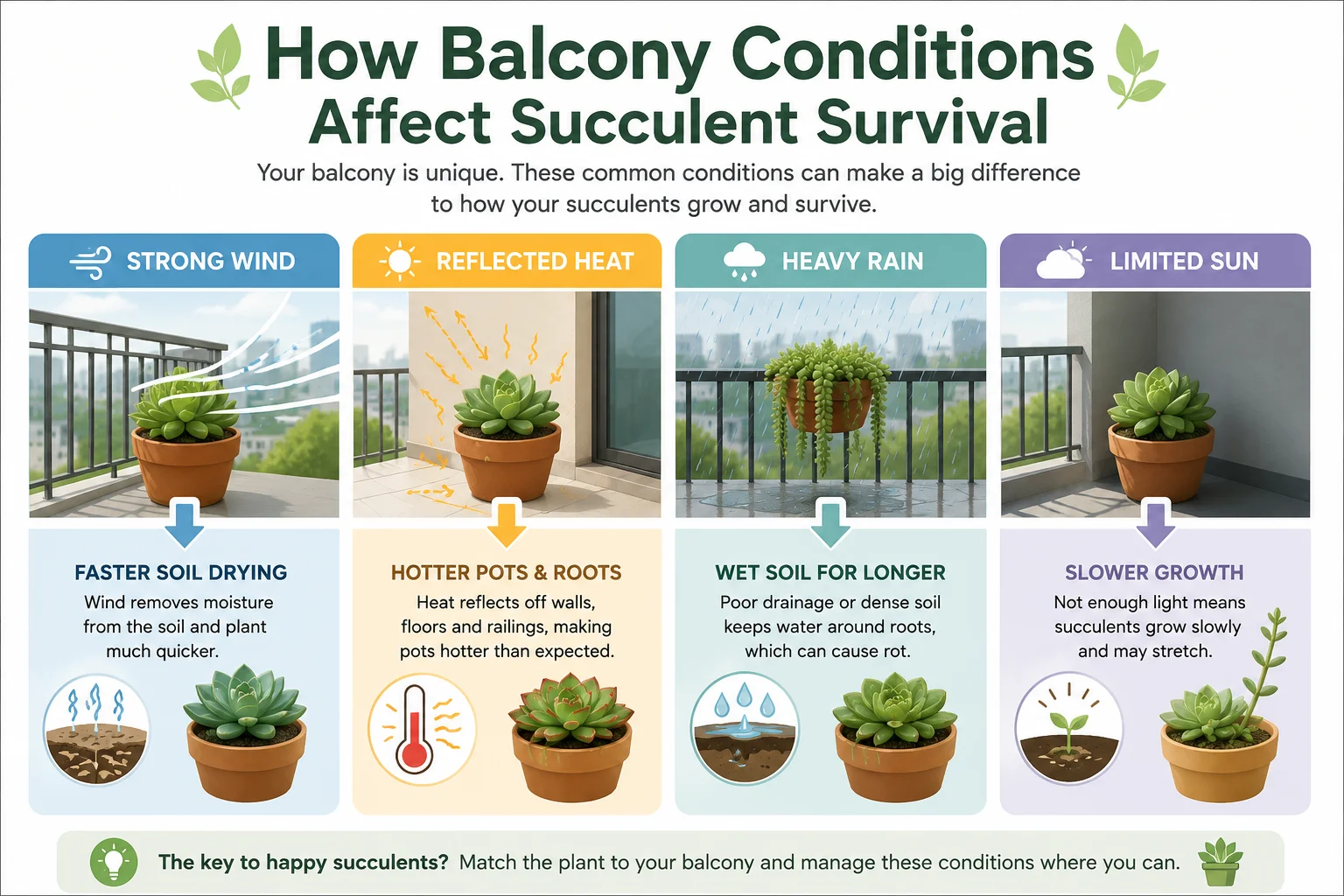
Outdoor succulents usually struggle for a reason. On balconies, the reason is often connected to how the space changes light, heat, wind, rain, and soil moisture.
Strong wind can dry the top of the pot quickly, even while moisture remains lower down. This can lead to overwatering if the surface is used as the only guide. Strong wind can also make light pots unstable, especially with taller jade plants or upright aloe.
Reflected heat can be another hidden issue. Walls, windows, tiles, concrete, and metal railings can bounce heat back onto the plant. Succulents like warmth, but roots in small containers can still become stressed when pots heat too quickly.
Rain can also be more complicated on balconies than it first appears. A covered balcony may receive almost no rain, while an exposed railing planter may become soaked during storms. Good drainage is important because wet roots cause more trouble for succulents than dry soil. For more help with this, see drainage tips for small balcony containers.
Limited sun creates a different problem. Some succulents survive in bright shade but slowly stretch toward the light. This stretched growth is often a sign that the plant is alive but not receiving enough direct or bright light to stay compact. If you are unsure how much sun your balcony receives, this article on how to measure sunlight on a balcony is a useful place to start.
Outdoor Succulent Tolerance Comparison
Not all balcony-friendly succulents tolerate the same conditions. Some handle wind better. Some suit small pots better. Some cope with rain better only when drainage is excellent.
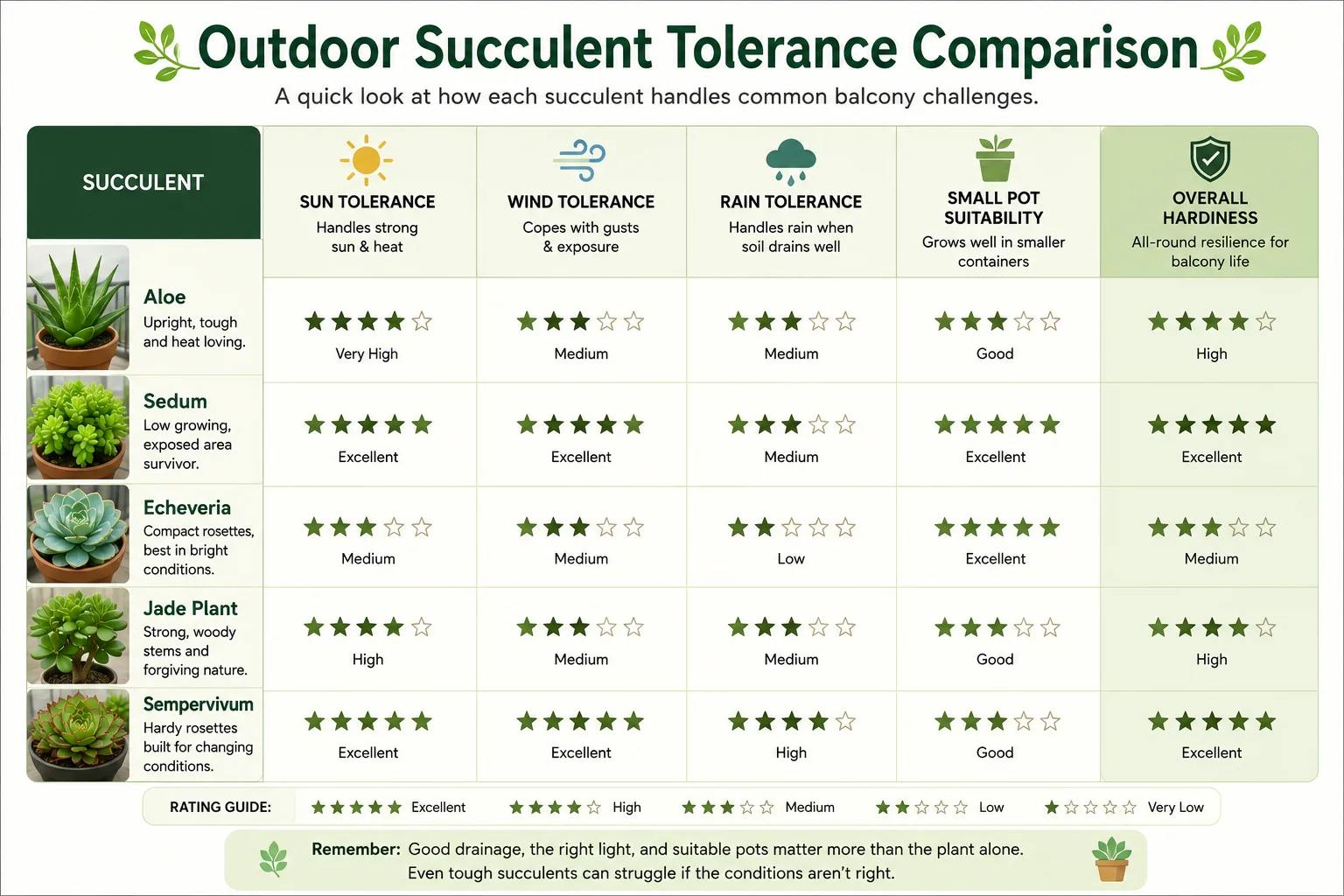
No succulent scores perfectly in every category, which is why matching the plant to your balcony conditions usually matters more than choosing the toughest-looking succulent.
| Succulent | Sun Tolerance | Wind Tolerance | Rain Sensitivity | Small Pot Suitability |
|---|---|---|---|---|
| Aloe | High | Medium | Medium | Good |
| Sedum | High | High | Medium | Excellent |
| Echeveria | Medium | Medium | Higher sensitivity | Excellent |
| Jade Plant | High | Medium | Medium | Good |
| Sempervivum | High | High | Lower sensitivity with good drainage | Good |
This comparison is a starting point, not a strict rule. A sedum in a soggy pot can still struggle, while an echeveria in a bright, sheltered, fast-draining pot may do very well.
Practical Tips for Outdoor Balcony Succulents
Outdoor succulents usually become easier to manage when the container setup supports their natural behaviour. They prefer dry periods, bright light, and roots that are not trapped in wet soil.
- Use pots with drainage holes so water can escape after rain or watering.
- Choose a well-draining succulent or cactus-style potting mix.
- Use slightly heavier pots for windy balconies.
- Place compact succulents near brighter railing areas when light is limited.
- Let the potting mix dry between waterings rather than watering on a fixed schedule.
- Move plants gradually into stronger outdoor sun to reduce leaf stress.
Soil drying can be confusing in balcony pots because wind and heat change the surface quickly. This guide on balcony soil drying out too fast explains why container soil behaves differently in apartment spaces.
Common Mistakes When Keeping Succulents Outside
Most outdoor succulent problems on balconies come from treating all succulents the same. They may share water-storing leaves, but they do not all enjoy the same mix of sun, rain, wind, and pot size.
- Using dense garden soil that holds water around the roots.
- Putting soft succulents into harsh afternoon sun too quickly.
- Watering because the soil surface looks dry, even when the lower pot is still damp.
- Using very small pots that heat up quickly in strong sun.
- Keeping rain-sensitive succulents where storms soak the pot repeatedly.
- Choosing lightweight pots on windy balconies without considering stability.
These mistakes are common because many succulents look tough. The plant may survive dry soil well, but it can still suffer when roots stay wet, when heat builds around the pot, or when light changes too suddenly.
Seasonal Context That Matters
Succulents respond strongly to seasonal changes, even when they are growing in containers. During warm months, balcony pots can heat faster and dry faster. Some succulents may grow more actively, while others may show sun-stress colours if the light becomes intense.
In cooler months, growth often slows. Water usually stays in the pot longer, especially on shaded or covered balconies. This is why winter problems are sometimes caused by wet soil rather than cold alone.
Rain also changes through the year. A succulent that does well outside in dry weather may struggle during long wet periods if the potting mix stays damp. On balconies, seasonal care is less about following a strict calendar and more about noticing how fast each container dries.
Balcony Haven Note: I have noticed that balcony succulents often succeed because they tolerate small mistakes better than many leafy plants, not because they need no attention at all. One balcony may dry pots in a single day, while another may keep the same pot damp for several days, so the same succulent can behave differently in each space.
Frequently Asked Questions
Can succulents stay outside all year on a balcony?
Some succulents can stay outside all year in mild balcony conditions, especially if they have bright light and excellent drainage. In very cold, wet, or exposed conditions, some types may need temporary protection.
Do outdoor succulents need direct sunlight?
Many outdoor succulents prefer some direct sun, but not all need harsh afternoon sun. Aloe, sedum, jade, and sempervivum usually enjoy strong light, while echeveria often does better with bright light or gentler morning sun.
Can rain damage succulents in balcony pots?
Rain can damage succulents when the pot stays wet for too long. Occasional rain is usually not a problem if the container drains well and the potting mix does not hold excess water.
Do succulents grow well in small balcony containers?
Many succulents grow well in small balcony containers because they stay compact and do not need deep soil. Echeveria, sedum, and sempervivum are especially useful for small pots, shallow bowls, and narrow balcony planters.
Why is my outdoor succulent stretching on the balcony?
Stretching usually means the succulent is reaching for more light. It may still be alive, but the balcony position may be too dim for that plant to stay compact.
Which succulent is best for a windy balcony?
Sedum is one of the better succulent choices for windy balconies because many varieties stay low and compact. Jade plants can also work if they are grown in a stable, heavier pot.
Final Thoughts
Succulents can be excellent outdoor balcony plants, but the best choice depends on the balcony itself. Aloe, sedum, echeveria, jade plants, and sempervivum are all realistic options when they are matched to the right light, wind, pot, and drainage conditions.
The main thing to remember is that balconies behave differently from gardens. Containers heat faster, dry differently, catch wind differently, and hold rainwater differently. A succulent that is tough outdoors still needs a pot setup that lets its roots breathe.
Once the plant and balcony match each other, succulents can become some of the most stable and low-stress plants to grow outside in small apartment spaces.
Leave a Reply