Plants for cold south-facing balconies can feel difficult to choose because these balconies often look bright enough for plants, but still feel cool, shaded, and slow-growing. Many apartment gardeners try healthy plants from the nursery, only to see them sit still for weeks, drop leaves, or stay small even with regular care.
Plants for cold south-facing balconies include ferns, cast iron plants, snake plants, peace lilies, spider plants, mint, parsley, lettuce, spinach, and some Asian greens. These plants cope better because they can handle lower light, cooler air, and slower soil drying. The most reliable choices are usually leafy, shade-tolerant plants rather than sun-loving vegetables or heavy-flowering plants.
The confusing part is that a south-facing balcony can still feel open and usable for people, while being difficult for plants that need warmth and direct sun. Containers also cool down faster than garden soil, and shaded balcony corners can stay damp for longer than expected.
This article explains why cold south-facing balconies behave differently, which plants are most realistic, where to place them, and what signs show that a plant may be too cold or too shaded for the space.
Why Cold South-Facing Balconies Feel Different
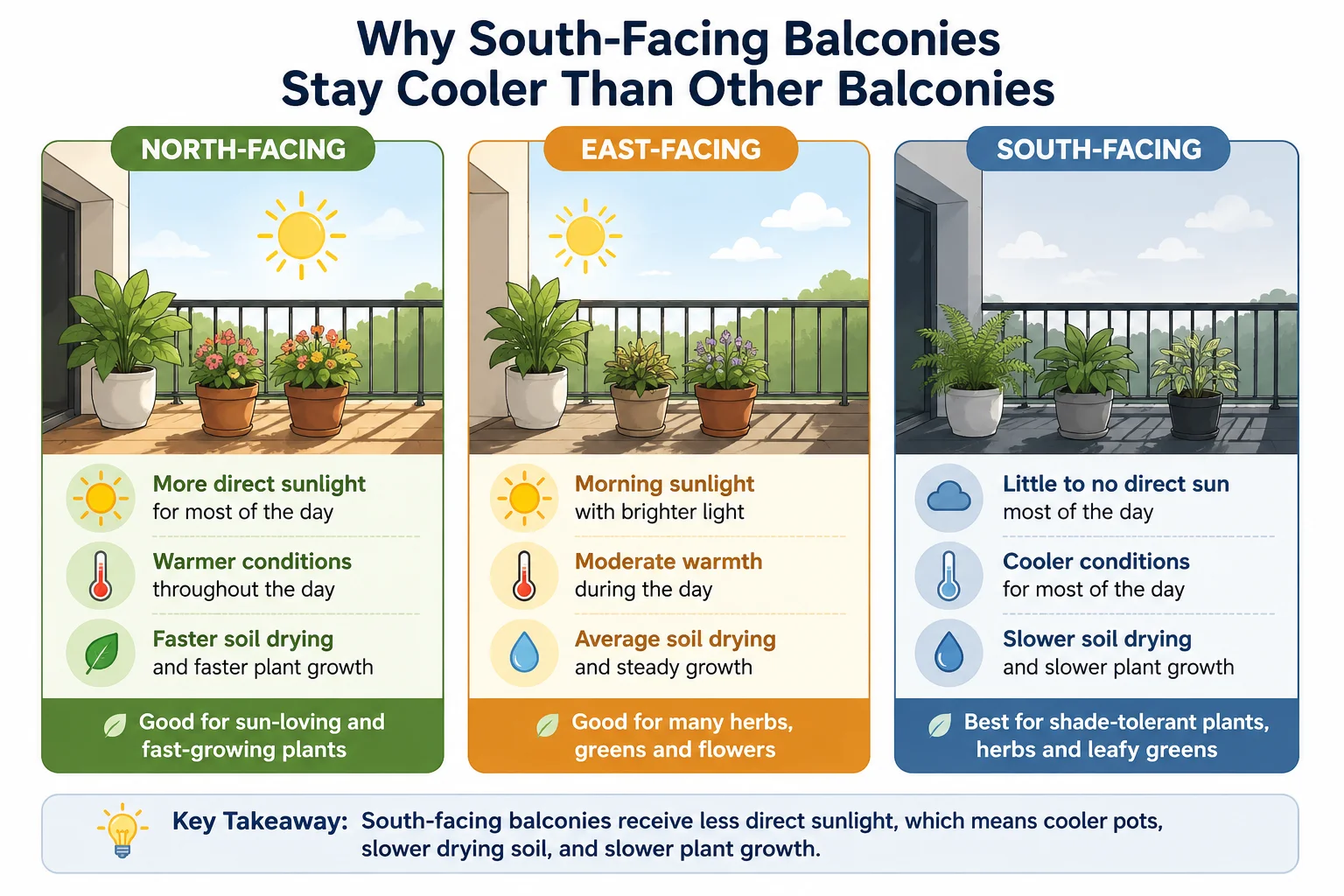
A cold south-facing balcony is not just a normal outdoor space with less sun. It has its own small climate. In many Australian apartments, south-facing balconies receive little direct sunlight, especially during cooler months. The balcony may still look bright, but much of that light is indirect or reflected.
This matters because plants use light for growth. When light is soft and temperatures stay low, plants usually grow more slowly. New leaves may take longer to appear. Herbs may stay smaller. Leafy greens may grow, but not as fast as they would in a warmer, brighter position.
Balcony surfaces can also make the space feel colder. Concrete floors, tiled surfaces, metal railings, and shaded walls may hold less warmth than garden soil. A plant in a container is more exposed to these changes because the roots are above ground and surrounded by air.
Wind can make this worse. Even a gentle breeze between apartment buildings can remove warmth from leaves and pots. This is why a south-facing balcony that feels only mildly cool to a person can still feel stressful for a warmth-loving plant.
What Most Plant Advice Misses About These Balconies
Many plant guides are written for garden beds, patios, or open yards. Those spaces usually have more soil volume, more sky exposure, and more natural warmth. A balcony is different because the plant is growing in a pot, surrounded by walls, ceilings, railings, and nearby buildings.
This is why advice like “give it partial shade” can be confusing. Partial shade in a garden may still include strong open light. Partial shade on a south-facing balcony may mean cool indirect light for most of the day. Those two conditions can produce very different plant growth.
Another thing most advice misses is how slowly cold balcony pots dry out. In a sunny garden, water may leave the soil quickly. On a cold south-facing balcony, the same pot may stay damp for days. This can make people water again too soon, which increases the risk of weak roots, yellow leaves, and root problems.
If your balcony has very little direct sun, this guide on gardening on balconies with no direct sun may also help you understand what still works in lower-light spaces.
Best Plants for Cold South-Facing Balconies
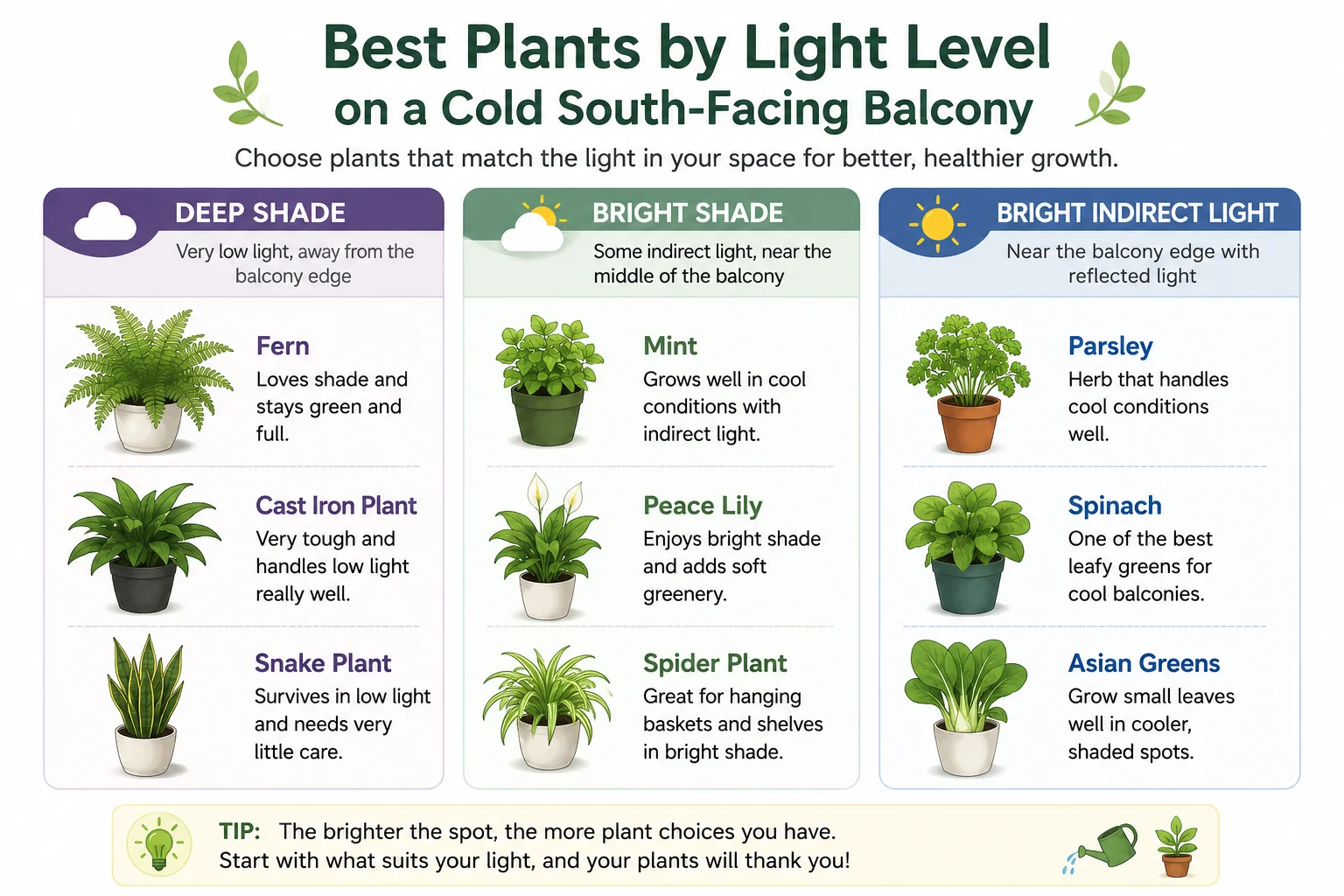
The best plants for cold south-facing balconies are usually plants that do not rely on long hours of direct sun. They tend to grow for leaves rather than fruit, flowers, or large harvests. This makes them more realistic for cool, shaded balcony conditions.
The table below gives a simple comparison of plants that are worth considering for this type of balcony.
| Plant | Best Balcony Light | Cold Tolerance | Best Use | Realistic Expectation |
|---|---|---|---|---|
| Fern | Bright shade to shade | Good | Foliage and soft greenery | Steady leaf growth if moisture is balanced. |
| Cast iron plant | Low light to bright shade | Good | Low-maintenance foliage | Very slow but reliable in shaded areas. |
| Snake plant | Low light to bright indirect light | Moderate | Upright container plant | Survives well, but grows slowly in cold shade. |
| Peace lily | Bright shade | Moderate | Foliage and occasional flowers | Can do well if protected from wind and cold extremes. |
| Spider plant | Bright shade to indirect light | Moderate | Hanging baskets or shelves | Good for sheltered spots with gentle light. |
| Mint | Bright shade to partial shade | Good | Edible herb | Usually grows, but may be slower and less dense. |
| Parsley | Bright shade to partial shade | Good | Edible herb | Often reliable in cooler months with enough light. |
| Lettuce | Bright shade to soft light | Good | Leafy edible | Can grow slowly but suits cool balcony conditions. |
| Spinach | Bright shade to partial shade | Good | Leafy green | One of the better edibles for low-light cool balconies. |
| Asian greens | Bright shade to partial shade | Good | Small edible greens | Best grown as small leaves rather than large plants. |
Not every plant will perform the same on every south-facing balcony. Building height, nearby walls, balcony depth, wind exposure, and seasonal sunlight can all change the results, even when the plant list looks suitable.
For a wider low-light plant comparison, the article on best plants for shaded apartment balconies is a useful next step because it covers shaded balcony choices beyond south-facing spaces. If you are comparing balcony directions, this guide on best plants for a north facing balcony may also help explain how different balcony light patterns affect plant choice.
Foliage Plants That Usually Cope Best
Foliage plants are often the most reliable choice for a cold south-facing balcony because they are not trying to produce fruit or heavy flowers. They mainly need enough light to maintain healthy leaves, which is more realistic in shaded balcony conditions.
Ferns are a good example. They usually prefer cooler, shaded spaces and can look natural on balconies that feel too dim for many flowering plants. They still need care with watering, though. A cold balcony can keep potting mix damp for longer, so ferns need moisture without sitting in soggy soil.
Cast iron plants are useful when the balcony is quite shaded and the gardener wants something tough. They are not fast growers, but that is part of why they suit difficult spaces. A cast iron plant may not change much from week to week, but it can stay healthy where more delicate plants struggle.
Snake plants and spider plants can also work, especially in sheltered positions. Snake plants tolerate low light well, although cold wet soil can still cause problems. Spider plants usually prefer a brighter part of the balcony, such as near an open railing or a spot with strong reflected light.
Herbs That Handle Cool, Shaded Balconies
Herbs can be more difficult on cold south-facing balconies because many popular herbs prefer warmth and sun. Basil, rosemary, thyme, and oregano often struggle when the balcony stays cool and shaded for long periods.
Mint is one of the better choices because it tolerates cooler conditions and does not need strong sun to stay alive. It may grow more slowly in cold shade, but it can still provide useful leaves when the pot is not too wet. Because mint can spread strongly in containers, this guide on mint spreading in small balcony pots may help if you plan to grow it in a small space.
Parsley is another realistic herb for a cool balcony. It often handles mild winter conditions better than heat-loving herbs and can stay useful in a bright shaded spot. It may not grow as quickly as parsley in open sun, but it is more suitable than many Mediterranean herbs for this type of balcony.
If your balcony receives a little more light than deep shade, you may also find this article on best herbs for balconies with 3 hours of sun useful for comparing herbs that can manage limited sunlight.
Leafy Greens That Can Grow in Cooler Balcony Conditions
Leafy greens are usually more realistic than fruiting vegetables on cold south-facing balconies. Plants like tomatoes, cucumbers, chillies, and eggplants need much more light and warmth to produce well. In a cool shaded balcony, they may grow leaves but struggle to flower or fruit properly.
Lettuce, spinach, and small Asian greens are better matched to cooler balcony conditions because they are grown mainly for leaves. They do not need to produce large fruit, so their energy needs are lower.
Spinach can be one of the more useful choices for low-light balconies, especially when the balcony still receives bright shade. It may grow slowly, but slow growth is often normal in cool container conditions. This guide on spinach for low light balconies explains this in more detail.
Lettuce can also work, especially loose-leaf types. On a cold south-facing balcony, it is often better to think of lettuce as a small, steady crop rather than a fast-growing harvest. Asian greens can be grown in a similar way, especially if picked young.
Where to Place Plants on a Cold South-Facing Balcony
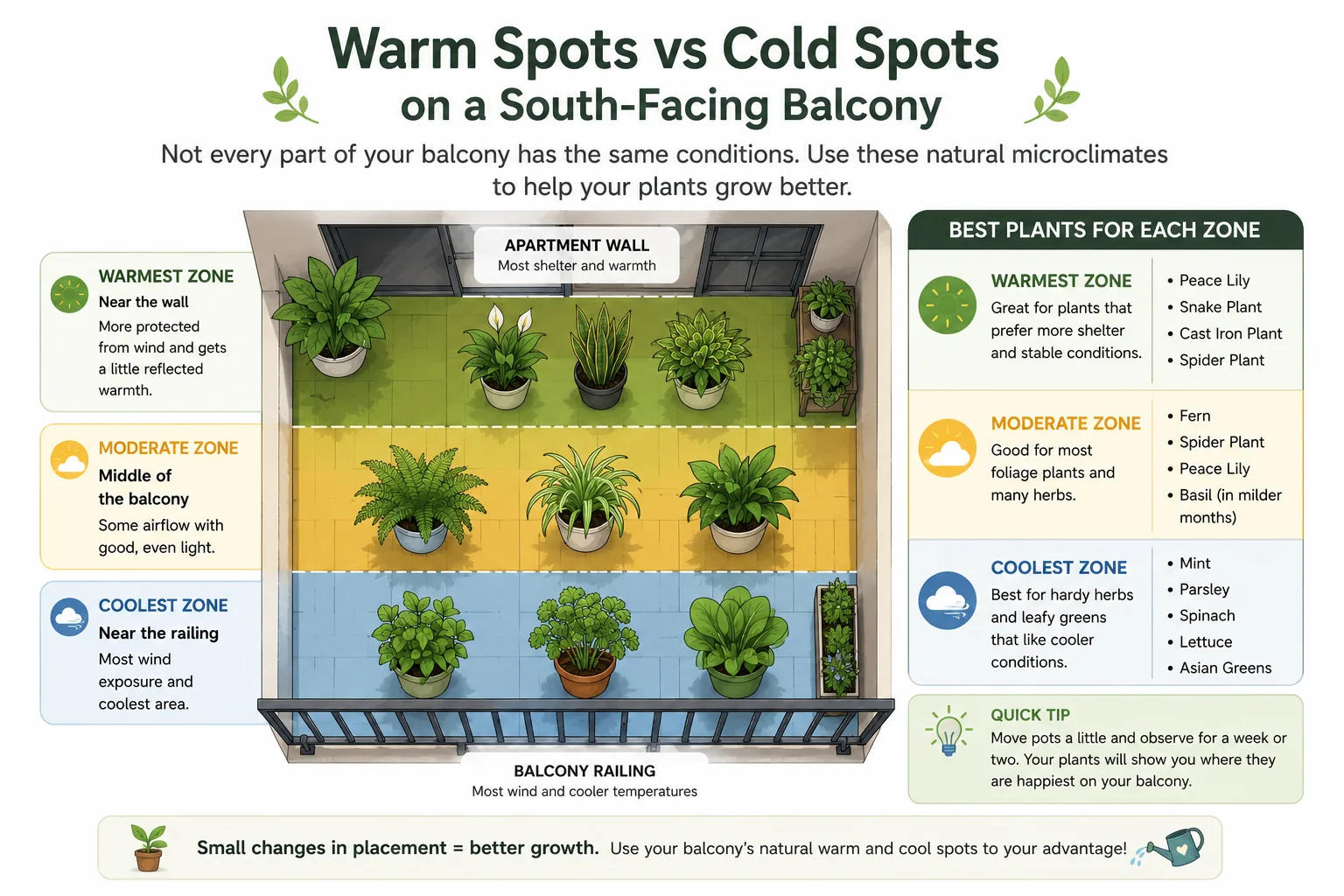
Plant placement matters a lot on a cold south-facing balcony because not every part of the balcony has the same conditions. A pot near the apartment wall may feel more protected than a pot beside the railing. A corner may hold less wind, while the outer edge may receive more light but also more cold air movement.
The warmest area is often close to the apartment wall, especially if the wall holds a little warmth from indoors. This can suit peace lilies, snake plants, spider plants, and other plants that dislike cold wind.
The brightest area is often near the railing or open edge. This spot may suit parsley, lettuce, spinach, and mint if wind is not too strong. However, railing positions can also be colder and more exposed, so they are not always best for delicate plants.
The middle of the balcony is usually a compromise. It may receive some reflected light while being less exposed than the railing. This can be a useful position for testing new plants before moving them into brighter or more sheltered spots.
Try moving a plant for one or two weeks before deciding it cannot grow on your balcony. Small placement changes are often easier to test than replacing the plant completely.
If your balcony is also exposed to moving air, this guide on best plants for a windy balcony may help you choose plants that cope better with wind as well as shade.
Signs a Plant Is Too Cold or Too Shaded
Plants on cold south-facing balconies often show stress slowly. They may not collapse straight away. Instead, they may stop growing, hold wet soil for too long, or slowly lose older leaves.
Slow growth is not always a problem. Many shade-tolerant plants naturally grow slowly in cool light. The concern is when slow growth appears with other signs of stress, such as yellowing leaves, soft stems, or soil that stays damp for many days.
| Sign | What It May Mean | Balcony-Specific Cause |
|---|---|---|
| No new leaves for a long time | The plant may be conserving energy. | Low light and cool temperatures are slowing growth. |
| Yellow lower leaves | The roots may be stressed or the plant is adjusting. | Cold, damp soil may be staying wet too long. |
| Dropping leaves | The plant may be reacting to cold or wind. | Outer balcony areas may be too exposed. |
| Soft stems or weak growth | The plant may not be receiving enough usable light. | The balcony may be deep shade rather than bright shade. |
| Soil stays wet for many days | The plant is using water slowly. | Cool shade and limited airflow reduce drying. |
If your plants are alive but not producing much new growth, this article on balcony plants not growing new leaves may help explain when slow growth is normal and when something needs attention.
Practical Insights for Cold South-Facing Balconies
Growing plants in this kind of balcony becomes easier when expectations match the space. The goal is usually steady, healthy growth rather than fast growth or heavy harvests.
- Choose leafy plants before fruiting plants.
- Use the brightest area for herbs and edible greens.
- Keep delicate foliage plants away from cold railing wind.
- Check soil moisture before watering because pots dry slowly in shade.
- Expect slower growth during cooler months.
- Test one or two plants first before filling the whole balcony.
Small changes can matter more than buying new plants. Moving a pot from the cold railing to a sheltered wall can sometimes improve growth more than changing fertiliser or watering more often.
Common Misunderstandings About South-Facing Balconies
Many problems happen because south-facing balconies are judged like sunny gardens. Once the balcony is understood as a cooler, shaded container space, plant behaviour becomes easier to read.
- Shade does not mean nothing will grow.
- Slow growth does not always mean poor care.
- More water does not fix low light.
- A bright-looking balcony may still lack direct sun.
- Sun-loving vegetables may survive but not produce much.
- Winter slowdown is normal for many balcony plants.
The biggest misunderstanding is thinking that a plant is failing because the gardener did something wrong. Often the plant is simply reacting to cold, shade, and container limits.
Seasonal Considerations for Australian Apartments
In Australian apartments, south-facing balconies can feel especially cold in winter because the sun sits lower and direct sunlight may be blocked by buildings, ceilings, or balcony walls. Pots may stay damp longer, and plants may grow very slowly.
Spring and autumn are often more forgiving. Light may feel brighter, temperatures may be milder, and some leafy plants may begin growing again after a slow period. Summer can still be shaded on a south-facing balcony, but the extra warmth may help some plants become more active.
This seasonal change is one reason the same plant may look almost still in winter but begin producing new leaves later. The balcony has not changed direction, but the light, warmth, and drying pattern have changed.
Balcony Haven Note: I have noticed that cool shaded balconies often reward patience more than quick changes. A plant may look like it is doing nothing for a while, but it can still be adjusting to the light, pot, and cooler air. Results can vary a lot between balconies, especially when one spot is sheltered and another spot is exposed to wind.
Frequently Asked Questions
What plants grow well on a cold south-facing balcony?
Ferns, cast iron plants, snake plants, peace lilies, spider plants, mint, parsley, lettuce, spinach, and Asian greens are some of the more realistic choices. They suit cooler, lower-light balcony conditions better than sun-loving fruiting plants.
Can vegetables grow on a cold south-facing balcony?
Some vegetables can grow, but leafy greens are usually more realistic than fruiting vegetables. Lettuce, spinach, and small Asian greens can cope better because they are grown for leaves rather than fruit.
Why do plants grow slowly on south-facing balconies?
Plants grow slowly on south-facing balconies because they usually receive less direct sunlight and less warmth. Cool containers also slow root activity, so the plant may use water and nutrients more slowly.
Should I water less on a cold shaded balcony?
Watering usually needs to be slower and more careful because shaded pots can stay wet for longer. The soil should be checked before watering rather than watered on a fixed schedule.
Can flowers grow on a cold south-facing balcony?
Some shade-tolerant flowers may grow if the balcony has bright shade, but heavy flowering is less predictable. Foliage plants and leafy edibles are usually more reliable than flowers in cold south-facing conditions.
Can a south-facing balcony become too cold for tropical plants?
Yes, some tropical plants may survive but grow very slowly if temperatures stay cool and direct sunlight is limited. Plants that prefer warm, humid, bright conditions may struggle more than tougher shade-tolerant foliage plants.
Is a south-facing balcony bad for plants?
A south-facing balcony is not bad for plants, but it suits a different group of plants. Shade-tolerant foliage plants, cool-season herbs, and leafy greens usually perform better than plants that need strong sun and warmth.
Final Thoughts
Cold south-facing balconies can grow plants, but they need realistic plant choices. These spaces usually favour steady leaf growth, shade tolerance, and patience rather than fast harvests or strong flowering.
Ferns, cast iron plants, snake plants, peace lilies, spider plants, mint, parsley, lettuce, spinach, and Asian greens are all worth considering because they match the conditions better than sun-loving plants. The results may be slower, but they can still be healthy and useful.
The most helpful approach is to read the balcony as its own small climate. Once the light, cold spots, wind, and slow-drying soil are understood, plant care becomes less frustrating and much more predictable.
Leave a Reply